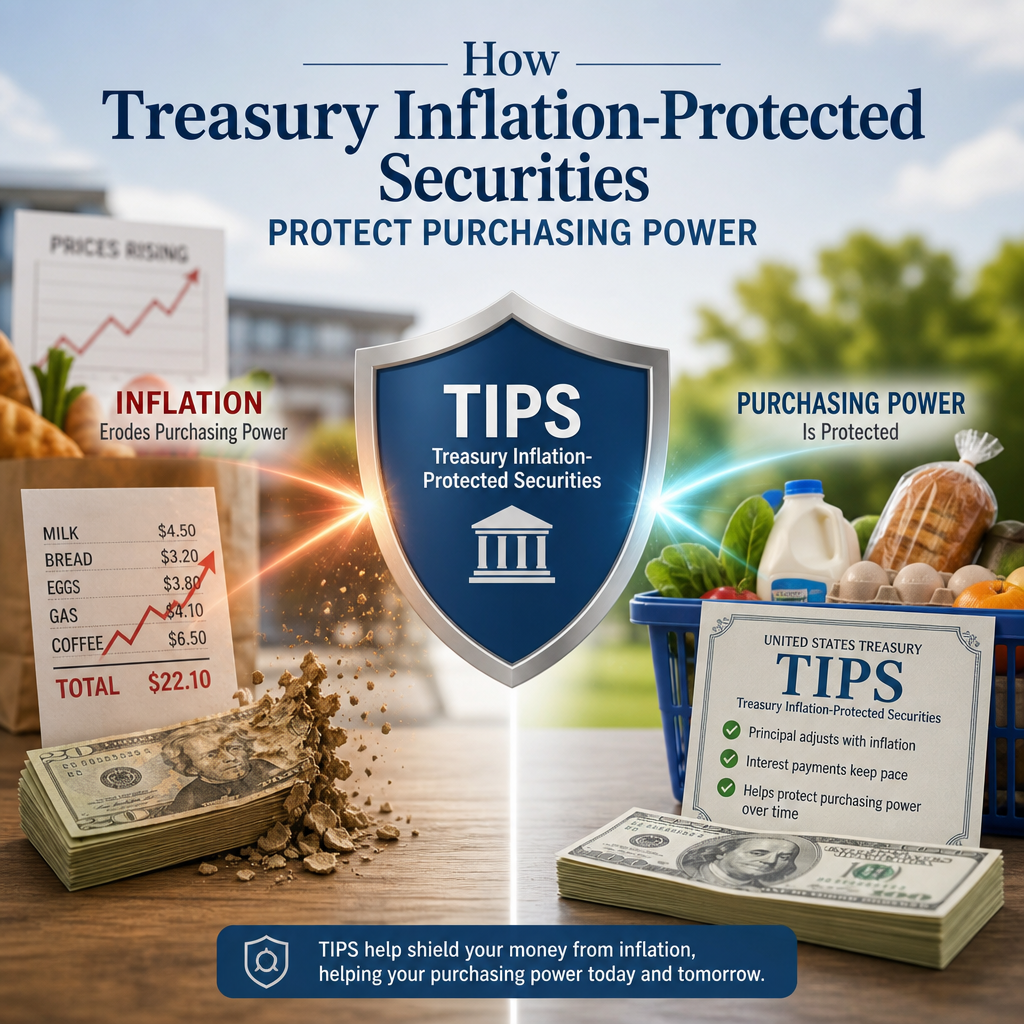
How Treasury Inflation-Protected Securities Protect Purchasing Power
Treasury Inflation-Protected Securities, or TIPS, are designed to help your money keep pace with inflation by adjusting their principal as prices rise. For investors focused on preserving purchasing power, they can be a practical way to add stability to a diversified portfolio.
By: Mary Mitchell on July 28, 2026
Inflation has a quiet way of eating into everyday budgets. Groceries cost more, gas prices rise, and the money sitting in a savings account can buy less than it used to. That’s why many investors look for ways to defend their money against rising prices. One option that often comes up is Treasury Inflation-Protected Securities, commonly called TIPS. These U.S. government bonds are designed to help protect purchasing power when inflation climbs.
TIPS can play a useful role in a diversified portfolio, especially for people who care about preserving the real value of their savings over time. But they are not a magic shield. To use them well, you need to understand how they work, what they protect against, and where they fit in a broader investment strategy.
What Are Treasury Inflation-Protected Securities?
Treasury Inflation-Protected Securities are U.S. Treasury bonds issued with a built-in adjustment for inflation. Like other Treasury securities, they are backed by the full faith and credit of the U.S. government, which makes them among the lowest-credit-risk investments available.
What makes TIPS different is the way their principal changes over time. Instead of staying fixed, the principal value adjusts based on changes in the Consumer Price Index for All Urban Consumers, or CPI-U. That means when inflation rises, the principal amount rises too. When deflation occurs, the principal can fall.
Because of that structure, TIPS are often viewed as an inflation hedge. They are designed to help investors maintain purchasing power, which is the amount of goods and services your money can buy.
A simple example
Suppose you buy a TIPS bond with a $1,000 principal. If inflation increases over time, that principal may be adjusted upward. Interest payments are then calculated using the adjusted principal, not the original amount. As a result, both the bond’s value and its income can rise with inflation.
This is the key idea behind Treasury Inflation-Protected Securities: they attempt to keep pace with inflation, rather than remain fixed while prices rise around them.
Why Inflation Hurts Purchasing Power
Before looking more closely at TIPS, it helps to understand the problem they address.
If your investments earn 4% in a year but inflation runs at 3%, your real return is much smaller than it appears. In practical terms, your money gained value on paper, but your buying power barely moved.
Inflation affects:
Everyday expenses like food and fuel
Long-term retirement planning
Fixed-income investors
Cash savings held for too long
This is especially important for retirees and near-retirees. People living off portfolios often rely on steady income, but if that income does not keep up with inflation, expenses can become harder to cover over time.
That’s where Treasury Inflation-Protected Securities can help. They are built to reduce the risk that inflation steadily erodes the real value of your savings.
How Treasury Inflation-Protected Securities Work
TIPS have a few moving parts, but the structure is fairly straightforward once you break it down.
Principal adjusts with inflation
The bond’s principal is linked to CPI-U. When inflation rises, the principal increases. When deflation occurs, the principal decreases. At maturity, investors receive the adjusted principal or the original principal, whichever is greater.
That last feature matters. It means investors are protected from losing the original principal at maturity even if deflation has occurred over the bond’s life.
Interest payments change too
TIPS pay a fixed interest rate, but because that rate is applied to the adjusted principal, the actual dollar amount of the interest payment can rise over time.
For example:
You buy a TIPS bond with a fixed interest rate.
Inflation increases the bond’s principal.
The interest payment is calculated on the higher principal.
Your payment amount rises, helping preserve real income.
This combination of inflation-adjusted principal and interest is what makes TIPS unique among government bonds.
They are sold in different maturities
The U.S. Treasury issues TIPS in several maturities, including short-, intermediate-, and long-term time frames. Investors can buy them directly from the Treasury or through funds such as mutual funds and ETFs that hold TIPS.
How Treasury Inflation-Protected Securities Help Protect Purchasing Power
The phrase protect purchasing power is central to understanding the value of TIPS. They do not guarantee profits, and they do not eliminate all risk. But they are specifically structured to address inflation risk.
They help your money keep up with rising prices
If inflation increases, the adjusted principal of a TIPS bond increases too. That means the bond is not stuck at a static dollar value while prices move higher in the real world.
This matters because dollars are not always equal over time. A $100 bill today may buy less in the future. TIPS help reduce that gap by linking part of your investment value to inflation.
They can provide more stable real returns
A nominal return is what you see on paper. A real return accounts for inflation. TIPS are designed to make real returns more predictable, especially compared with ordinary fixed-rate bonds, which can lose ground when inflation spikes.
For conservative investors, that can make planning easier. It may also help reduce the chance that a retirement portfolio loses buying power during periods of unexpectedly high inflation.
They can complement other assets
TIPS work best as part of a broader strategy. Many investors pair them with:
Stocks for growth
Nominal bonds for income and stability
Cash for short-term needs
Real assets such as commodities or real estate for broader inflation exposure
Used this way, Treasury Inflation-Protected Securities can provide a stabilizing layer against inflation without forcing a portfolio to rely on one solution alone.
Pros and Cons of Treasury Inflation-Protected Securities
Like any investment, TIPS have tradeoffs. Understanding both sides helps you decide whether they belong in your portfolio.
Advantages
Inflation adjustment: Principal rises with CPI-U, helping preserve purchasing power.
U.S. government backing: Credit risk is very low.
Deflation floor at maturity: You get at least the original principal when the bond matures.
Predictable structure: Useful for planning long-term inflation protection.
Tax-deferred option in some accounts: TIPS can be held in tax-advantaged retirement accounts, which may simplify tax treatment.
Drawbacks
Interest-rate risk: TIPS prices can fall when interest rates rise, just like other bonds.
Tax complexity in taxable accounts: Inflation adjustments to principal may be taxable before you receive them in cash, depending on the situation.
Lower yield than some alternatives: Investors may accept less current income in exchange for inflation protection.
Not a complete hedge: TIPS are tied to CPI-U, which may not match your personal inflation experience exactly.
In other words, Treasury Inflation-Protected Securities are useful, but they are not perfect. Their job is to reduce inflation risk, not erase all investment uncertainty.
Who Might Benefit Most from TIPS?
TIPS can fit a wide range of investors, but they tend to be most useful for people with specific goals.
Retirees and pre-retirees
If you are drawing down savings or approaching retirement, preserving purchasing power becomes more important. Retirees often need predictable spending power over long periods, and inflation can be especially damaging when income is fixed.
Conservative investors
People who prioritize capital preservation may appreciate the government backing and inflation adjustment of TIPS. They can be especially appealing when traditional bonds offer yields that do not comfortably exceed inflation.
Long-term planners
Investors saving for future expenses, such as college tuition or healthcare costs, may use TIPS to reduce the risk that inflation will make those goals more expensive than expected.
Portfolio diversifiers
Even growth-focused investors sometimes add a TIPS allocation as a defensive anchor. When inflation rises unexpectedly, TIPS can help offset pressure on other parts of a portfolio.
TIPS vs. Other Inflation Hedges
TIPS are only one way to address inflation. They are important, but not always sufficient on their own.
TIPS vs. regular Treasury bonds
Traditional Treasury bonds pay fixed interest. If inflation rises, their purchasing power may fall. TIPS, by contrast, adjust for inflation and therefore offer a more direct hedge.
TIPS vs. savings accounts and CDs
Cash-like investments are useful for liquidity, but they generally offer limited inflation protection. If inflation exceeds the yield, real value declines. TIPS may offer stronger long-term protection, though they are less liquid if held individually to maturity.
TIPS vs. stocks
Equities can be a strong long-term inflation hedge because companies may raise prices and grow earnings over time. But stocks also carry market volatility. TIPS offer a more conservative alternative for investors who want inflation protection with lower credit risk.
TIPS vs. real estate and commodities
Real estate and commodities can respond to inflation, but they also bring different risks, management costs, and market cycles. TIPS are simpler and more direct, though they typically offer less upside potential.
How to Invest in TIPS
There are several ways to gain exposure to Treasury Inflation-Protected Securities.
Buy individual TIPS
You can purchase TIPS directly through TreasuryDirect or through a broker. Buying individual bonds may be appealing if you want to hold them to maturity and lock in the inflation adjustment.
Use TIPS mutual funds or ETFs
Many investors prefer funds because they provide diversification across multiple maturities and simplify management. However, funds do not mature like individual bonds, so their market value fluctuates more visibly.
Hold them in tax-advantaged accounts
TIPS can be especially practical in IRAs, 401(k)s, and other tax-deferred accounts. That can help reduce the complexity of taxation on inflation adjustments, depending on your situation.
What to Consider Before Buying TIPS
A good TIPS decision depends on your time horizon, income needs, and overall portfolio mix.
Ask these questions:
What am I trying to protect?
Is your goal retirement income, future spending power, or portfolio stability?
How long will I hold the investment?
TIPS are generally better suited to medium- and long-term goals.
Do I need current income or future inflation protection?
TIPS may offer more value as a hedge than as a high-income source.
Am I using a taxable or tax-advantaged account?
Tax treatment matters and can affect after-tax results.
How does this fit with the rest of my portfolio?
A balanced allocation usually works better than concentrating too much in one asset class.
Common Misunderstandings About TIPS
A few misconceptions can lead investors to use TIPS incorrectly.
“TIPS always go up when inflation rises”
Not necessarily. The principal adjusts for inflation, but market prices of TIPS can still decline if interest rates rise quickly.
“TIPS are risk-free”
They are low credit risk, but not risk-free. Inflation may differ from your personal cost of living, and market prices can fluctuate.
“TIPS are only for retirees”
Retirees often use them, but younger investors can also benefit, especially if they are saving for future expenses and want inflation protection.
“TIPS replace all other bonds”
They usually do not. A portfolio may still need nominal bonds, cash, and growth assets depending on your goals.
Practical Example: Using TIPS in a Portfolio
Imagine an investor with a balanced portfolio who worries that inflation may stay elevated for several years. Instead of moving everything into TIPS, the investor allocates a portion of the bond sleeve to TIPS.
That decision may help in several ways:
It adds inflation-linked protection
It reduces reliance on fixed-rate bonds alone
It provides a more stable anchor than stocks during inflation shocks
It supports long-term spending plans
This kind of measured approach is often more effective than making a dramatic all-or-nothing move.
Frequently Asked Questions
1. What are Treasury Inflation-Protected Securities?
Treasury Inflation-Protected Securities are U.S. government bonds whose principal value adjusts with inflation, as measured by CPI-U. They are designed to help preserve purchasing power over time.
2. How do TIPS protect against inflation?
TIPS increase their principal when inflation rises. Because interest is paid on the adjusted principal, both the bond’s value and income can rise with inflation, helping offset the decline in purchasing power caused by higher prices.
3. Are TIPS safe investments?
TIPS carry very low credit risk because they are backed by the U.S. Treasury. However, they are still subject to interest-rate risk and can lose market value before maturity, especially if rates rise.
4. Do TIPS always beat regular bonds?
Not necessarily. TIPS are designed for inflation protection, not maximum yield. In periods of low inflation, nominal bonds may outperform TIPS. Their main advantage appears when inflation is unexpectedly high or persistent.
5. Should I buy individual TIPS or a TIPS fund?
It depends on your goals. Individual TIPS may suit investors who want to hold to maturity and lock in inflation protection. TIPS funds and ETFs offer diversification and convenience but fluctuate in market value and do not mature like individual bonds.
Treasury Inflation-Protected Securities offer a straightforward way to address one of the most persistent risks investors face: inflation. By adjusting principal and interest payments based on CPI-U, TIPS are designed to help preserve purchasing power when prices rise. That makes them especially valuable for retirees, conservative investors, and anyone planning for future expenses that may become more costly over time.
Still, TIPS are not a one-size-fits-all solution. They can lose market value when interest rates rise, and their inflation adjustments may not perfectly match your personal spending pattern. For that reason, they work best as part of a diversified portfolio rather than as a standalone strategy.
If your goal is to keep more of your money’s real value intact over time, Treasury Inflation-Protected Securities deserve a serious look. They may not deliver flashy returns, but they can offer something many investors need just as much: a disciplined way to defend purchasing power in an unpredictable economy.
Mary S, CFP®, is a Certified Financial Planner with over 12 years of experience in personal finance, retirement planning, and wealth management. She writes educational content that helps readers understand financial concepts and make informed decisions based on reliable information.