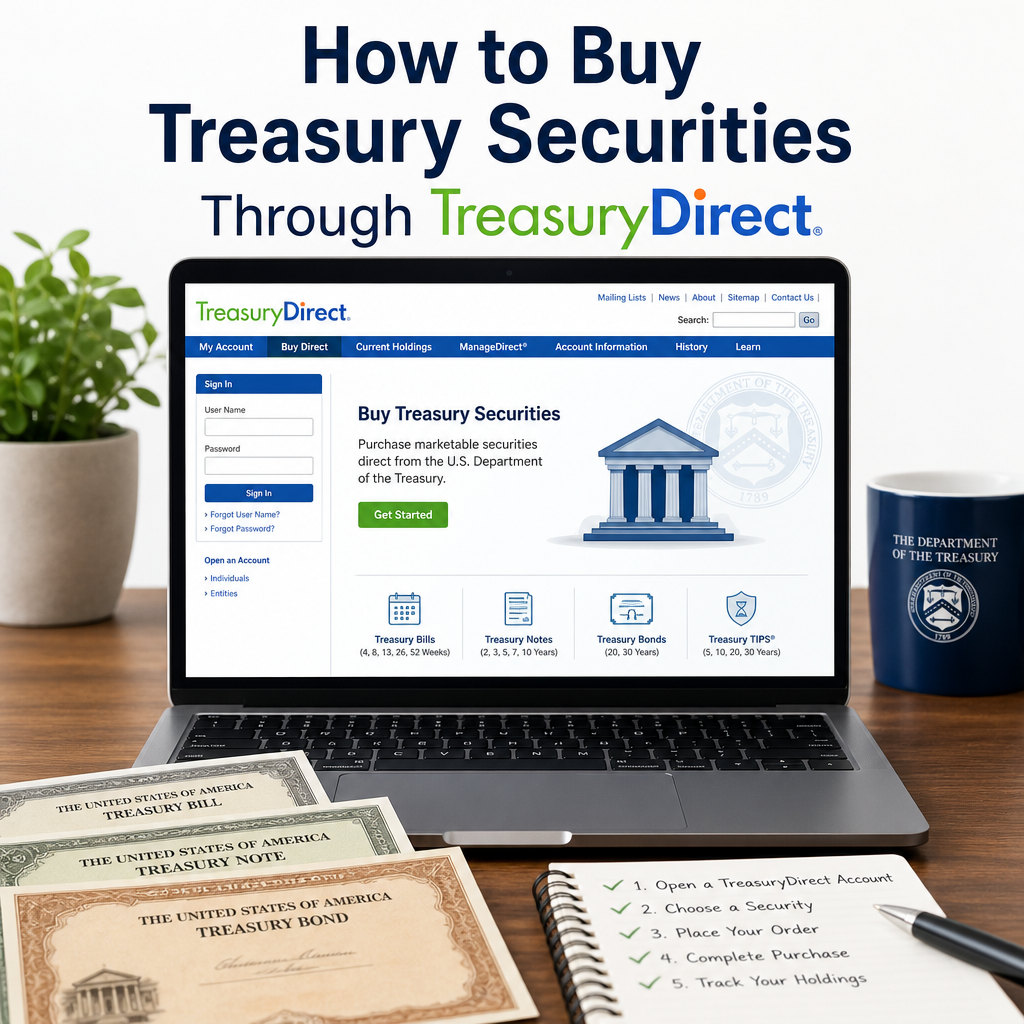
How to Buy Treasury Securities Through TreasuryDirect
Buying TreasuryDirect securities is a straightforward way to purchase U.S. government-backed investments without going through a broker. In this guide, you’ll learn how TreasuryDirect works, how to set up an account, and how to place your first order with confidence.
By: Mary Mitchell on July 28, 2026
Buying U.S. government debt can feel intimidating at first, but how to buy Treasury securities through TreasuryDirect is easier than many first-time investors expect. TreasuryDirect is the official U.S. Department of the Treasury website for purchasing certain government securities directly from the source, without a broker. If you want a straightforward way to invest in Treasury bills, Treasury notes, Treasury bonds, TIPS, or Series I savings bonds, this platform is worth understanding.
In this guide, you’ll learn what TreasuryDirect does, how to set up an account, how to place an order, and what to expect after your purchase. You’ll also get practical tips to help you avoid common mistakes and decide whether Treasury securities fit your financial goals.
What Is TreasuryDirect?
TreasuryDirect is an online system run by the U.S. Department of the Treasury. It allows individual investors to buy and manage certain Treasury securities directly from the government.
Through TreasuryDirect, you can purchase:
Treasury bills
Treasury notes
Treasury bonds
Treasury Inflation-Protected Securities (TIPS)
Series I savings bonds
Series EE savings bonds
Because these securities are backed by the full faith and credit of the U.S. government, they are widely viewed as among the lowest-credit-risk investments available. That does not mean they are risk-free in every sense, but they are generally considered a conservative option for preserving capital or earning predictable income.
Why Buy Treasury Securities Through TreasuryDirect?
Investing through TreasuryDirect offers a few clear advantages:
No broker commissions for purchases from the Treasury
Direct ownership of the security in your TreasuryDirect account
Automatic reinvestment options for certain securities
Simple access to auction purchases and savings bonds
Secure government-backed platform for managing holdings
For many investors, the biggest appeal is transparency. You can see the auction process, buy at face value, and receive interest or principal according to the security’s terms.
Understanding the Types of Treasury Securities
Before learning how to buy Treasury securities through TreasuryDirect, it helps to know what you’re actually buying.
Treasury Bills
Treasury bills, or T-bills, are short-term securities that mature in one year or less. They do not pay periodic interest. Instead, you buy them at a discount and receive the full face value at maturity.
Example:
If you buy a 26-week T-bill at a discount, you pay less upfront and receive $1,000 per bill at maturity.
Treasury Notes
Treasury notes have maturities from 2 to 10 years and pay interest every six months. These can be useful if you want predictable income over a medium-term horizon.
Treasury Bonds
Treasury bonds mature in 20 or 30 years and also pay semiannual interest. They are typically used by investors seeking long-term income and government-backed principal repayment.
TIPS
Treasury Inflation-Protected Securities adjust their principal based on changes in the Consumer Price Index. That means they are designed to help protect purchasing power from inflation.
Series I and EE Savings Bonds
These are savings bonds available to individuals through TreasuryDirect.
Series I bonds are designed to protect against inflation and earn interest based on a fixed rate plus an inflation rate.
Series EE bonds earn a fixed rate and are intended to double in value over a long holding period, assuming you hold them long enough under the bond’s terms.
What You Need Before You Start
Before you open TreasuryDirect, gather the basic information you’ll need to register and fund your account.
Personal Information
Have these details ready:
Full legal name
Social Security number or Taxpayer Identification Number
Date of birth
Residential address
Email address
Bank account and routing numbers
Bank Account Information
TreasuryDirect uses your bank account to move funds in and out of your account. The account must generally be a checking or savings account at a U.S. financial institution.
Access to Email and a Secure Device
Because TreasuryDirect handles sensitive financial information, use a secure computer or mobile device and a reliable email address you can access regularly.
How to Buy Treasury Securities Through TreasuryDirect: Step by Step
Here’s the core process for how to buy Treasury securities through TreasuryDirect.
1. Create a TreasuryDirect Account
Go to the official TreasuryDirect website and choose the option to open an individual account.
You’ll need to:
Enter your personal information
Provide your bank account details
Create a password and account credentials
Set up security questions and authentication steps
Once you submit your application, TreasuryDirect may take time to verify and activate your account. Keep your login information in a safe place.
2. Log In and Review Your Account Dashboard
After your account is active, log in to TreasuryDirect. Your dashboard shows your account information, holdings, and purchase options.
Take a few minutes to:
Confirm your bank information
Review security settings
Read the account help pages
Understand how purchases, reinvestments, and redemptions work
If you plan to buy multiple Treasury securities over time, a little setup now can save confusion later.
3. Choose the Security You Want to Buy
From the purchase menu, select the type of Treasury security that fits your goal.
Ask yourself:
Do I need short-term cash management? A T-bill may fit.
Do I want steady interest payments? Consider Treasury notes or bonds.
Am I trying to protect against inflation? Look at TIPS or Series I bonds.
Your investment timeline matters. A security that looks attractive on paper may be a poor match if you need the money soon.
4. Select the Auction or Purchase Type
For marketable Treasury securities, TreasuryDirect generally lets you place a noncompetitive bid in a scheduled auction. That means you agree to accept the security at the auction-determined yield or price, up to the amount available for your order.
For savings bonds like Series I or EE bonds, you purchase them at fixed amounts through the site rather than at auction.
5. Enter Your Purchase Amount
Follow the prompts to enter how much you want to buy. Treasury securities are typically sold in increments of $100.
Be sure to check:
Minimum purchase rules
Maximum purchase limits, especially for savings bonds
Whether you want to reinvest at maturity
The settlement date or issue date
If you’re new to the platform, double-check every field before submitting.
6. Confirm and Submit the Order
TreasuryDirect will show a summary of your order. Review it carefully.
Look for:
Security type
Amount
Purchase date
Maturity date
Bank account used for funding
Reinvestment elections
Once everything looks right, confirm the purchase. TreasuryDirect will process the order according to the auction or issuance schedule.
7. Monitor Your Holdings
After the purchase settles, your security appears in your TreasuryDirect account. From there, you can:
View current holdings
Track maturity dates
Schedule reinvestments
Manage redemption or transfer instructions when eligible
For many investors, setting reminders for maturity dates is a smart habit. It helps you decide whether to reinvest or use the proceeds elsewhere.
Important Things to Know Before You Buy
Even though Treasury securities are simple compared with many other investments, there are still a few details worth understanding.
Interest Rates and Auction Pricing Can Change
For marketable securities, the final yield is set by auction. If rates are higher or lower than you expect, the return may differ from your assumptions.
Treasury Notes and Bonds Can Lose Market Value if Sold Early
If you hold a note, bond, or TIPS to maturity, you receive the face value and scheduled interest payments according to the terms. But if you need to sell a marketable Treasury security before maturity in the secondary market, the price may be higher or lower than what you paid.
Savings Bond Rules Are Different
Series I and EE savings bonds have separate rules, including minimum holding periods and potential early redemption penalties. Read those terms carefully before buying.
Taxes Still Apply
Treasury securities are exempt from state and local income taxes, but federal taxes still apply to interest earnings and certain other amounts. If you buy TIPS, inflation adjustments can affect taxable income even before you receive the cash.
For tax questions, it’s wise to consult a qualified tax professional or review IRS guidance directly.
Common Mistakes to Avoid
When learning how to buy Treasury securities through TreasuryDirect, beginners often run into avoidable issues.
Using the Wrong Account Type
TreasuryDirect accounts are designed for individuals and certain entity types. Make sure you select the correct registration and ownership structure.
Forgetting About Liquidity Needs
A Treasury bond may look safe, but if you need the money in a few months, a long maturity could be a poor fit. Match the term to your time horizon.
Ignoring Reinvestment Settings
If you don’t review your reinvestment choices, your funds may not behave the way you expect when a security matures.
Overlooking Tax Reporting
Keep records of your purchases, interest, and maturities. Even simple Treasury investments can create tax reporting obligations.
Assuming TreasuryDirect Works Like a Brokerage
TreasuryDirect is its own system. It is not a brokerage account, and it does not function like one. Transfers, sales, and account actions may follow different rules and timelines.
Practical Example: Buying a Treasury Bill
Suppose you want a low-risk place to park cash for about six months. You open TreasuryDirect, choose a 26-week Treasury bill, and place a noncompetitive bid for $1,000.
Here’s what happens in simple terms:
You submit the order before the auction deadline.
TreasuryDirect processes your bid.
You buy the T-bill at the auction price, which may be below face value.
At maturity, the Treasury pays you the full $1,000.
Your return is the difference between the purchase price and the amount received at maturity.
This approach can work well for short-term goals such as tuition expenses, planned home repairs, or an emergency reserve segment that you don’t expect to use immediately.
When TreasuryDirect Makes the Most Sense
TreasuryDirect may be a good fit if you want:
Direct access to U.S. government securities
A simple way to buy and hold to maturity
Low credit-risk investments
Inflation protection through TIPS or Series I bonds
A place to keep part of your savings in conservative assets
It may be less suitable if you want:
Frequent trading
A broad selection of corporate or municipal bonds
Portfolio management tools like those found at full-service brokerages
Easy same-day selling access for all security types
In other words, TreasuryDirect is excellent for direct government purchases, but it is not designed to be a complete investment platform.
Tips for a Smooth TreasuryDirect Experience
A few practical habits can make the process easier:
Use a strong, unique password
Save your account recovery details securely
Keep your bank information current
Track maturity dates on a calendar
Read each purchase confirmation carefully
Review TreasuryDirect announcements for system updates or policy changes
The platform is secure and useful, but like any financial account, it rewards careful attention.
Frequently Asked Questions
What is the minimum amount to buy Treasury securities through TreasuryDirect?
The minimum amount is typically $100 for marketable Treasury securities and savings bonds, though specific rules can vary by security type. Purchases are usually made in $100 increments. Always review the current TreasuryDirect purchase guidelines before placing an order.
Can I buy Treasury securities through TreasuryDirect with an IRA?
No, TreasuryDirect is generally for individual and certain entity registrations, not retirement accounts like IRAs. If you want to hold Treasury securities in an IRA, you would usually do that through a brokerage or custodian that offers retirement accounts.
Are Treasury securities through TreasuryDirect safe?
Treasury securities are backed by the U.S. government, which makes them among the lowest-credit-risk investments available. However, they are not completely free of risk. Marketable securities can change in value if sold before maturity, and inflation can affect purchasing power over time.
How do I get my money after a Treasury security matures?
When a Treasury security matures, TreasuryDirect typically returns the proceeds to your linked bank account or follows your reinvestment instructions if you selected that option. Make sure your bank details are current so you do not experience delays.
Can I sell Treasury securities before maturity?
Some marketable Treasury securities can be sold before maturity through a broker or secondary market, but TreasuryDirect itself is mainly designed for holding securities and managing redemptions at maturity. Savings bonds have different redemption rules and may be subject to holding periods and penalties.
Learning how to buy Treasury securities through TreasuryDirect gives you a direct, government-run path to conservative investing. Whether you want a short-term Treasury bill, a longer-term Treasury note or bond, inflation protection through TIPS, or savings bonds for long-term planning, the TreasuryDirect platform makes it possible to buy and manage these securities without a broker.
The key is to match the security to your goal, understand the auction or purchase process, and review important details like maturity, tax treatment, and reinvestment settings before you place an order. Treasury securities can play a valuable role in a diversified financial plan, especially for investors who want stability, predictable income, or a simple place to hold cash for a known time period.
If you’re ready to move forward, start by reviewing your timeline, checking your bank details, and exploring the official TreasuryDirect site. A careful first purchase can set you up for a smoother experience the next time you buy.
Mary S, CFP®, is a Certified Financial Planner with over 12 years of experience in personal finance, retirement planning, and wealth management. She writes educational content that helps readers understand financial concepts and make informed decisions based on reliable information.