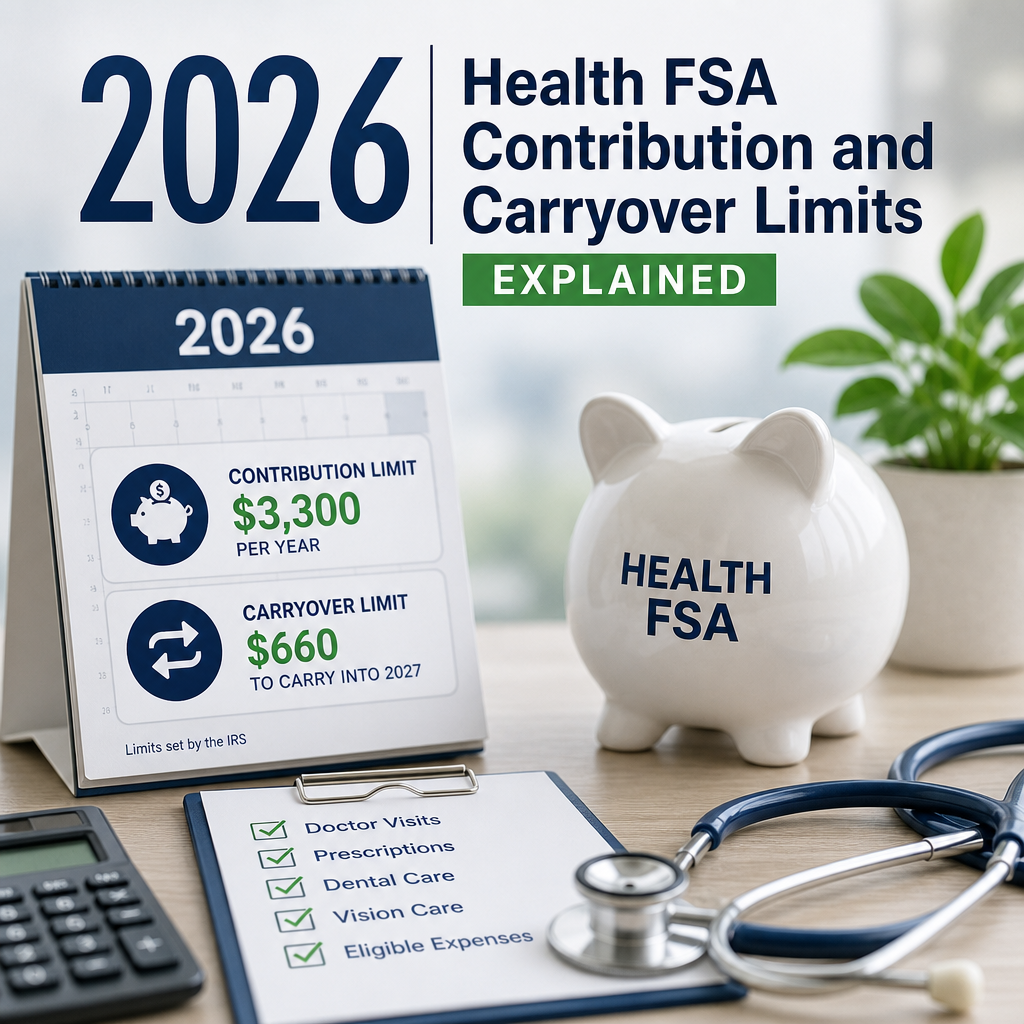
2026 Health FSA Contribution and Carryover Limits Explained
Planning ahead for your Health FSA can help you stretch your benefits further and avoid losing unused funds. Here’s what the 2026 Health FSA contribution limits and carryover rules mean for your wallet.
By: Mary Mitchell on July 28, 2026
If you rely on a Health FSA to help pay for eligible medical expenses, 2026 is a year worth paying attention to. The rules around flexible spending accounts can affect how much you set aside during open enrollment, how much you can carry into the next year, and how you avoid losing money at the end of the plan year. Understanding the 2026 Health FSA contribution and carryover limits can help you make smarter benefit decisions, reduce out-of-pocket costs, and use your tax-advantaged dollars more effectively.
A Health FSA can be a valuable workplace benefit, but only if you know how the plan works. Contribution limits, rollover rules, and employer-specific plan designs all matter. In this guide, we’ll break down what a Health FSA is, what the 2026 limits mean, how carryovers work, and how to choose an election amount that fits your real-world spending.
What Is a Health FSA?
A Health FSA, or health flexible spending account, is an employer-sponsored benefit that lets you set aside pre-tax money for qualified medical expenses. Because the money goes in before taxes, you may lower your taxable income while covering eligible health care costs.
Common eligible expenses may include:
Copays
Deductibles
Prescription medications
Dental care
Vision care
Certain medical supplies
Over-the-counter items that qualify under IRS rules
A Health FSA is different from a Health Savings Account (HSA). You usually must enroll in your employer’s plan, and the funds are generally tied to your plan year. That’s why knowing the 2026 Health FSA contribution and carryover limits is so important.
2026 Health FSA Contribution and Carryover Limits
Each year, the IRS can update the maximum amount employees may contribute to a Health FSA. Employers then decide whether to adopt the maximum or choose a lower cap. The 2026 Health FSA contribution and carryover limits will depend on the official IRS guidance for the 2026 plan year and your employer’s plan documents.
Contribution limits: what they mean
The contribution limit is the maximum amount you can elect to put into your Health FSA for the plan year. Your employer may allow you to contribute up to the IRS maximum, but not beyond it. If you and your spouse both have access to separate employer plans, each of you may have your own election subject to plan rules.
When reviewing the 2026 limit:
Check the IRS annual update for the official maximum
Confirm whether your employer has adopted that full limit
Review whether your plan allows both spouses to contribute to separate FSAs
Carryover limits: what they mean
A carryover lets you move a portion of unused funds from one plan year into the next. This feature can reduce the risk of “use it or lose it” forfeitures, but it has a cap. The carryover limit is usually set by IRS rules and is often updated periodically.
For 2026, you should verify:
The maximum amount your plan allows you to carry over
Whether your employer uses a carryover feature or a grace period
Whether unused funds above the carryover cap are forfeited
Why These Limits Matter During Open Enrollment
Open enrollment is your chance to estimate your annual medical expenses and elect the right contribution amount. If you contribute too little, you may miss out on tax savings. If you contribute too much, you could end up with unused funds that you can’t fully recover.
The 2026 Health FSA contribution and carryover limits affect your decision in several ways:
They determine the maximum tax-advantaged amount you can save.
They influence how much risk you take with unused money.
They help you decide whether to front-load savings for expected early-year expenses.
They guide you in coordinating with other benefits, such as an HSA or dependent care FSA.
A thoughtful election can make your benefits work harder for you.
How a Health FSA Carryover Works
A carryover feature allows a portion of unused FSA funds to move into the next plan year. This is helpful if your expenses fluctuate or you underestimate your costs late in the year.
Example of a carryover
Imagine you elect to contribute $2,000 in 2026. By the end of the plan year, you have used $1,700 on eligible expenses. That leaves $300 unused. If your employer’s plan includes a carryover and the unused amount is within the limit, that $300 may roll into 2027 instead of being forfeited.
If your leftover balance is above the carryover cap, the excess may be lost.
Carryover is not the same as a grace period
Some plans offer a grace period instead of, or in addition to, a carryover. A grace period usually gives you extra time after the plan year ends to incur eligible expenses. A carryover lets you keep part of the unused balance for the next year.
Important differences:
Carryover: Moves part of unused funds into the next year
Grace period: Extends the time you have to spend prior-year funds
Plan rules: Your employer chooses which feature to offer, subject to IRS rules
Always read your plan documents carefully because these features can be easy to confuse.
Strategies for Choosing Your 2026 Health FSA Election
Estimating your annual spending is the best way to avoid leaving money behind. A Health FSA works best when you treat it like a planning tool, not a guess.
1. Review your past expenses
Start with last year’s receipts and claims. Look for recurring costs such as:
Annual physical copays
Ongoing prescriptions
Braces or orthodontia
Glasses or contact lenses
Therapy or specialist visits
Planned procedures
If your situation has changed, adjust for it. A new baby, surgery, or a chronic condition can shift your expected spending significantly.
2. Consider known upcoming expenses
Think beyond routine care. Do you already know you’ll need:
A dental crown
LASIK
New prescription glasses
Physical therapy
A series of specialist visits
These predictable expenses are exactly what a Health FSA can help cover.
3. Build in a safety margin
It’s often smarter to elect a slightly conservative amount than to overfund your account. Even with a carryover, your plan may not protect every unused dollar.
A practical approach:
Estimate your expected eligible expenses
Add a modest buffer for surprise copays or prescriptions
Avoid contributing more than you can reasonably spend
4. Coordinate with other benefits
If you have an HSA, make sure your Health FSA doesn’t create conflicts. In some cases, only a limited-purpose FSA is compatible with an HSA. A general-purpose Health FSA can affect HSA eligibility.
Also check whether your spouse’s plan covers some of the same expenses. You may be able to avoid duplication and maximize tax savings.
Common Eligible Expenses Under a Health FSA
Not every medical cost qualifies, but many everyday expenses do. Knowing what you can use FSA dollars for helps you estimate a realistic election.
Usually eligible expenses include:
Doctor and specialist copays
Deductibles and coinsurance
Dental cleanings and fillings
Eye exams, glasses, and contacts
Prescription drugs
Certain over-the-counter items
Medical equipment and supplies
Some treatment-related transportation costs, depending on the rules
Expenses that may not qualify
Some expenses are usually not covered, such as:
Cosmetic procedures
General wellness items without medical necessity
Health club memberships
Non-medical toiletries
Expenses already reimbursed by insurance or another account
Because IRS rules can change and plan details vary, always verify with your employer or benefits administrator before assuming an expense is eligible.
Mistakes to Avoid With Your 2026 Health FSA
A few simple missteps can make a good benefit less valuable. Pay attention to these common problems.
Overestimating your annual costs
This is the most common mistake. People often assume they’ll use more than they do. If you overestimate, you may end the year with unused funds and too little time to spend them.
Ignoring the plan deadline
Health FSAs are deadline-driven. If you forget the deadline for submitting claims or spending funds, you could lose money even if you had eligible expenses.
Forgetting to submit claims
Some people pay out of pocket and never request reimbursement. Keep receipts and submit claims promptly so your FSA works the way it should.
Not checking carryover rules
Never assume unused funds will automatically carry forward. Your employer’s plan may have a carryover, a grace period, or neither.
Mixing up FSA and HSA rules
If you have access to an HSA, confirm that your FSA type won’t interfere with HSA contributions. This is one of the easiest compliance mistakes to avoid with a quick benefits review.
How Employers Decide Their Plan Design
Employers have some flexibility in how they design Health FSA plans. That means two employees in different companies may have very different experiences, even if the IRS maximums are the same.
Your plan may differ in these ways:
Maximum contribution allowed
Whether unused funds carry over
Whether a grace period is offered
Minimum election amounts
Claim submission deadlines
Eligible expense definitions
This is why the phrase 2026 Health FSA contribution and carryover limits is only part of the story. Your employer’s plan terms matter just as much as federal limits.
Practical Planning Example
Let’s say you expect these 2026 expenses:
$400 in prescriptions
$250 in dental work
$180 in eye care
$300 in specialist copays
That gives you a rough total of $1,130 in expected eligible expenses.
If your plan allows a carryover and you’re comfortable with a small buffer, you might elect slightly more than that amount. But if your expenses are uncertain, you may want to be conservative and avoid overcommitting.
A good rule of thumb:
Base your election on likely expenses
Add only a modest cushion
Don’t assume you’ll spend every available dollar
When to Reevaluate Your Election
You usually choose your FSA amount during open enrollment, but life changes can happen during the year. In most cases, elections can only be changed after a qualifying life event, such as:
Marriage
Birth or adoption of a child
Divorce
Loss of coverage
Other plan-approved changes
If your situation changes, contact your HR or benefits team right away. Even if you can’t change your election, you may still want to track your spending more closely.
Frequently Asked Questions
What is the 2026 Health FSA contribution limit?
The official 2026 limit is set through IRS guidance and then adopted by employers through their plan documents. Your company may allow up to the IRS maximum or set a lower cap. Check your open enrollment materials or benefits portal for the exact amount.
Does unused Health FSA money automatically carry over in 2026?
Not always. Whether money carries over depends on your employer’s plan design. Some plans allow a carryover, some offer a grace period, and some use the traditional forfeiture rule. Review your plan documents so you know what happens to unused funds.
Can I have both a Health FSA and an HSA?
Sometimes, but only if the FSA is structured correctly. A general-purpose Health FSA can affect HSA eligibility, while a limited-purpose FSA may be compatible. If you contribute to an HSA, make sure you understand the interaction before enrolling in a Health FSA.
What happens if I contribute too much to my Health FSA?
If you elect more than you use, the unused amount may be partially or fully forfeited depending on your plan’s carryover or grace period rules. That’s why estimating annual expenses carefully is so important during open enrollment.
What expenses are typically reimbursable through a Health FSA?
Common reimbursable expenses include copays, deductibles, prescriptions, dental care, vision care, and certain medical supplies. Some over-the-counter items may also qualify. Always verify specific items through IRS guidance or your plan administrator.
The 2026 Health FSA contribution and carryover limits can make a real difference in how much value you get from your workplace benefits. When you understand the annual election cap, the carryover rules, and your employer’s plan design, you can estimate your expenses more accurately and reduce the chance of losing unused funds.
The key is to plan ahead. Review last year’s medical spending, think about expected 2026 expenses, and confirm whether your employer offers a carryover or grace period. If you also have an HSA, make sure your accounts work together without creating eligibility problems. A few minutes of review during open enrollment can save you frustration later.
Health FSAs are most useful when you treat them as part of a broader benefits strategy, not just a one-time election. Take time to read your plan documents, verify the official 2026 limits, and make a contribution decision based on real needs rather than estimates alone. The more informed your choice, the more effectively your FSA can help you manage health care costs throughout the year.
Mary S, CFP®, is a Certified Financial Planner with over 12 years of experience in personal finance, retirement planning, and wealth management. She writes educational content that helps readers understand financial concepts and make informed decisions based on reliable information.