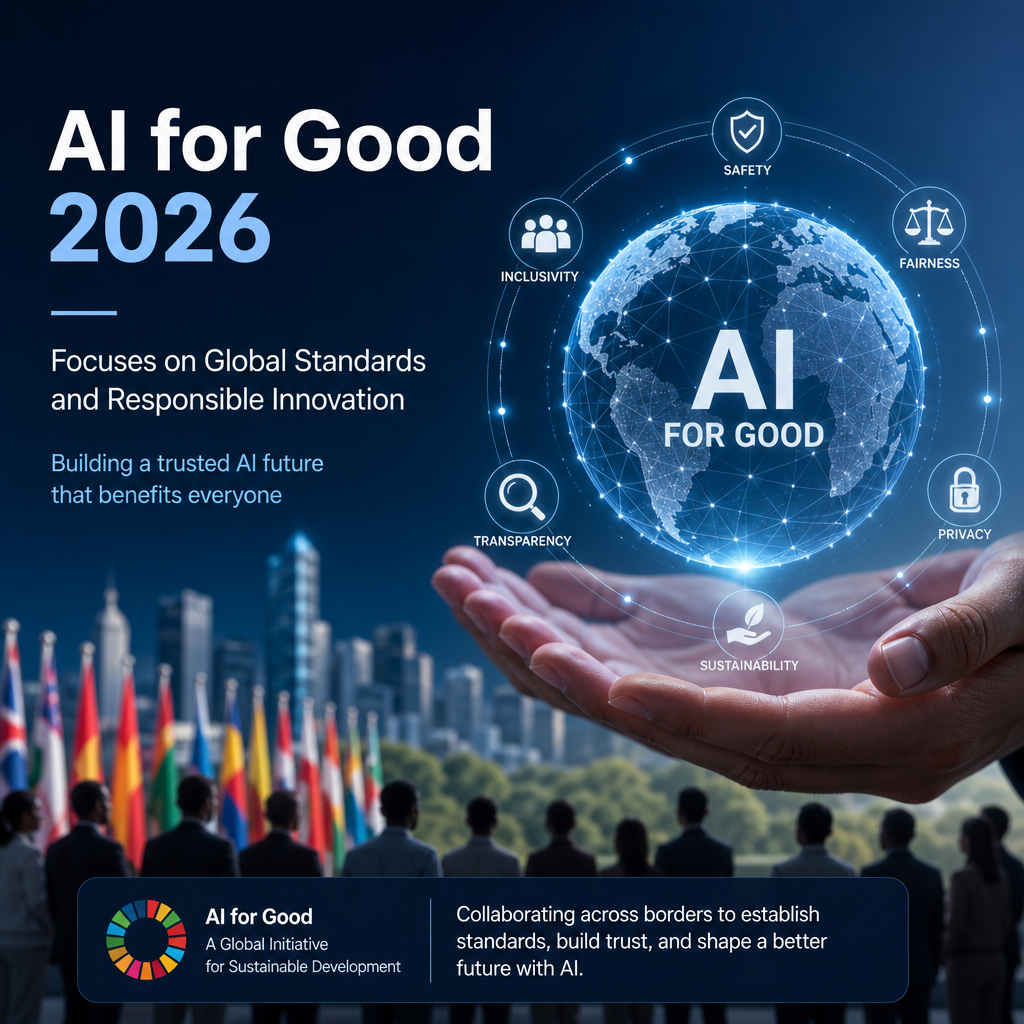
AI for Good 2026 Focuses on Global Standards and Responsible Innovation
Artificial intelligence is moving quickly from experimental pilots to essential infrastructure, and AI for Good 2026 arrives at a moment when the world is asking a bigger question: not just what AI can do, but what it should do. The growing emphasis on global standards and responsible innovation reflects a simple reality. As AI systems influence hiring, education, healthcare, public services, media, and even infrastructure, strong guardrails matter just as much as technical breakthroughs.
AI for Good 2026 is expected to bring together policymakers, researchers, industry leaders, civil society, and technologists around a shared goal: making AI more useful, trustworthy, inclusive, and safe. That means the conversation is no longer centered only on performance benchmarks or model size. It is also about governance, interoperability, transparency, accountability, and the practical steps needed to ensure AI benefits people across borders and communities.
Why AI for Good 2026 Matters Now
The AI landscape has changed dramatically in just a few years. Organizations are deploying generative AI, predictive analytics, and automated decision systems at scale. At the same time, concerns about bias, privacy, misinformation, labor impacts, and security risks have become harder to ignore.
AI for Good 2026 matters because it sits at the intersection of two urgent needs:
- Innovation that moves fast
- Standards that keep pace
Without shared standards, AI adoption can become fragmented. One region may require strong transparency disclosures while another has no clear rules. One company may publish safety documentation while another keeps its model behavior opaque. That patchwork makes it harder for businesses to scale responsibly and harder for users to know what to trust.
Global standards help solve that problem by creating common expectations for:
- Data governance
- Model evaluation
- Risk management
- Human oversight
- Security testing
- Accessibility and inclusion
Responsible innovation ensures those standards do not become a brake on progress. Instead, they become the foundation that lets AI scale with confidence.
The Shift from Rapid Deployment to Responsible Innovation
For years, many AI projects focused mainly on capability: Can the system predict? Can it generate? Can it automate? That approach helped push the field forward, but it also created blind spots. In many cases, systems were deployed before teams fully understood how they would behave in real-world settings.
Responsible innovation changes that pattern. It asks teams to build with the full lifecycle in mind, from design and training to deployment, monitoring, and retirement.
What responsible innovation looks like in practice
Responsible AI development usually includes:
- Clear use-case definition
Teams should define exactly what the AI system is meant to do and what it should never do. - Risk assessment
Developers need to identify possible harms, including bias, safety issues, privacy concerns, and misuse. - Human oversight
People should remain in the loop for decisions that affect rights, safety, or access to critical services. - Documentation
Model cards, data sheets, system descriptions, and evaluation notes help users understand how a system works. - Ongoing monitoring
AI systems can drift over time. Monitoring helps catch failures, emerging risks, and unintended consequences.
AI for Good 2026 is likely to reinforce the idea that innovation is not responsible just because it is new. It becomes responsible when teams can explain, test, audit, and improve it in ways that protect the public.
Why Global Standards Are Becoming Essential
AI is inherently global. Models are trained on data from multiple countries, deployed across borders, and used by organizations that serve international customers. That makes global standards increasingly important.
Common standards improve trust
When organizations follow shared standards, users have a better sense of what to expect. This can improve trust in areas such as:
- Safety and reliability
- Privacy protection
- Explainability
- Bias mitigation
- Incident response
Standards reduce compliance confusion
Companies operating in multiple markets often face a maze of rules. Global standards can reduce confusion by aligning baseline expectations. That does not eliminate local laws, but it can create a more predictable framework for innovation and governance.
Standards help smaller organizations compete
Large AI developers often have dedicated legal, safety, and policy teams. Smaller companies and nonprofits usually do not. Clear global standards can lower barriers for these groups by offering practical guidance they can adopt without building a full governance program from scratch.
The Role of International Cooperation
AI for Good 2026 is especially important because no single government or company can solve AI governance alone. International cooperation helps ensure that standards are credible, interoperable, and adaptable.
Key areas where collaboration matters
1. Safety evaluation
Countries and organizations need consistent ways to test AI models for harmful behavior, robustness, and misuse potential.
2. Data governance
Shared expectations around consent, provenance, and data quality can improve both privacy and performance.
3. Cross-border interoperability
If systems and rules do not align, it becomes harder for companies to operate globally and harder for regulators to compare outcomes.
4. Capacity building
Not every country has the same technical resources. International cooperation can support training, tools, and institutional development.
5. Crisis response
When AI systems fail or are misused at scale, international channels can help coordinate response and mitigation efforts.
This is where AI for Good 2026 can have real impact: not by imposing one universal solution, but by building a shared language for responsible AI.
What Responsible AI Means for Businesses
Businesses often hear the phrase responsible innovation and assume it mainly applies to public policy or ethics teams. In reality, it affects product design, customer trust, and long-term resilience.
Practical business benefits of responsible AI
- Lower risk of regulatory surprises
- Better customer confidence
- More reliable deployment in sensitive settings
- Improved internal decision-making
- Stronger brand reputation
Steps companies can take now
- Create a governance process
Assign ownership for AI review, approvals, and escalation. - Inventory AI systems
Many organizations use AI in more places than they realize, including marketing, support, HR, and finance. - Classify use cases by risk
Not every model needs the same level of oversight. A chatbot answering general questions carries different risks than an AI tool screening job candidates. - Test for bias and performance
Evaluate systems across different user groups and edge cases. - Prepare incident response plans
Know how to pause, correct, or roll back an AI system if it behaves unexpectedly.
Responsible innovation is not just a compliance exercise. It is a way to build AI products that last.
How Public Institutions Can Benefit from AI Standards
Governments, schools, hospitals, and public agencies are under increasing pressure to modernize services. AI can help, but public-sector use cases carry high stakes. Errors can affect benefits access, education opportunities, healthcare decisions, and civic trust.
AI for Good 2026 is relevant here because public institutions often need especially clear guidance on fairness, accountability, and accessibility.
Examples of public-sector use cases
- Translation tools for multilingual communities
- Chatbots for routine service questions
- Document triage for administrative workflows
- Forecasting tools for resource planning
- Accessibility features for people with disabilities
What public agencies should prioritize
- Transparent procurement requirements
- Vendor documentation and audit rights
- Plain-language explanations for citizens
- Bias testing before deployment
- Human review for consequential decisions
If public institutions adopt strong standards early, they can use AI to improve service delivery without sacrificing legitimacy or public confidence.
The Human Side of AI for Good
AI for Good 2026 is not just about systems and standards. It is also about people.
Responsible innovation must account for how AI affects workers, students, patients, creators, and communities. A technically impressive system may still fail if it confuses users, erodes trust, or pushes costs onto people least able to absorb them.
Questions to ask about human impact
- Does this AI system make a person’s life easier or more confusing?
- Does it improve access or create new barriers?
- Does it respect user choice?
- Can a person challenge or correct an automated decision?
- Are affected communities included in the design process?
These questions matter because AI is rarely neutral in practice. It reflects the choices made by its builders and the values embedded into its design.
What to Watch for at AI for Good 2026
The conference and surrounding discussions will likely highlight several themes that signal where the field is headed.
1. Standardized evaluation frameworks
Expect more conversation around common testing methods, documentation requirements, and comparable benchmarks.
2. Responsible deployment at scale
Organizations are moving beyond small pilots and asking how to govern AI across entire enterprises or public systems.
3. Interoperability across jurisdictions
Shared approaches to AI standards could help reduce friction between national and regional regulations.
4. Safety, security, and resilience
Model misuse, prompt injection, adversarial attacks, and system failures remain real concerns.
5. Inclusion and access
AI should work for more people, not fewer. That includes language access, disability access, and support for low-resource settings.
How Organizations Can Prepare for the New AI Standard
If your organization wants to align with the direction AI for Good 2026 represents, start with practical governance rather than lofty statements.
A simple readiness checklist
- Do you know where AI is used across the organization?
- Have you defined acceptable and prohibited uses?
- Do you have documented review procedures?
- Are your vendors providing enough transparency?
- Can you monitor outputs after deployment?
- Is there a plan for user complaints or model failures?
You do not need a perfect system on day one. But you do need a process that can adapt as standards mature.
The Bigger Message Behind AI for Good 2026
The strongest message behind AI for Good 2026 is that progress and responsibility are no longer separate goals. The future of AI depends on both. Global standards provide the structure needed for trust, while responsible innovation keeps those standards grounded in real-world impact.
Organizations that embrace this mindset will be better prepared for regulation, more resilient in the face of public scrutiny, and more likely to build systems people actually want to use.
Frequently Asked Questions
What is AI for Good 2026?
AI for Good 2026 refers to a global focus on using artificial intelligence to create positive social, economic, and public-interest outcomes while strengthening standards for safety, transparency, and accountability. It emphasizes responsible innovation rather than unchecked deployment.
Why are global standards important for AI?
Global standards help create common expectations for safety, data governance, model evaluation, and accountability. They make it easier for organizations to build trustworthy systems and operate across different countries and regulatory environments.
What does responsible innovation mean in AI?
Responsible innovation means designing, testing, deploying, and monitoring AI systems with attention to ethical, legal, and social impacts. It includes risk assessment, documentation, human oversight, and ongoing improvement.
How can businesses prepare for stricter AI expectations?
Businesses can prepare by inventorying AI systems, creating governance processes, testing for bias, documenting model behavior, and setting up incident response plans. These steps reduce risk and improve trust.
Will AI standards slow down innovation?
Not necessarily. Good standards can actually support innovation by reducing uncertainty, improving trust, and making it easier to scale systems responsibly. The goal is not to block progress, but to guide it in safer and more useful directions.
Official Resources
- UNESCO: Recommendation on the Ethics of Artificial Intelligence
- OECD AI Principles
- National Institute of Standards and Technology (NIST) AI Risk Management Framework
- International Telecommunication Union (ITU) AI for Good
- European Commission: AI Act
Conclusion
AI for Good 2026 highlights a clear shift in the global AI conversation. The world is moving beyond excitement about what AI can generate or automate and toward a more mature question: how do we make sure AI serves people well? The answer increasingly depends on global standards and responsible innovation.
That means building systems with transparency, testing them carefully, monitoring them continuously, and aligning their use with human needs and public values. It also means recognizing that trust is not automatic. It has to be earned through consistent practices, thoughtful governance, and meaningful cooperation across sectors and borders.
For businesses, public institutions, and policymakers, the takeaway is simple: the future of AI will not be shaped by speed alone. It will be shaped by the ability to deploy AI in ways that are safe, fair, useful, and durable. The organizations that embrace this approach now will be better prepared for what comes next—and better positioned to turn AI into something genuinely beneficial.