Treasury Bills Explained: How Short-Term Government Securities Work
Treasury bills are a simple, low-risk way to earn a return on cash you don’t need right away. Backed by the U.S. government, these short-term securities are bought at a discount and pay out their full value at maturity.
By: Mary Mitchell on July 28, 2026
If you’ve been looking for a low-risk way to park cash for a short period, Treasury bills are worth understanding. These short-term government securities are issued by the U.S. Department of the Treasury and are often used by investors who want a predictable place to hold money without taking on the ups and downs common in stocks or longer-term bonds.
This guide explains Treasury bills explained in plain English: what they are, how they work, how they’re priced, and why people use them. Whether you’re building an emergency fund, managing business cash, or simply trying to make your money work harder, Treasury bills can play a useful role in a broader financial plan.
What Are Treasury Bills?
Treasury bills, often called T-bills, are short-term debt securities backed by the U.S. government. When you buy a T-bill, you are lending money to the government for a fixed period, usually ranging from a few weeks to one year.
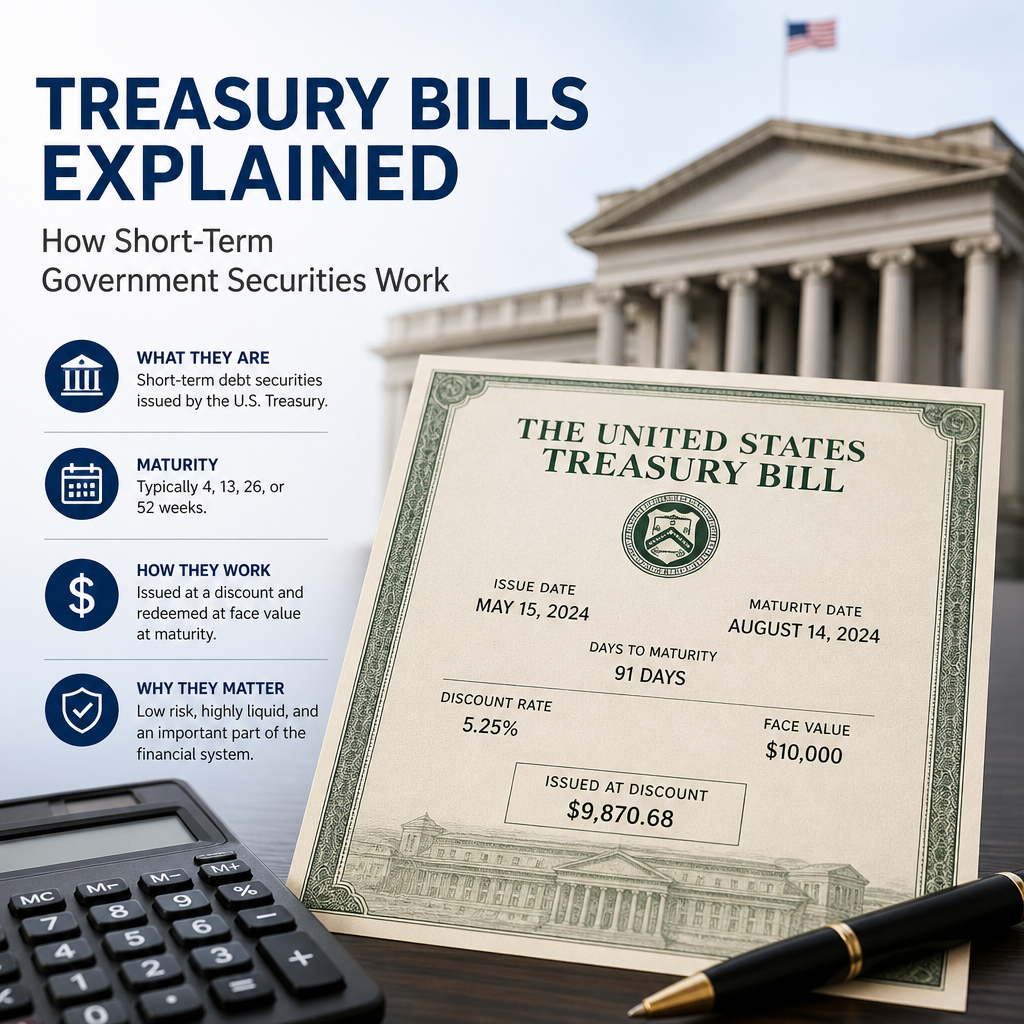
Unlike traditional bonds, Treasury bills do not pay periodic interest. Instead, they are sold at a discount to their face value and mature at full face value. The difference between what you pay and what you receive at maturity is your return.
For example:
You buy a $1,000 T-bill for $975
You hold it until maturity
The Treasury pays you $1,000
Your return is the $25 difference
That simple structure is one reason Treasury bills are so popular with conservative investors and institutions.
How Treasury Bills Work
Understanding how Treasury bills work starts with the auction process. The U.S. Treasury issues bills through regular auctions. Investors can buy them directly from the government at TreasuryDirect or through a broker.
Step 1: Treasury issues a bill
The Treasury announces a new issue with:
A maturity date
A face value
A discount pricing structure
A term length, such as 4, 8, 13, 26, or 52 weeks
Step 2: Investors bid or buy
There are two main ways to participate:
Noncompetitive bid: You agree to accept the yield determined at auction. This is the simplest method for individual investors.
Competitive bid: You specify the discount rate you’re willing to accept. This is more common among institutional investors.
Step 3: The bill matures
When the T-bill reaches maturity, the Treasury repays the full face value. If you bought through TreasuryDirect, the funds are deposited into your account. If you bought through a broker, the proceeds usually settle automatically.
Why Investors Use Treasury Bills
Treasury bills are not designed to generate high returns. Their appeal comes from stability, simplicity, and liquidity.
Common reasons people buy T-bills
Capital preservation: T-bills are backed by the U.S. government, so they are widely viewed as among the safest investments available.
Short-term parking for cash: They can be useful if you have money you may need soon.
Predictable outcome: If held to maturity, you know the amount you’ll receive.
Portfolio diversification: T-bills can help balance risk in a larger investment strategy.
Lower volatility: Their prices are generally less volatile than stocks or longer-term bonds.
For many investors, Treasury bills are not a substitute for growth investments. Instead, they are a tool for stability and liquidity.
Treasury Bills Explained Through the Discount Price Model
One of the most important things to understand about Treasury bills is that they are not sold like coupon bonds. They use a discount price model.
That means:
You pay less than face value
You receive full face value at maturity
Your return is based on the difference
Example of a T-bill return
Suppose you buy a 6-month Treasury bill with:
Face value: $10,000
Purchase price: $9,800
At maturity, you receive $10,000. Your gross return is $200.
This structure makes T-bills easy to understand once you get used to the idea that the “interest” is embedded in the purchase discount rather than paid out along the way.
Treasury Bill Maturities and Terms
Treasury bills are issued with short maturities, typically:
4 weeks
8 weeks
13 weeks
17 weeks
26 weeks
52 weeks
These shorter terms make them different from Treasury notes and Treasury bonds, which have longer maturities and usually pay interest semiannually.
Which maturity should you choose?
The answer depends on your timeline:
Very short-term needs: 4- or 8-week bills
Medium short-term needs: 13- or 26-week bills
Longer short-term horizon: 52-week bills
A shorter maturity gives you quicker access to your money. A longer maturity may lock in a yield for a bit more time, but it also reduces flexibility.
Where to Buy Treasury Bills
You can buy Treasury bills in two main places.
TreasuryDirect
TreasuryDirect is the official U.S. government website for buying Treasury securities directly. It’s a common choice for investors who want to avoid broker fees and hold securities in a direct account.
Benefits include:
Direct government purchase
No commission
Simple access to new issues
Brokerage firms
Many major brokerages also sell Treasury bills. This can be convenient if you already manage your investments at the same firm.
Potential advantages:
Easier integration with existing accounts
Ability to buy in the secondary market
Portfolio management in one place
When comparing options, look at:
Fees
Minimum purchase requirements
Ease of reinvesting at maturity
Account features
Treasury Bills vs. Bonds vs. CDs
People often compare Treasury bills with other safe or conservative options. Here’s a quick breakdown.
Treasury bills vs. Treasury bonds
Treasury bills: Short-term, no periodic interest, sold at a discount
Treasury bonds: Long-term, pay interest over time, higher interest rate risk
Treasury bills vs. certificates of deposit (CDs)
T-bills: Backed by the U.S. government, sold at a discount, can be sold before maturity in the secondary market
CDs: Offered by banks and credit unions, usually pay fixed interest, often come with early withdrawal penalties
Treasury bills vs. money market funds
T-bills: Individual securities with a set maturity
Money market funds: Mutual funds that invest in short-term instruments and aim to maintain stability, but are not the same as owning a bill directly
Each option serves a different purpose. T-bills are best understood as a short-term government security with a known payoff at maturity.
Taxes on Treasury Bills
Treasury bills are subject to federal income tax, but they are generally exempt from state and local income taxes. That tax treatment can make them more attractive than some other short-term investments, especially in high-tax states.
A few tax points to keep in mind:
You may owe federal tax on the interest income
State and local taxes usually do not apply
If you buy a T-bill at a discount, the difference may be treated as interest income
Tax reporting can vary depending on how and where you hold the bill
Because tax rules can be nuanced, it’s smart to review your situation with a tax professional if you’re investing meaningful amounts.
How Treasury Bills Fit Into a Financial Plan
Treasury bills can serve different roles depending on your goals.
1. Emergency fund parking place
If you want a stable place for cash you may need soon, T-bills can be part of an emergency reserve strategy. Just be sure to keep enough money accessible for immediate needs.
2. Cash management for businesses
Businesses often use Treasury bills to manage temporary excess cash while reducing idle balances.
3. Laddered short-term income strategy
Some investors build a Treasury bill ladder by buying bills with staggered maturity dates. This can help maintain liquidity while spreading reinvestment risk.
For example:
Buy one 4-week bill
Buy one 8-week bill
Buy one 13-week bill
Reinvest as each one matures
This approach can create a steady cycle of maturing cash.
4. Conservative portfolio allocation
In volatile markets, T-bills may help reduce portfolio risk. They won’t usually outperform equities over the long run, but they can add stability during uncertain periods.
Risks and Limitations of Treasury Bills
Even though Treasury bills are considered low risk, they are not risk-free in every sense.
Key limitations to understand
Inflation risk: If inflation rises faster than your return, your purchasing power may decline.
Reinvestment risk: When a bill matures, you may have to reinvest at a lower yield.
Opportunity cost: Money in T-bills may earn less than in stocks or other growth assets.
Market price risk: If you sell before maturity, the market price may be above or below what you paid.
For investors seeking growth, T-bills alone are usually not enough. They work best as part of a broader plan that matches your time horizon and risk tolerance.
How to Read Treasury Bill Auction Results
Once you start following T-bills, you’ll likely see auction announcements and results.
Important terms include:
Discount rate: The rate at which the bill is sold below face value
High yield: The yield associated with the highest accepted competitive bid
Maturity date: The date the bill is repaid at face value
CUSIP: A unique security identifier used in the U.S. market
If the auction results show a lower yield than expected, that can happen because Treasury securities are influenced by current market demand and prevailing interest rates.
Practical Example: A Treasury Bill in Real Life
Imagine you have $5,000 sitting in a savings account and you know you won’t need it for six months. You want safety and a better return than a standard checking account might offer.
A 26-week Treasury bill could be a reasonable fit.
Here’s why:
You lock in a short term.
You know the maturity date in advance.
You get full face value at maturity.
You avoid tying up money in a long-term investment.
That said, if you may need the funds sooner, or if you want daily liquidity, a savings account or money market fund may be more practical.
Treasury Bills Explained for Beginners: What to Remember
If you’re new to fixed income investing, keep these takeaways in mind:
Treasury bills are short-term U.S. government securities
They are sold at a discount and redeemed at face value
They do not pay periodic interest
They are often used for short-term cash preservation
They can be purchased through TreasuryDirect or brokerages
They may be exempt from state and local taxes
They are low risk, but they still have tradeoffs
The key is to match the investment to your goal. T-bills are excellent for short-term stability, not long-term growth.
Frequently Asked Questions
1. Are Treasury bills a good investment?
Treasury bills can be a good investment if your main goal is safety, short-term cash management, or preserving principal. They are especially useful when you need a low-risk place to hold money for a few weeks to a year. If you want higher long-term growth, you’ll likely need other investments too.
2. How do you make money with Treasury bills?
You make money by buying the bill for less than its face value and receiving the full face value at maturity. The difference between the two amounts is your return. Because T-bills do not pay regular interest, your earnings are built into the discount.
3. Can you lose money on Treasury bills?
If you hold a Treasury bill until maturity, you receive the face value from the U.S. government. However, you could lose money if you sell it early in the secondary market and the market price has fallen. Inflation can also reduce the real value of your return over time.
4. How are Treasury bills taxed?
Treasury bills are subject to federal income tax. They are generally exempt from state and local income taxes. The discount you earn is typically treated as interest income. Tax treatment can vary depending on your holdings, so check with a tax professional if needed.
5. What is the minimum amount needed to buy a Treasury bill?
The minimum purchase amount for Treasury bills is typically $100 when buying through TreasuryDirect, and they are sold in increments of $100. Brokerages may have their own minimums or account-specific rules, so it’s worth checking before you buy.
Treasury bills offer a straightforward way to invest short-term cash in a government-backed security with a known maturity date and a predictable payoff if held to maturity. They are not built for aggressive growth, but they do serve an important purpose: preserving capital, improving cash management, and reducing uncertainty in a financial plan.
For beginners, the biggest advantage of Treasury bills is their simplicity. You buy them at a discount, hold them until maturity, and receive the full face value. For experienced investors, they can provide a useful anchor during volatile markets or a practical home for cash that needs to stay relatively accessible.
As with any investment, the right choice depends on your goals, timeline, and tax situation. If you understand how Treasury bills work, you can use them more confidently as part of a balanced strategy. Before investing, compare maturities, yields, and access methods so you can choose the option that fits your needs best.
Mary S, CFP®, is a Certified Financial Planner with over 12 years of experience in personal finance, retirement planning, and wealth management. She writes educational content that helps readers understand financial concepts and make informed decisions based on reliable information.