Even small investment fees can quietly chip away at your portfolio over time, reducing the money left to compound and grow. Understanding where these costs come from is one of the easiest ways to protect more of your long-term returns.
By: Mary Mitchell on July 28, 2026
When people talk about building wealth, they usually focus on market returns, asset allocation, and time in the market. But one factor often gets less attention: investment fees. Over many years, even seemingly small fees can quietly reduce your long-term returns and make a meaningful difference in the size of your portfolio.
That’s why understanding how investment fees work is so important. Whether you invest in mutual funds, ETFs, retirement accounts, or advisory services, every dollar you pay in fees is a dollar that is no longer compounding for you. In other words, fees do not just cost money today—they can also reduce future growth.
What Are Investment Fees?
Investment fees are the costs you pay to own, manage, or trade investments. These fees can come from fund providers, brokers, financial advisors, and even the accounts themselves.
Some fees are obvious. Others are buried in the fine print.
Common types of investment fees
Here are the most common fees investors encounter:
Expense ratios: Annual fees charged by mutual funds and ETFs to cover management and operating costs.
Sales loads: Commissions paid when buying or selling certain mutual funds.
Advisory fees: Charges for financial advice, often based on a percentage of assets under management.
Trading commissions: Fees for buying or selling investments through a brokerage.
Account maintenance fees: Charges for keeping an account open or meeting certain minimum balances.
12b-1 fees: Marketing or distribution fees built into some mutual funds.
Expense and transaction costs in funds: Costs related to portfolio turnover, trading, and other operational activity.
Not every investment comes with every fee, but most investors pay at least some of them. The key is knowing what you’re paying and what you’re getting in return.
How Investment Fees Reduce Long-Term Returns
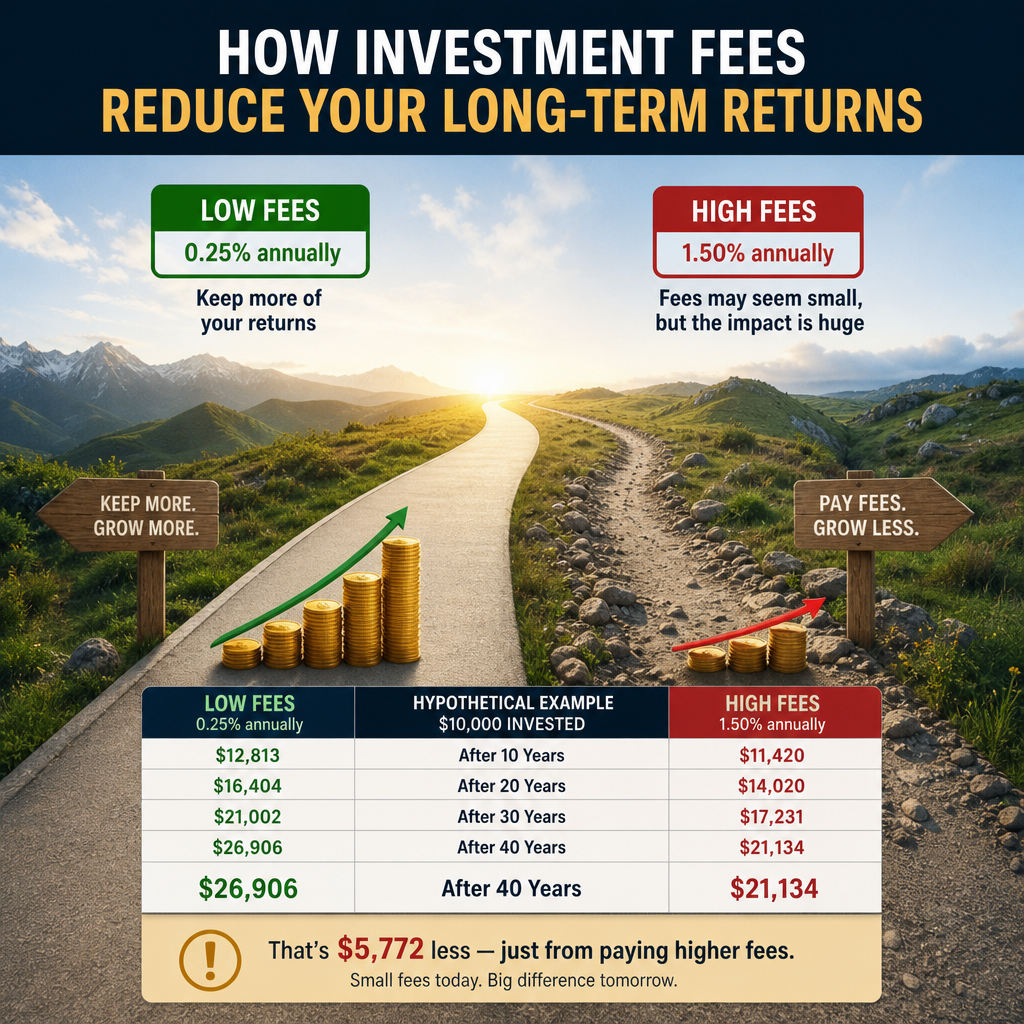
The impact of investment fees is not always easy to see in the short term. A fee of 0.50% or 1% may not feel large at first glance. But over 10, 20, or 30 years, the effect can be substantial because fees reduce the amount of money that stays invested and compounds.
The power of compounding works both ways
Compounding is what helps investments grow over time. Your returns generate more returns, which then generate even more.
Fees interrupt that process.
For example:
If your investment earns 7% before fees but you pay 1% in fees, your net return may be closer to 6%.
That 1% difference may seem small in a single year.
Over decades, however, the gap can widen dramatically because you are losing growth on the fee amount every year.
This is why investors often say that fees are one of the few predictable drags on returns. Markets fluctuate, but fees usually keep coming.
A simple example of fee impact
Imagine two investors each start with $100,000 and invest for 30 years.
Investor A pays 0.25% in annual fees.
Investor B pays 1.25% in annual fees.
Both portfolios earn the same gross annual return before fees.
Over time, Investor B’s higher fees reduce the amount left to compound. Even if the difference in annual fees looks modest, the ending balance could be meaningfully lower.
The exact outcome depends on market performance and fee structure, but the principle is consistent: higher fees usually lead to lower net returns.
Why Small Fee Differences Matter So Much
Many investors assume that a tiny fee difference is too small to matter. That’s understandable—until you look at the long time horizon of investing.
Fees compound over time
When you pay fees every year, the cost is not just the amount deducted today. It also includes the lost growth on that money in future years.
That means:
You pay a fee.
The fee amount no longer stays invested.
You lose any future earnings that money might have generated.
The effect repeats year after year.
This is why even a difference of 0.50% annually can become expensive in retirement investing or other long-term accounts.
High fees can be especially damaging in low-return markets
When market returns are strong, fees may be easier to overlook. But in lower-return environments, fees can take a larger share of total performance.
For example:
A fund returning 5% before fees loses more of its value to a 1% fee than a fund returning 12%.
In a modest-return year, high fees can consume a bigger piece of the investor’s gain.
If returns are weak, fees may turn a small gain into a flat or negative result.
That’s one reason cost control is such an important part of investing.
Which Investment Fees Deserve the Most Attention?
Not all fees affect investors in the same way. Some are one-time charges, while others recur every year. The recurring ones deserve special attention because they continue to reduce returns over time.
1. Expense ratios
Expense ratios are among the most important fees to compare when choosing mutual funds or ETFs. They are expressed as a percentage of assets and deducted automatically from the fund’s performance.
A fund with a 0.05% expense ratio is much cheaper to own than one with a 1.00% expense ratio. That difference can add up significantly over the years.
2. Advisory fees
If you work with a financial advisor, you may pay an advisory fee based on a percentage of your assets. This is not necessarily bad—good advice can be valuable. But it’s important to understand exactly what services you are paying for.
Ask whether the advisor provides:
Financial planning
Tax strategy support
Retirement income guidance
Portfolio management
Ongoing monitoring and rebalancing
The more comprehensive the service, the easier it may be to justify the cost.
3. Sales loads and commissions
Some mutual funds charge front-end or back-end sales loads. These fees can reduce the amount you invest right away or eat into your proceeds when you sell.
If two funds have similar strategies, a no-load version may be a more efficient choice.
4. Trading costs and turnover
Even when a fund advertises a low expense ratio, frequent trading inside the fund can still create costs. Higher turnover can lead to:
Larger trading expenses
Taxable capital gains distributions
Lower net performance
This is one reason index funds and many ETFs are popular with cost-conscious investors.
How to Compare Investment Fees Effectively
Looking only at returns is not enough. A fund with strong historical performance might still underperform after fees. To make better comparisons, focus on the full cost picture.
Ask these questions before investing
What is the annual expense ratio?
Are there sales loads or redemption fees?
Does the account have maintenance or inactivity fees?
Are advisory fees charged as a percentage of assets?
Are there hidden trading or turnover costs?
What services do I receive in exchange for the fee?
If you cannot clearly understand the fee structure, that is a warning sign.
Read the fund prospectus and fee disclosure documents
Fund providers are required to disclose costs in their prospectuses and other materials. It may not be exciting reading, but it is one of the best ways to see what you are paying.
Look for:
Annual fund operating expenses
Share class differences
Transaction fees
Expense examples
Risk and performance information
The details may feel technical, but they can reveal a lot about the true cost of ownership.
Investment Fees vs. Value: Not Every Fee Is Bad
It’s tempting to think the lowest-cost option is always the best option. In reality, that is not always true.
A fee may be worth paying if it provides genuine value.
When a fee may be justified
You might reasonably pay more if you receive:
Personalized financial planning
Tax-efficient portfolio management
Behavioral coaching during market downturns
Estate planning coordination
Retirement drawdown strategies
Access to a specialized investment approach
For example, an investor nearing retirement may benefit from advice that helps reduce withdrawal risk or improve tax efficiency. In that case, a moderate advisory fee might be a worthwhile tradeoff.
The goal is not to avoid every fee. The goal is to avoid unnecessary fees and pay only for value that improves your financial outcome.
Practical Ways to Reduce Investment Fees
Reducing fees does not require you to become an expert overnight. A few disciplined habits can make a real difference.
1. Favor low-cost index funds and ETFs
Many broad market index funds and ETFs offer diversification at a relatively low cost. These are often good building blocks for long-term investors because they keep more of your return working for you.
2. Review your portfolio regularly
A yearly review can help you spot high-cost funds, duplicate holdings, or outdated accounts with unnecessary charges.
Look for:
Funds with unusually high expense ratios
Active funds that consistently underperform cheaper alternatives
Old 401(k) plans with limited, expensive options
Accounts that charge maintenance fees you could avoid elsewhere
3. Avoid unnecessary trading
Frequent buying and selling can lead to commissions, bid-ask spreads, and tax consequences. A long-term approach usually costs less and may also improve after-tax returns.
4. Consolidate accounts when appropriate
If you have several small accounts, you may be paying multiple fees or missing minimum balance requirements. Consolidating accounts can simplify management and reduce expenses.
5. Negotiate or compare advisory services
If you pay for advice, compare different fee structures:
Percentage-based fees
Flat fees
Hourly planning
Subscription-based advice
A lower-fee structure may work well if your needs are straightforward.
The Tax Side of Fees
Investment fees and taxes are different, but they can interact. Some funds generate more taxable distributions because of trading activity. That means the cost of investing may include both explicit fees and tax drag.
Why tax efficiency matters
Tax-efficient investing helps keep more of your money compounding. Funds with lower turnover often create fewer taxable events, which can be especially important in taxable brokerage accounts.
When comparing investments, it helps to consider:
Fee level
Turnover ratio
Distribution history
Account type
A fund that looks cheap on paper may still be costly after taxes.
How to Build a Cost-Conscious Investing Habit
A fee-aware investor does not chase the cheapest option blindly. Instead, they look for strong value at a reasonable cost.
A simple process to follow
Identify each fee attached to your accounts and investments.
Compare costs across similar funds or services.
Check whether the value justifies the price.
Reduce high-cost holdings where practical.
Revisit costs regularly, especially after major life changes.
This habit can make investing more intentional and improve long-term outcomes.
Frequently Asked Questions
1. What is the biggest investment fee most investors should watch?
For many long-term investors, the most important fee to watch is the expense ratio. Since it is charged annually and comes directly out of fund performance, it can compound into a significant cost over time. Advisory fees also deserve close attention because they recur every year.
2. Are higher-fee funds always worse?
Not always. Some higher-fee funds or advisors may offer specialized strategies, tax management, or personalized guidance that adds value. The key is to compare the fee with the benefit received. If the extra cost does not improve your outcome, it may not be worth paying.
3. How can I find out what I’m paying in fees?
Check your account statements, fund prospectuses, annual reports, and advisory agreements. Brokerage platforms and retirement plans often show expense ratios and account charges. If anything is unclear, ask your provider or advisor for a plain-language explanation of all recurring and transaction-based fees.
4. Do ETFs always have lower fees than mutual funds?
No, but many ETFs do have lower expense ratios than actively managed mutual funds. Still, you should compare the total cost, not just the label. Some mutual funds are also very low-cost, and some ETFs may carry trading spreads or other costs depending on how they are used.
5. Can fees really make a big difference over time?
Yes. Even small annual fee differences can become meaningful over long periods because of compounding. The more years your money stays invested, the more a higher fee can reduce your ending balance. That is why cost control matters so much for retirement and other long-term goals.
Understanding how investment fees can reduce your long-term returns is one of the most practical skills any investor can develop. Fees may not feel dramatic in the moment, but over time they can quietly erode the growth of your portfolio by taking money out of compounding. That is why it pays to know what you are paying, why you are paying it, and whether the cost is justified by the value you receive.
A smart investing strategy is not only about finding strong returns. It is also about keeping expenses under control, choosing cost-effective funds when appropriate, and paying for professional help only when it truly adds value. By reviewing expense ratios, advisory fees, and hidden account charges, you give your money a better chance to grow.
If you want stronger long-term results, start with your fees. Small improvements in cost control today can create meaningful benefits over the years ahead.
Mary S, CFP®, is a Certified Financial Planner with over 12 years of experience in personal finance, retirement planning, and wealth management. She writes educational content that helps readers understand financial concepts and make informed decisions based on reliable information.