How to Compare Mortgage Rates Before Buying a Home
Learning how to compare mortgage rates before buying a home can help you spot the best overall deal, not just the lowest advertised number. By looking at fees, loan terms, and long-term costs, you can choose a mortgage that fits your budget and goals.
By: Mary Mitchell on July 28, 2026
Shopping for a home is exciting, but the financing side can make or break your budget. That’s why learning how to compare mortgage rates before buying a home is one of the smartest steps you can take as a buyer. A small difference in interest rate may not look like much on paper, but over the life of a loan, it can change your monthly payment and total cost in a big way.
The good news: comparing mortgage offers is more than just glancing at the advertised rate. You need to understand loan terms, lender fees, rate locks, and how your credit profile affects the deal you get. With the right approach, you can confidently evaluate options and choose a mortgage that fits your financial goals.
Why Mortgage Rate Comparison Matters
A mortgage is likely the largest loan you’ll ever take out, so even a fraction of a percentage point matters. When you compare mortgage rates before buying a home, you’re not just looking for the lowest number—you’re looking for the best overall value.
The real cost goes beyond the rate
Two lenders can advertise similar interest rates, but one may charge higher closing costs, points, or lender fees. Another may offer a slightly higher rate with lower upfront costs. The “best” loan depends on your timeline, budget, and how long you expect to stay in the home.
A lower rate can mean long-term savings
If you plan to keep the loan for many years, a lower interest rate can save thousands over time. If you might sell or refinance in a few years, paying extra upfront to shave the rate down may not be worth it.
Start With Your Financial Profile
Before you compare mortgage offers, it helps to know what lenders will likely see.
Check your credit score and report
Your credit score is one of the biggest factors in mortgage pricing. Borrowers with stronger credit usually qualify for better mortgage interest rates. Review your credit reports for errors and pay down high balances if possible.
Know your debt-to-income ratio
Lenders look at your debt-to-income ratio, or DTI, to see how much of your monthly income already goes toward debt payments. A lower DTI can improve your chances of getting better loan terms.
Estimate your down payment
Your down payment affects both your loan amount and how lenders view your risk. In many cases:
A larger down payment may lead to better mortgage rates
Putting less than 20% down may require mortgage insurance
Lower equity can sometimes mean slightly higher costs
Gather Multiple Mortgage Quotes
One of the best ways to compare mortgage rates before buying a home is to request quotes from several lenders. Don’t rely on just one estimate, even if the first lender seems competitive.
Where to get quotes
You can compare offers from:
Banks
Credit unions
Mortgage brokers
Online lenders
Local mortgage companies
Each lender may have different pricing models, underwriting standards, and fee structures.
Ask for the same loan details
To make a fair comparison, request quotes using the same basic parameters:
Loan amount
Loan type
Property type
Down payment amount
Estimated credit score
Occupancy status, such as primary residence
If the inputs differ, the comparison won’t be accurate.
Understand the Loan Estimate
After you apply for a mortgage, federal rules require lenders to provide a Loan Estimate. This document is one of the most important tools for comparing mortgage offers.
What to look for
Pay attention to these sections:
Interest rate: The rate used to calculate your monthly principal and interest
Annual Percentage Rate (APR): A broader measure that includes some fees and costs
Projected monthly payment: Includes principal, interest, and possibly escrow items
Closing costs: Upfront fees due at closing
Cash to close: The amount you’ll need to bring to closing
Rate vs. APR
The mortgage rate tells you the cost of borrowing the principal. The APR gives you a more complete picture because it includes certain loan fees. A loan with a slightly higher rate but much lower fees may actually be the better deal.
Compare More Than Just the Interest Rate
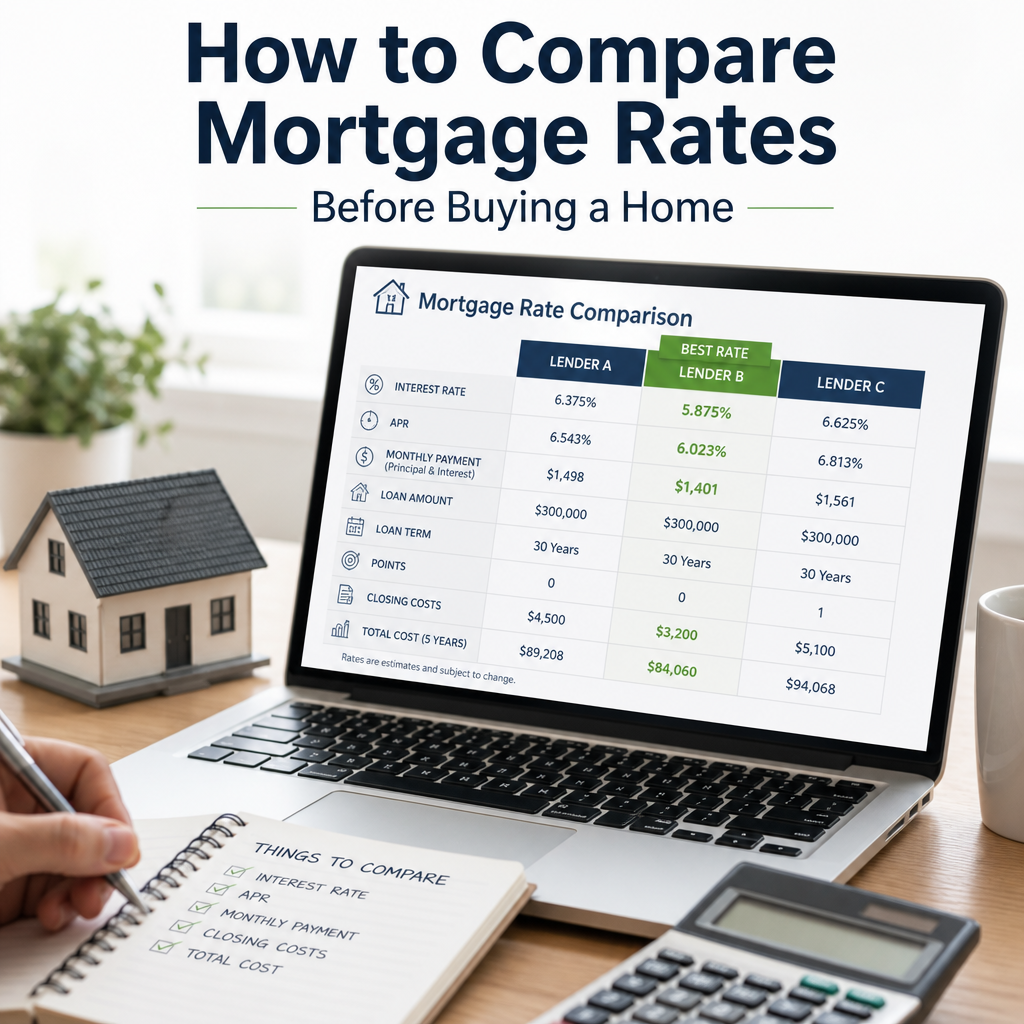
A common mistake is focusing only on the headline mortgage rate. To compare mortgage rates before buying a home effectively, look at the full loan package.
Key factors to compare
1. Interest rate
This affects your monthly payment and total interest paid over the life of the loan.
2. Points
Discount points are optional upfront fees you may pay to lower your rate. This can make sense if you plan to keep the mortgage long enough to recover the cost.
3. Lender fees
These may include origination fees, underwriting fees, processing fees, and application fees.
4. Third-party fees
Appraisal, title, escrow, and recording fees can vary by lender or location.
5. Mortgage insurance
If your down payment is less than 20% on a conventional loan, you may pay private mortgage insurance (PMI). FHA loans also have mortgage insurance costs.
6. Prepayment penalties
Some loans charge a fee if you pay off the mortgage early. This can be a major issue if you plan to refinance or sell soon.
Compare Loan Types Carefully
The mortgage rate you see is tied to the type of loan you choose. A rate that looks low on one loan program may not be the best once you factor in eligibility rules and insurance requirements.
Conventional loans
Conventional mortgages often offer competitive rates for borrowers with good credit and stable income. They typically do not require mortgage insurance if you put down 20% or more.
FHA loans
FHA loans are popular with first-time buyers and borrowers with smaller down payments or lower credit scores. The rate may be attractive, but mortgage insurance adds to the total cost.
VA loans
Eligible veterans, active-duty service members, and some surviving spouses may qualify for VA loans. These often offer strong terms and no monthly mortgage insurance.
USDA loans
USDA loans help eligible buyers in certain rural and suburban areas. They can be appealing for low- to moderate-income households that meet location and income guidelines.
Evaluate the Rate Lock
Mortgage rates can change quickly. A rate lock protects your quoted rate for a set period while your loan moves toward closing.
Why a rate lock matters
If rates rise after you apply, your locked rate can save you money. But you should also know the lock period and whether extending it costs extra.
Questions to ask
How long is the rate lock valid?
Is there a fee for locking?
What happens if my closing is delayed?
Can I float down if market rates improve?
A rate lock is especially important in a volatile market or when your closing date is uncertain.
Use the Same Comparison Method for Every Quote
To compare mortgage rates before buying a home accurately, use a consistent process. Otherwise, small differences in assumptions can make one offer look better than it really is.
A simple comparison checklist
For each quote, write down:
Loan type
Loan amount
Interest rate
APR
Monthly principal and interest payment
Estimated closing costs
Points paid or earned
Mortgage insurance
Prepayment penalties
Rate lock period
This makes it easier to spot which lender is truly offering the best value.
Look at the Break-Even Point
If you’re paying points or extra upfront fees to lower your mortgage rate, calculate the break-even point. That tells you how long it will take for monthly savings to offset the upfront cost.
Example
If paying $2,000 in discount points lowers your payment by $50 per month, your break-even point is 40 months. If you expect to move or refinance before then, paying those points may not be worthwhile.
Why this matters
Break-even analysis helps you avoid choosing a loan that looks cheap monthly but costs more overall.
Don’t Ignore Service and Communication
The lowest rate isn’t always the best mortgage experience. A lender’s communication, responsiveness, and closing process matter too.
What good service looks like
A strong lender should:
Explain loan terms clearly
Respond promptly to questions
Provide accurate estimates
Keep you informed through underwriting
Help you close on time
A delayed or poorly managed loan can create stress and even jeopardize your home purchase.
Be Careful With Rate Shopping Timing
When you compare mortgage rates before buying a home, timing matters. Multiple mortgage inquiries within a short window are generally treated as a single credit inquiry for scoring models, but it’s still smart to be organized.
Best practices
Compare quotes within a focused time period
Keep your financial profile stable during the process
Avoid taking on new debt before closing
Ask lenders whether the quote is tied to a specific credit pull date
This helps you get accurate offers without creating unnecessary complications.
Common Mistakes to Avoid
Even well-prepared buyers make mistakes when comparing mortgage offers. Avoid these common pitfalls.
1. Choosing the lowest advertised rate without checking fees
A low rate may come with expensive points or charges.
2. Comparing quotes with different assumptions
Different loan amounts, down payments, or property types can distort the results.
3. Ignoring monthly insurance costs
Mortgage insurance can change your payment significantly.
4. Forgetting about long-term plans
The best loan for a short stay may not be the best loan for a long-term home.
5. Focusing only on the monthly payment
You also need to consider closing costs, flexibility, and total loan cost.
Practical Example: Comparing Two Mortgage Offers
Imagine you’re buying a home with a $300,000 loan.
Offer A
Interest rate: 6.50%
Closing costs: Higher
Points: None
Monthly payment: Slightly lower than Offer B
Offer B
Interest rate: 6.75%
Closing costs: Lower
Points: None
Monthly payment: Slightly higher than Offer A
At first glance, Offer A seems better because of the lower rate. But if Offer B saves several thousand dollars upfront and you plan to move in five years, the lower closing costs may make it the smarter choice.
This is why comparing mortgage rates before buying a home should always include both monthly and upfront costs.
Frequently Asked Questions
1. How many mortgage lenders should I compare?
Most buyers benefit from comparing at least three lenders. That gives you a better sense of market pricing and helps you identify fees or terms that stand out. More quotes can be useful, but keep the loan details consistent so the comparison stays fair.
2. Is the lowest mortgage rate always the best deal?
Not necessarily. The lowest rate may come with higher fees, discount points, or less flexible terms. Look at the APR, closing costs, monthly payment, and break-even point before deciding.
3. What affects the mortgage rate I’m offered?
Lenders consider several factors, including your credit score, loan type, down payment, debt-to-income ratio, property type, and market conditions. Even a small change in one of these factors can influence your final rate.
4. What’s the difference between a mortgage rate and APR?
The mortgage rate is the interest rate used to calculate your loan payment. APR includes the interest rate plus certain lender fees and costs, giving you a broader view of the loan’s overall expense.
5. Should I pay points to get a lower rate?
It depends on how long you plan to keep the loan. Paying points can make sense if you’ll stay in the home long enough to recover the upfront cost through lower monthly payments. If you may move or refinance soon, the math may not work in your favor.
Knowing how to compare mortgage rates before buying a home can save you money, reduce stress, and help you choose a loan that truly fits your plans. The best decision isn’t always the one with the lowest advertised rate. It’s the one that balances interest rate, APR, closing costs, mortgage insurance, rate lock terms, and lender service.
If you take the time to gather multiple quotes, compare them using the same assumptions, and review the Loan Estimate carefully, you’ll be in a much stronger position when it’s time to make an offer. A mortgage should support your homeownership goals—not strain them.
Before you sign anything, slow down and review the full picture. A thoughtful comparison today can lead to a more manageable payment, fewer surprises at closing, and better long-term financial confidence.
Mary S, CFP®, is a Certified Financial Planner with over 12 years of experience in personal finance, retirement planning, and wealth management. She writes educational content that helps readers understand financial concepts and make informed decisions based on reliable information.