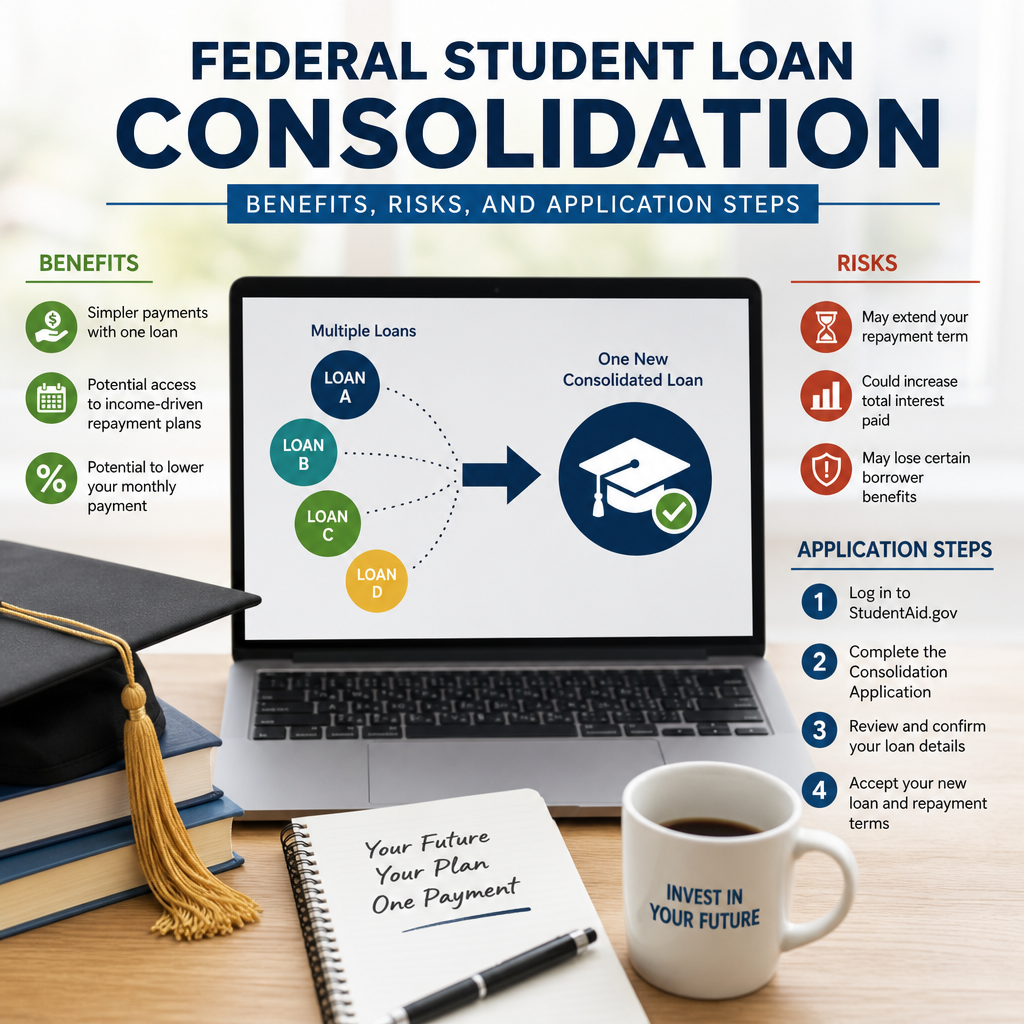
Federal Student Loan Consolidation: Benefits, Risks, and Application Steps
Federal student loan consolidation can simplify repayment by combining multiple federal loans into one new Direct Consolidation Loan, but it may also affect your interest rate, repayment term, and eligibility for forgiveness programs. Learn when consolidation can help—and when it could cost you more in the long run.
By: Jennifer Collins - Education on July 28, 2026
Federal student loan consolidation can be a smart financial move for some borrowers, but it is not the right solution for everyone. If you have multiple federal student loans and want a simpler repayment setup, federal student loan consolidation may help streamline your debt into one monthly payment. Still, it can also change the terms of your loans in ways that matter, especially if you are working toward loan forgiveness or using an income-driven repayment plan.
This guide explains what federal student loan consolidation is, how it works, the main benefits and risks, and how to apply. If you are trying to make sense of your repayment options, understanding the details can save you time, money, and stress.
What Is Federal Student Loan Consolidation?
Federal student loan consolidation is the process of combining one or more eligible federal student loans into a single new loan called a Direct Consolidation Loan. The U.S. Department of Education offers this option through the federal student aid system.
The goal is not to reduce your total balance dramatically or erase interest. Instead, consolidation changes how your loans are packaged and repaid. You may get:
One monthly bill instead of several
A new loan servicer for the consolidated loan
Access to certain repayment plans or forgiveness programs
A longer repayment term in some cases
It is important to separate federal student loan consolidation from private refinancing. Refinancing with a private lender can lower your interest rate, but it replaces your federal loans with a private loan and removes federal protections. Consolidation keeps your debt in the federal system.
How Federal Student Loan Consolidation Works
When you consolidate federal student loans, the government pays off your existing eligible federal loans and issues a new Direct Consolidation Loan. The new interest rate is a weighted average of the interest rates on the loans being consolidated, rounded up to the nearest one-eighth of one percent.
Which Loans Can Be Consolidated?
Generally, you can consolidate most federal student loans, including:
Direct Loans
Federal Family Education Loan (FFEL) Program loans
Perkins Loans
PLUS loans
Some defaulted loans
Some situations have special rules. For example, Parent PLUS loans can be consolidated, but they are only eligible for certain repayment options afterward. If you have both undergraduate and graduate loans, consolidation may affect which repayment plans you can access.
What Happens After Consolidation?
Once consolidation is complete:
Your old eligible federal loans are paid off.
A new Direct Consolidation Loan is created.
You choose a repayment plan for the new loan.
Your first payment becomes due after the new loan enters repayment.
The process can take weeks, and during that time you may still need to make payments on your current loans unless told otherwise by your servicer.
Benefits of Federal Student Loan Consolidation
Federal student loan consolidation can offer practical advantages, especially if your loans are spread across different servicers or have complicated repayment terms.
1. Simplified Repayment
One of the most obvious benefits is simplicity. Instead of tracking several due dates and loan accounts, you make one monthly payment.
This can help if you:
Struggle to keep up with multiple loan servicers
Want a clearer view of your overall debt
Prefer one repayment schedule instead of several
For many borrowers, a simpler setup reduces the chance of missed payments.
2. Access to Additional Repayment Options
Some borrowers consolidate to become eligible for federal repayment plans they could not otherwise use. For example, older FFEL or Perkins Loans may not qualify for the same flexible repayment options as Direct Loans.
After consolidation, you may gain access to:
Income-driven repayment (IDR) plans
Graduated repayment
Extended repayment
This can be especially useful if your monthly payment needs to be more manageable.
3. Can Help Bring Loans Out of Default
If you have certain defaulted federal loans, consolidation may help you get them back into good standing. This can open the door to renewed federal aid eligibility, repayment options, and more stable financial footing.
In some cases, consolidation may be faster than other default resolution methods, but it is not always the best option. Borrowers should compare available paths carefully.
4. May Lower Monthly Payments
A longer repayment term can reduce your monthly bill, even though you may pay more interest over time. For borrowers facing a tight budget, this temporary relief can help create breathing room.
That said, a lower payment does not always mean a better deal overall. It depends on your long-term financial goals.
Risks and Drawbacks of Federal Student Loan Consolidation
Federal student loan consolidation has tradeoffs. Before applying, it is wise to understand what you may give up.
1. You May Pay More Interest Over Time
If consolidation extends your repayment term, your monthly payments may shrink, but the total interest you pay can increase. A lower payment is appealing, but it can make the loan more expensive in the long run.
For example, someone with a few years left on repayment might be better off keeping the original loans rather than stretching them out again.
2. You Could Lose Progress Toward Forgiveness
This is one of the biggest concerns for borrowers pursuing forgiveness. When you consolidate, the new loan typically resets certain forgiveness-related timelines.
That can matter if you are working toward:
Public Service Loan Forgiveness (PSLF)
Income-driven repayment forgiveness
Loan-specific cancellation programs
In many cases, your prior qualifying payments may not carry over automatically to the new loan, or they may be affected by the type of loan and program. It is critical to check the rules before consolidating if forgiveness is part of your plan.
3. Interest Capitalization Can Increase the Balance
When unpaid interest is added to the principal, it is called capitalization. Consolidation can cause some accrued interest to capitalize, which means your new loan balance may be higher than expected.
That can raise your total cost and make the loan harder to pay off.
4. You Lose Certain Loan Benefits
Not all federal loan benefits transfer cleanly into a consolidated loan. Depending on what you have now, you could lose:
Borrower benefits tied to specific loans
Interest rate discounts
Certain cancellation or discharge protections
Progress toward specialized repayment milestones
This is why consolidation is not a one-size-fits-all solution.
5. It May Not Lower Your Interest Rate
Many borrowers hope consolidation will reduce their rate, but federal student loan consolidation does not work that way. The new rate is based on the weighted average of existing rates, rounded up slightly.
If your goal is a lower rate, private refinancing may appear attractive, but that comes with major federal loan tradeoffs. For borrowers who need federal protections, consolidation is usually about convenience and eligibility—not a lower rate.
When Federal Student Loan Consolidation Makes Sense
Federal student loan consolidation may be a good idea if:
You have multiple federal loans and want one payment
You need access to a repayment plan available only for Direct Loans
You have older federal loans that do not qualify for current repayment benefits
You are trying to get out of default
You are not pursuing PSLF or another forgiveness program that would be harmed by consolidation
It can also make sense if your borrowing situation is messy and you want a cleaner repayment structure.
When You Should Think Twice
You may want to avoid consolidation if:
You are close to loan forgiveness
You already have a manageable monthly payment
Your current loans have valuable borrower benefits
You are using PSLF and need to preserve qualifying payment progress
You are unsure whether the new repayment terms will help you financially
A good rule of thumb: do not consolidate just because it sounds simpler. Make sure the change improves your situation in a meaningful way.
How to Apply for Federal Student Loan Consolidation
The application process is straightforward, but it helps to be prepared before you begin.
Step 1: Review Your Current Loans
Make a list of all your federal student loans, including:
Loan type
Current balance
Interest rate
Loan servicer
Whether the loans are in repayment, deferment, forbearance, or default
This will help you understand which loans are eligible and whether consolidation is a smart move.
Step 2: Check Your Goals
Ask yourself what you want consolidation to accomplish.
Common goals include:
Lowering monthly payments
Simplifying repayment
Restoring access to repayment plans
Bringing loans out of default
If your goal is forgiveness, compare consolidation rules carefully before moving forward.
Step 3: Compare Repayment Plans
After consolidation, you will need to choose a repayment plan for the new loan. Common options include:
Standard repayment
Graduated repayment
Extended repayment
Income-driven repayment plans
If you expect income changes or want the lowest possible required payment, an IDR plan may be worth reviewing before you consolidate.
Step 4: Submit the Application
You can apply for federal student loan consolidation through the Federal Student Aid website. The application usually asks for:
Your personal information
Your loan details
Your preferred loan servicer
Your selected repayment plan
You can often complete the application online.
Step 5: Review the Terms Before Finalizing
Before the process is finished, read the terms carefully. Confirm:
Which loans are being consolidated
Your new interest rate
Your expected monthly payment
Your repayment term
Whether any special benefits may be affected
This is your chance to stop if the numbers do not make sense.
Step 6: Continue Making Payments if Required
While the consolidation is being processed, do not assume your old loans are automatically paused. Stay in contact with your servicer and keep making payments if required to avoid delinquency.
Practical Example: How Consolidation Can Help
Imagine you have three federal loans with different servicers and separate due dates. You are paying on time, but the monthly tracking feels overwhelming.
By choosing federal student loan consolidation, you combine those loans into one Direct Consolidation Loan. Now you have one servicer, one bill, and one repayment plan. If you select an income-driven repayment option, your payment may fit your budget better.
Now imagine a second borrower who is two years away from PSLF forgiveness. For that borrower, consolidation could be a mistake if it resets progress or otherwise affects qualifying payments. In that case, keeping the loans separate may be the better choice.
The right answer depends on the borrower’s goals, loan types, and timeline.
Common Mistakes to Avoid
Borrowers often run into problems by moving too quickly. Watch out for these missteps:
Consolidating without checking forgiveness consequences
Assuming consolidation lowers interest rates
Ignoring capitalization of unpaid interest
Forgetting to compare repayment plans
Consolidating simply to “clean up” loans without a real benefit
A careful review can prevent costly surprises.
Frequently Asked Questions
1. Does federal student loan consolidation reduce my interest rate?
Not usually. The new rate is the weighted average of the loans you consolidate, rounded up slightly. Consolidation is mainly used to simplify repayment or access certain federal options, not to lower interest.
2. Will consolidation affect my progress toward loan forgiveness?
It can. If you are pursuing forgiveness through PSLF or an income-driven repayment plan, consolidation may change how progress is counted. Before applying, review the rules for your specific forgiveness program and loan types.
3. Can I consolidate only some of my federal loans?
Yes. You do not have to include every federal loan in the process. However, you should consider how the choice affects your repayment strategy and whether leaving certain loans out creates complications.
4. Is federal student loan consolidation the same as refinancing?
No. Federal consolidation stays within the federal student loan system. Refinancing usually means replacing federal loans with a private loan from a bank or lender, which can remove federal benefits and protections.
5. How long does the consolidation process take?
The timeline can vary. It may take several weeks from application to completion. During that time, you should keep an eye on your loan accounts and continue making required payments until you receive confirmation that the consolidation is complete.
Federal student loan consolidation can be a useful tool, but only when it matches your goals. For some borrowers, it offers a simpler repayment experience, better access to federal repayment plans, or a way out of default. For others, it can create problems by extending repayment, increasing total interest, or interfering with forgiveness progress.
The key is to look beyond convenience and focus on long-term impact. Review your loan types, compare repayment options, and think carefully about any benefits you might lose. If you are pursuing PSLF or another forgiveness path, pay special attention before combining loans.
A well-informed decision can save you money and protect your future flexibility. If consolidation improves your repayment strategy, it may be worth pursuing. If not, keeping your loans as they are could be the smarter move. Take the time to evaluate your options now so you can build a repayment plan that supports your financial goals.
Jennifer, M.Ed., holds a degree in Higher Education Administration, with
a focus on U.S. college financial aid, admissions policy, and student
support systems. She researches and writes about scholarships, federal
aid programs, and the college planning process to help students and
families make informed, well-supported decisions.