Teacher Loan Forgiveness in 2026: Eligibility and Service Requirements
Teacher Loan Forgiveness can be a valuable way for eligible educators to reduce federal student debt after meeting the program’s service requirements. If you’re teaching full time in a qualifying school, understanding how Teacher Loan Forgiveness works in 2026 could help you avoid missed opportunities and costly mistakes.
By: Jennifer Collins - Education on July 28, 2026
Teacher loan forgiveness remains one of the most valuable benefits available to educators who carry federal student debt. If you are teaching full time and wondering whether Teacher Loan Forgiveness in 2026 could help reduce your loan burden, the answer depends on a few important factors: where you teach, what you teach, which loans you have, and how many years of qualifying service you complete.
Because student loan rules can change, it is smart to understand the current requirements before you assume you qualify. In this guide, you’ll learn how the program works, what counts as eligible service, which borrowers can benefit, and how to avoid common mistakes when applying.
What Is Teacher Loan Forgiveness?
Teacher Loan Forgiveness is a federal program that can forgive part of your Direct Loans or certain FFEL loans after you complete qualifying teaching service in a low-income school or educational service agency.
Unlike Public Service Loan Forgiveness, which focuses on long-term repayment and full loan cancellation after 120 qualifying payments, teacher loan forgiveness offers a one-time forgiveness amount after a set service requirement is met.
In many cases, this program can be especially helpful for:
New teachers entering high-need schools
Educators with moderate federal loan balances
Borrowers who do not expect to stay in public service for 10 years
Teachers who want a faster path to student loan relief
Teacher Loan Forgiveness in 2026: What You Need to Know
For 2026, the core structure of Teacher Loan Forgiveness in 2026 is expected to remain centered on these same federal rules:
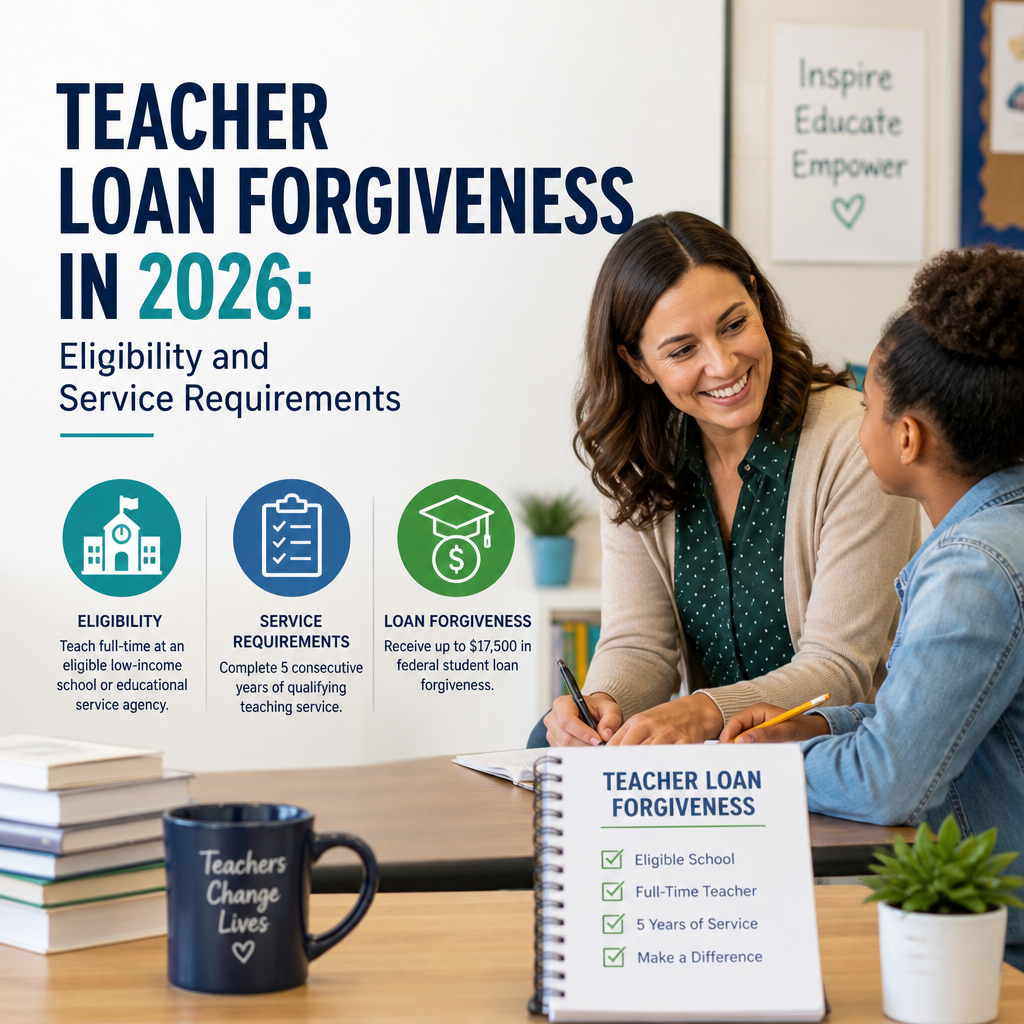
You must teach full time for five complete and consecutive academic years
Your school must qualify as a low-income school or educational service agency
Your teaching role and subject area must meet program requirements
Your loans must be eligible federal student loans
You must not have counted the same service toward another forgiveness benefit that conflicts with the program rules
The program is administered through the U.S. Department of Education, and your loan servicer processes the actual forgiveness request.
Why this benefit matters
Teaching can be rewarding, but student debt can add stress to an already demanding career. Teacher loan forgiveness may help free up money for:
Rent or mortgage payments
Childcare
Emergency savings
Classroom expenses
Professional development
For many teachers, even partial forgiveness makes a meaningful difference.
Eligibility Requirements for Teacher Loan Forgiveness
To qualify, you must meet several separate requirements. Missing even one can disqualify you, so it helps to review them carefully.
1. You must be a highly qualified teacher
The federal program generally requires that you be considered highly qualified under applicable law. In practice, this means you usually need the appropriate state certification and meet the academic and professional standards for your grade level or subject area.
This requirement matters most for teachers in elementary, middle, and high school settings. If you are unsure whether your credentials fit the definition, check with your state education agency or school district human resources department.
2. You must teach full time for five complete and consecutive academic years
The service requirement is one of the most important parts of Teacher Loan Forgiveness in 2026.
Your five years must be:
Full time
Consecutive
Completed at an eligible school or educational service agency
Full-time status is based on the school or agency’s definition, not just your personal workload. If your employer considers you full time, that usually meets the standard, assuming you also satisfy the federal rules.
A few important notes:
Breaks for approved leave may not necessarily disqualify you
Midyear starts or stops can make it harder to count a full academic year
Transfers between eligible schools may still count if the service remains continuous and qualifying
3. Your school or educational service agency must qualify
Not every school qualifies. Your employer must be a low-income school or educational service agency listed in the federal directory for at least one year during your service period.
In general, qualifying schools serve a high percentage of students from low-income families. The federal government maintains a searchable directory that helps teachers verify eligibility.
If your school’s status changes, your service may still count if the school was eligible during the relevant year. Always verify the specific dates.
4. Your loan type must be eligible
Teacher loan forgiveness only applies to certain federal student loans. These typically include:
Direct Subsidized Loans
Direct Unsubsidized Loans
Direct Consolidation Loans, if they include eligible underlying loans
Federal Stafford Loans or FFEL Program loans, depending on the circumstances
Private student loans do not qualify.
Also, Parent PLUS Loans are not eligible for this benefit, even if a parent works as a teacher. The forgiveness is tied to the borrower and the loan type, not just the profession.
5. You must not have an outstanding balance from a qualifying loan before October 1, 1998, unless specific rules apply
This older rule can matter for some borrowers, though most current teachers focus more on their eligible service and loan type. If you have older federal loans, review the official guidance carefully before applying.
Which Teaching Roles Count?
The program does not treat every teaching role the same way. The subject and grade level you teach can affect how much forgiveness you receive.
Elementary school teachers
Elementary school teachers typically qualify if they meet the full-time service requirement and teach at an eligible low-income school.
Secondary school teachers
Middle school and high school teachers may qualify as well, especially if they teach in a subject area the federal program recognizes as a high-need field.
Special education teachers
Special education teachers are often eligible if they serve in an approved school and meet the certification and full-time requirements.
Subject-area teachers in high-need fields
Teachers in certain shortage areas may qualify for the higher forgiveness amount. These commonly include:
Mathematics
Science
Special education
Foreign language, in some cases
Other designated shortage subjects depending on current federal rules
If you teach more than one subject, your primary assignment may matter. Keep documentation from your school that clearly shows your role.
How Much Can You Get Forgiven?
Teacher Loan Forgiveness offers a one-time forgiveness amount, not unlimited cancellation.
In general, the amount depends on whether your subject area is considered high-need:
Up to a set amount for teachers in most eligible subjects and grade levels
A higher amount for highly qualified mathematics, science, and special education teachers in secondary or elementary settings
Because federal benefit amounts can change, always check the current Department of Education guidance before filing your application.
Important limitation
You cannot “double count” the same five years of teaching toward both Teacher Loan Forgiveness and some other loan relief options in a way that violates program rules. This is one reason many borrowers compare this benefit with Public Service Loan Forgiveness before deciding on a strategy.
Teacher Loan Forgiveness vs. Public Service Loan Forgiveness
Many teachers qualify for both programs in theory, but they work very differently.
Teacher Loan Forgiveness
Requires five consecutive years of qualifying teaching
Offers a one-time forgiveness amount
Has school and subject-specific requirements
Can be used relatively sooner
Public Service Loan Forgiveness
Requires 120 qualifying monthly payments
Focuses on working for a qualifying public service employer
Can forgive the remaining balance tax-free under current federal rules
May provide more value for borrowers with larger balances
If you are deciding between them, ask:
How large is your loan balance?
How long do you plan to keep teaching?
Does your school qualify for both programs?
Are you on an income-driven repayment plan or another qualifying repayment path?
For some teachers, Teacher Loan Forgiveness in 2026 is the better short-term benefit. For others, PSLF offers more long-term value.
How to Apply for Teacher Loan Forgiveness
Applying is usually straightforward, but documentation matters.
Step 1: Confirm your eligibility
Before you apply, verify:
Your school was eligible during the years you taught
You completed five consecutive years of full-time teaching
Your loans are eligible federal loans
You meet the “highly qualified” standard
Step 2: Complete the official application
You must submit the Teacher Loan Forgiveness application to your loan servicer. The form typically requires certification from your school or school district confirming your years of service.
Step 3: Gather supporting records
Keep copies of:
Employment verification letters
Pay stubs
Teaching certificates
School assignment records
Copies of the completed forgiveness application
This documentation can help if the servicer requests clarification.
Step 4: Follow up with your servicer
After submission, monitor your loan account and keep notes of any messages or calls. Forgiveness processing can take time, and errors are more common when records are incomplete.
Common Mistakes That Delay or Deny Forgiveness
Even eligible teachers sometimes run into problems. Here are some of the most common ones.
Assuming any school qualifies
Not every public school is on the eligible list. Always check the official directory.
Missing the full-time requirement
Part-time work, even if it feels substantial, may not count.
Using the wrong loans
Private loans and Parent PLUS Loans are not eligible.
Failing to document consecutive service
If you changed schools, took leave, or had a contract break, keep precise records.
Confusing forgiveness programs
Teacher Loan Forgiveness and PSLF have different rules. A strategy that helps with one may not help with the other.
Practical Tips to Strengthen Your Application
A little preparation can make the process smoother.
Keep a yearly teaching file
Store one folder for each academic year with:
Employment verification
Certification documents
Contract copies
School eligibility proof
Notes on job title and grade level
Verify your school’s status early
Check the school’s eligibility before each academic year begins if possible. That way you can plan ahead if your status changes.
Track your years carefully
Keep a simple spreadsheet with:
Start and end dates
Employer name
Grade level
Subject taught
Full-time status
Notes about leave or school transfers
Review other forgiveness options before applying
If you may qualify for PSLF or other federal relief, compare the likely benefits. The right choice depends on your loan balance and career plan.
Who Benefits Most From Teacher Loan Forgiveness?
This program is often most valuable for teachers who:
Work in low-income schools
Teach eligible high-need subjects
Have eligible federal loans
Want relief after five years rather than ten
Prefer a predictable, one-time forgiveness process
It may be less useful for borrowers with large loan balances who expect to remain in public service long term, especially if PSLF could wipe out more debt.
Frequently Asked Questions
1. Can I qualify for Teacher Loan Forgiveness if I teach at a charter school?
Yes, possibly. Some charter schools qualify if they are listed as eligible low-income schools or meet the program’s requirements. You should verify the school’s status using the official federal directory rather than assuming charter status alone makes it eligible.
2. Do substitute teachers qualify for Teacher Loan Forgiveness?
Usually, no. The program generally requires full-time teaching for five consecutive academic years in a qualifying role. Short-term or substitute positions typically do not meet the full-time service standard unless the assignment and employment structure clearly satisfy the federal definition.
3. Can I use Teacher Loan Forgiveness after consolidating my loans?
Sometimes. A Direct Consolidation Loan may qualify if it includes eligible underlying federal loans. However, consolidation can change how your loans are treated, so it is important to review the rules before consolidating. In some cases, consolidation can help; in others, it can complicate eligibility.
4. Is Teacher Loan Forgiveness taxable?
Under current federal law, Teacher Loan Forgiveness is generally not treated as taxable income at the federal level. However, tax rules can change, and some states may have different treatment. It is wise to review current IRS guidance or consult a tax professional before assuming how forgiveness will affect your tax return.
5. What if my school was eligible for only part of my teaching period?
The school must be eligible for at least one year during your five-year service period, but exact eligibility depends on the dates and program rules. If your school changed status, your service may still count for the qualifying period. Keep documentation showing when the school was listed as eligible.
Teacher Loan Forgiveness in 2026 can offer meaningful relief for educators who dedicate five consecutive years to qualifying schools and meet the program’s loan and certification rules. While the benefit is not automatic, it can significantly reduce the burden of federal student debt for teachers who work in low-income schools or high-need subject areas.
The key is to verify every requirement early: your school’s eligibility, your full-time status, your loan type, and your teaching credentials. Careful recordkeeping can make the application process much easier and help you avoid delays or denials. If you are also considering Public Service Loan Forgiveness, compare both programs before making a final decision, since the right path depends on your loan balance and long-term career plans.
For teachers committed to serving students in high-need communities, this benefit is more than a financial incentive. It is a practical way to support a career that already gives so much. Take time now to review your records, confirm your eligibility, and move one step closer to lower student debt.
Jennifer, M.Ed., holds a degree in Higher Education Administration, with
a focus on U.S. college financial aid, admissions policy, and student
support systems. She researches and writes about scholarships, federal
aid programs, and the college planning process to help students and
families make informed, well-supported decisions.