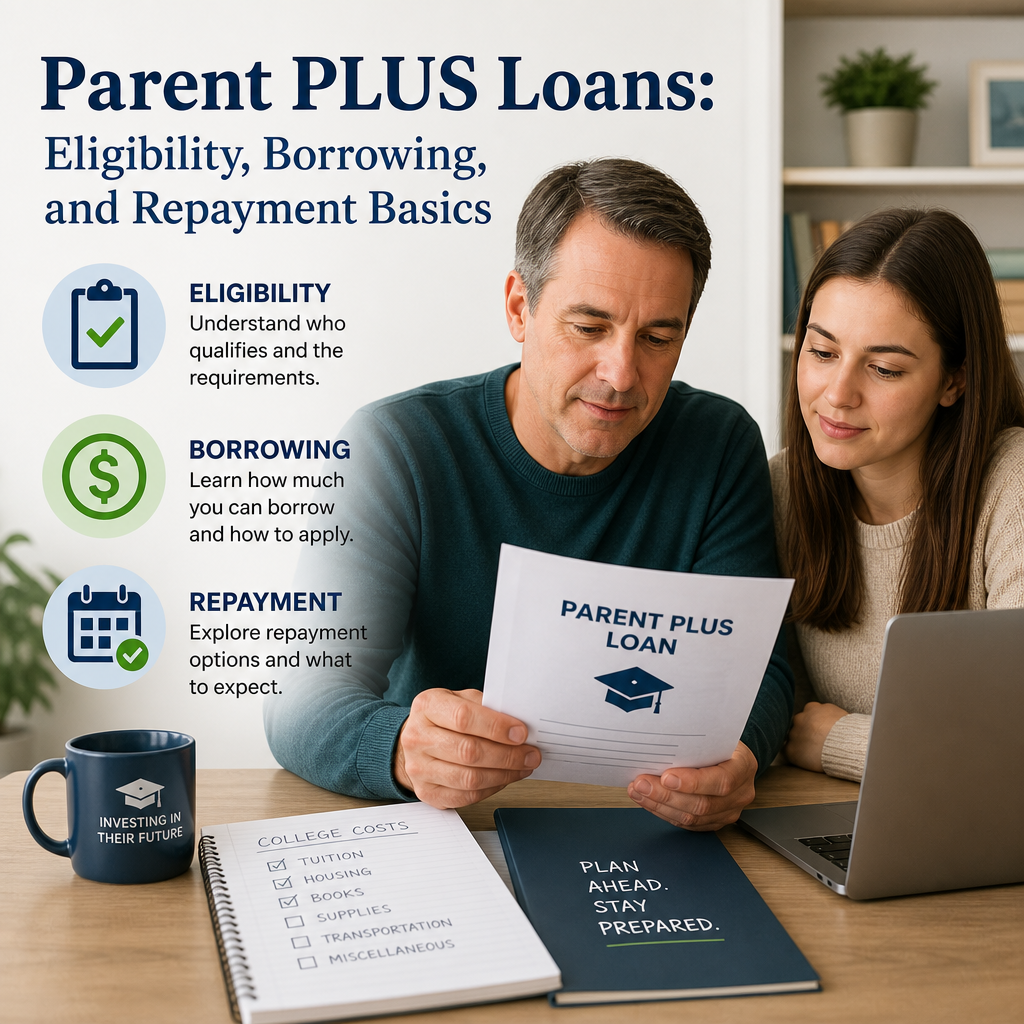
Parent PLUS Loans: Eligibility, Borrowing, and Repayment Basics
Parent PLUS Loans can help bridge the gap when federal aid and savings fall short, but understanding who qualifies, how much you can borrow, and what repayment may look like is key. This guide breaks down the basics so you can decide whether Parent PLUS Loans are the right fit for your family.
By: Jennifer Collins - Education on July 28, 2026
Paying for college can be stressful for any family, and federal student aid does not always cover the full bill. That is where Parent PLUS Loans can come into the picture. These federal loans let eligible parents borrow money to help pay for a dependent undergraduate student’s education costs. Before you apply, though, it is important to understand Parent PLUS Loans eligibility, how borrowing works, and what repayment can look like after disbursement.
This guide breaks down the basics in plain English so you can make a more informed decision. Whether you are comparing federal loan options, planning for college costs, or trying to understand repayment terms, knowing how Parent PLUS Loans work can help you avoid surprises later.
What Are Parent PLUS Loans?
Parent PLUS Loans are federal Direct PLUS Loans made to the parents of dependent undergraduate students. They are designed to help cover the gap between the cost of attendance and other financial aid received.
Unlike private parent loans, Parent PLUS Loans come from the U.S. Department of Education. That means they have fixed rules, federal protections, and repayment options that may be more flexible than many private loans.
What can Parent PLUS Loans cover?
These loans can be used for educational expenses such as:
Tuition and fees
Room and board
Books and supplies
Transportation
Other school-related costs
The school sets the maximum amount you can borrow based on the student’s cost of attendance minus other financial aid. In other words, the loan is meant to fill a financing gap, not exceed the actual cost of attendance.
Parent PLUS Loans Eligibility Requirements
To qualify for Parent PLUS Loans, both the parent borrower and the student must meet certain conditions. The rules are straightforward, but they matter.
Who can apply?
You may apply if you are:
The biological or adoptive parent of a dependent undergraduate student
In some cases, a stepparent, if you are married to the student’s custodial parent and meet federal aid requirements
Grandparents, legal guardians, and other relatives generally are not eligible to borrow Parent PLUS funds unless they have legally adopted the student.
Student eligibility basics
The student must:
Be enrolled at least half-time in an eligible program
Be a dependent undergraduate student for federal aid purposes
Meet general federal student aid requirements
Credit requirements
One of the biggest differences between Parent PLUS Loans and other federal loans is the credit check. You do not need excellent credit, but you cannot have an adverse credit history.
An adverse credit history may include:
Recent delinquent accounts
Bankruptcy, foreclosure, repossession, or tax liens
Certain defaulted debts or other serious negative credit events
If your credit does not meet the standard, you may still qualify by:
Getting an endorser, similar to a cosigner, who does not have adverse credit
Documenting extenuating circumstances to the Department of Education’s satisfaction
Citizenship and other federal requirements
You must also meet the basic federal aid requirements, which typically include:
Being a U.S. citizen or eligible noncitizen
Having a valid Social Security number
Not being in default on other federal student aid
Meeting any other applicable federal aid conditions
How Parent PLUS Loans Work
Once approved, Parent PLUS Loans are sent directly to the school. The school applies the funds to the student’s account first, and any remaining amount is usually refunded to the borrower or student, depending on school procedures.
Key features of Parent PLUS Loans
Some important features include:
Fixed interest rate: The rate is set by the federal government and remains the same for the life of the loan
Loan fee: Federal loans include an origination fee, which is deducted from the disbursement amount
Borrowing limit: You can borrow up to the school’s cost of attendance minus other aid
No annual aggregate limit: You can potentially borrow each year if eligible, though total borrowing is still tied to the cost of attendance
Because interest starts accruing once the loan is disbursed, the balance can grow during school if payments are deferred.
A simple example
Suppose a student’s school lists a cost of attendance of $35,000 for the academic year. The student receives $20,000 in grants and scholarships plus $5,000 in other federal loans.
That leaves a remaining gap of $10,000. A parent may borrow up to that amount through a Parent PLUS Loan, as long as eligibility is met and the loan is approved.
Borrowing Smart: Before You Take Out Parent PLUS Loans
Borrowing for college should always be a careful decision. Parent PLUS Loans can be useful, but they also create long-term debt for the parent, not the student.
Ask these questions first
Before borrowing, consider:
How much of the bill is truly necessary to borrow?
Can the family contribute from savings, income, or a payment plan?
Are scholarships, grants, or lower-cost schools still available?
Would a smaller federal loan or student borrowing plan reduce total debt?
Compare Parent PLUS Loans with other options
A Parent PLUS Loan may not be the only path. Depending on your situation, you might also evaluate:
Federal Direct Subsidized and Unsubsidized Loans in the student’s name
State aid or institutional grants
Work-study opportunities
Private student loans, though these often have fewer protections
Payment plans offered by the school
Federal student loans in the student’s name may offer more borrower-focused repayment options. Parent PLUS Loans can still make sense when parents want to keep the debt in their own name, but the tradeoff is that repayment responsibility stays with the parent.
Borrow only what you need
It can be tempting to borrow the full available amount, especially when college expenses pile up. But interest and fees make every borrowed dollar more expensive over time.
A practical approach is to:
Review the school’s full cost of attendance
Subtract grants, scholarships, and other aid
Cover remaining costs with savings or income if possible
Borrow only the minimum amount needed for the semester or year
Parent PLUS Loans Repayment Basics
Repayment is one of the most important parts of the decision. The parent borrower is legally responsible for repaying the loan, even though the funds support the student’s education.
When repayment begins
In general, repayment starts after the loan is fully disbursed. However, parents may be able to request a deferment while the student is enrolled at least half-time and for a period after that.
If repayment is deferred, interest continues to accrue. That means the loan balance may grow before you make the first payment.
Standard repayment terms
Parent borrowers are usually placed on a standard repayment plan with a fixed monthly payment over 10 years. Depending on the total balance, this may create a larger monthly payment than some families expect.
The amount due will depend on:
Total borrowed
Interest rate
Fees
Whether interest was allowed to accrue during deferment
Repayment options
Parent PLUS borrowers may have access to different repayment approaches, including:
Standard Repayment Plan
Graduated Repayment Plan
Extended Repayment Plan if loan balance qualifies
Income-Contingent Repayment (ICR) after consolidating into a Direct Consolidation Loan
That last option is especially important. Parent PLUS Loans themselves are not eligible for income-driven repayment plans directly. However, if a parent consolidates the loan into a Direct Consolidation Loan, they may become eligible for ICR.
Deferment and forbearance
If you need a temporary break from payments, federal rules may allow:
Deferment while the student is enrolled at least half-time and in some other qualifying situations
Forbearance if you are experiencing financial hardship or another approved circumstance
Keep in mind that interest can continue during both deferment and forbearance, especially on unsubsidized federal loans like Parent PLUS Loans.
Pros and Cons of Parent PLUS Loans
Like any borrowing decision, Parent PLUS Loans have both advantages and drawbacks.
Potential advantages
Federal loan protections
Fixed interest rate
Ability to borrow up to remaining educational need
No need for student credit history
Possible access to deferment and certain repayment options
Potential drawbacks
Credit check required
Parent, not student, is legally responsible
Interest starts accruing immediately
Fees increase the cost of borrowing
Repayment may stretch family finances after graduation
For some families, the federal structure and borrowing flexibility make Parent PLUS Loans a practical solution. For others, the monthly payment may be too heavy, especially if there are multiple children in college or if retirement is near.
Tips for Managing Parent PLUS Loan Debt
If you decide to borrow, a few practical habits can help keep the loan manageable.
1. Track each loan separately
If you borrow over multiple years, keep records of:
Loan amount
Disbursement date
Interest rate
Repayment start date
Servicer contact information
2. Start paying interest early if possible
Even small payments while the student is in school can reduce the amount of interest that capitalizes later.
3. Create a repayment plan before borrowing
Before accepting the loan, estimate what the monthly payment might be after graduation or after deferment ends. This helps prevent last-minute budget shocks.
4. Reevaluate every year
A freshman-year borrowing plan may not fit your situation four years later. Reassess costs annually and look for ways to reduce borrowing.
5. Communicate with your loan servicer
If repayment becomes difficult, contact the servicer early. Acting quickly may open more options than waiting until the loan becomes delinquent.
Common Mistakes to Avoid
Borrowers often run into trouble by overlooking a few key details.
Mistake 1: Assuming the student will repay it
A Parent PLUS Loan is the parent’s debt. Even if everyone agrees the student will help, the legal obligation remains with the borrower.
Mistake 2: Ignoring fees and interest
The headline loan amount is not the full cost. Origination fees reduce the amount received, and interest adds to the total over time.
Mistake 3: Borrowing for more than the family can handle
It is wise to think beyond the current school year. Ask whether the loan is still manageable if there are job changes, medical expenses, or other family obligations.
Mistake 4: Missing repayment or deferment paperwork
If you want deferment, forbearance, or a repayment option, be sure you submit the right request forms on time.
Frequently Asked Questions
1. Can parents borrow Parent PLUS Loans for any college?
No. The school must participate in the federal student aid program, and the student must be enrolled at least half-time in an eligible undergraduate program. The loan is tied to attendance at a qualifying school.
2. Do Parent PLUS Loans require a cosigner?
Not usually, but if you have adverse credit history, you may need an endorser to qualify. An endorser is similar to a cosigner, though federal rules treat it differently.
3. Can a parent transfer the loan to the student later?
No, Parent PLUS Loans are legally the parent’s responsibility. Some families refinance with a private lender later, but that is not the same as a federal transfer and may remove federal protections.
4. Are Parent PLUS Loans eligible for forgiveness?
In some cases, yes. Parent PLUS Loans may qualify for federal loan forgiveness programs if certain requirements are met, such as working in public service after consolidation into a Direct Consolidation Loan and meeting program rules. Eligibility can be complex, so borrowers should review the program carefully.
5. What happens if I can’t make payments?
Contact your loan servicer as soon as possible. You may be able to request forbearance, explore deferment, or consider consolidation and another repayment option. Waiting too long can lead to delinquency or default, which can damage your credit and financial stability.
Parent PLUS Loans can be a valuable way to bridge the gap between college costs and other financial aid, but they are not a decision to make lightly. Because the parent borrower is fully responsible for repayment, it helps to understand the eligibility rules, borrowing limits, interest charges, and repayment choices before accepting the loan.
The most responsible approach is to borrow with a clear plan. Estimate the total cost, compare alternatives, and think through how the monthly payment may affect your household budget after the student graduates. If you do move forward, stay organized, monitor your loan servicing information, and pay attention to deferment or repayment deadlines.
Used wisely, Parent PLUS Loans can help a student stay on track academically without creating avoidable financial stress. The key is to treat the loan as a long-term family commitment, not just a short-term solution. Review the facts, ask questions early, and make each borrowing decision with the future in mind.
Jennifer, M.Ed., holds a degree in Higher Education Administration, with
a focus on U.S. college financial aid, admissions policy, and student
support systems. She researches and writes about scholarships, federal
aid programs, and the college planning process to help students and
families make informed, well-supported decisions.