How to Compare Auto Loans and Avoid Costly Financing Mistakes
Learn how to compare auto loans the smart way so you can spot hidden costs, avoid costly financing mistakes, and choose the best deal with confidence. By looking beyond the monthly payment and focusing on APR, terms, fees, and total repayment, you can save money and make a better car-buying decision.
By: Mary Mitchell on July 28, 2026
Shopping for a car is exciting, but the financing can make or break the deal. If you want to save money and avoid stress, you need to know how to compare auto loans before signing anything. A low monthly payment can look appealing, but it may hide a longer term, higher interest charges, or expensive add-ons that increase the true cost of the vehicle.
The good news is that comparing auto loans is straightforward once you know what to look for. By focusing on the right details—interest rate, loan term, fees, and total repayment—you can make a smart decision and avoid common financing mistakes that many buyers regret later.
How to Compare Auto Loans the Right Way
When buyers compare auto loans, they often focus on just one number: the monthly payment. That’s a mistake. A payment that seems affordable today can cost much more over time if the loan term is too long or the APR is high.
A better approach is to compare the entire loan offer, not just the monthly amount. That means reviewing:
Annual percentage rate (APR)
Loan term
Monthly payment
Total interest paid
Fees and add-ons
Prepayment rules
Lender reputation and flexibility
If you compare these factors side by side, you’ll have a much clearer picture of which loan is actually the best deal.
Start with the APR, not the monthly payment
The APR is one of the most important numbers in an auto loan comparison because it reflects the cost of borrowing, including certain fees. Two loans can have the same monthly payment but very different APRs and total costs.
For example:
Loan A: lower payment, longer term, higher total interest
Loan B: slightly higher payment, shorter term, lower total cost
Loan B may be the better choice even though it feels less comfortable month to month.
Compare loan terms carefully
The loan term is the number of months you have to repay the loan. Common terms include 36, 48, 60, 72, and sometimes 84 months.
Longer terms usually mean:
Lower monthly payments
More interest paid over the life of the loan
Greater risk of owing more than the car is worth
Shorter terms usually mean:
Higher monthly payments
Less total interest
Faster payoff and less financial risk
A longer term can be useful if you need to keep payments manageable, but it should be a deliberate choice—not the default option.
Key Factors to Compare Before You Sign
To truly compare auto loans, you need more than a rate quote. Here are the main elements that affect the real cost of financing.
Interest rate vs. APR
People often use these terms interchangeably, but they are not the same.
Interest rate: the basic cost of borrowing the money
APR: the interest rate plus certain lender fees, giving a more complete view of loan cost
When possible, compare APRs across lenders. That gives you a more apples-to-apples comparison.
Total loan cost
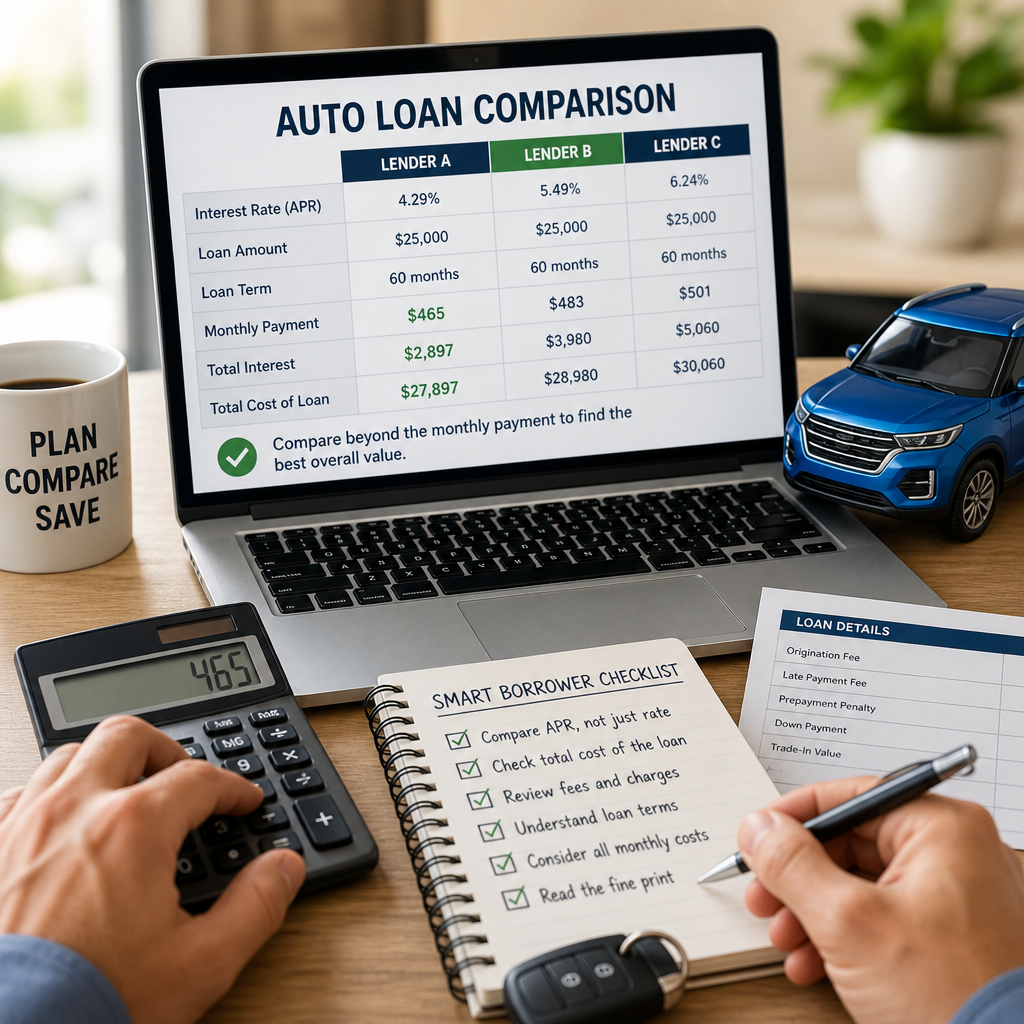
The total amount you repay over time matters more than the monthly payment alone. A loan with a low monthly bill can still be expensive if the term is stretched out.
To estimate total cost, multiply the monthly payment by the number of months in the term. Then compare that number to the amount borrowed.
A practical example:
$25,000 loan at a low monthly payment over 84 months may cost much more than
the same loan over 60 months with a higher payment but lower total interest
Fees and extra charges
Some auto loans include fees that can increase your borrowing cost. Watch for:
Origination fees
Documentation fees
Prepayment penalties
Late payment fees
Required add-on products
Dealership financing may also include administrative or processing charges. Always ask for a full breakdown.
Prepayment flexibility
If you plan to pay off your loan early, check whether the lender charges a prepayment penalty. Some lenders allow extra payments with no penalty, while others limit flexibility.
A loan without prepayment penalties gives you more control. If your budget improves later, you can reduce interest by paying down the principal faster.
Down payment requirements
A larger down payment can lower the amount you need to finance, reduce monthly payments, and shrink the total interest paid.
It can also help prevent negative equity, which happens when you owe more on the vehicle than it is worth. This is especially important if you’re buying a car that depreciates quickly.
Where to Get Auto Loan Quotes
When you compare auto loans, it helps to gather quotes from multiple sources instead of relying on the first offer you receive.
Banks
Banks often offer competitive rates, especially if you have a solid credit profile or an existing relationship with the institution. They may also provide more predictable loan terms and clear disclosures.
Credit unions
Credit unions are known for member-focused lending and may offer lower rates or fewer fees than other lenders. If you qualify for membership, it’s worth checking their offers.
Online lenders
Online lenders can be convenient and fast. They often let you prequalify without affecting your credit score, which makes early comparison easier.
Dealership financing
Dealer financing can be convenient because you can arrange everything in one place. However, it’s smart to treat dealership offers as one option among several, not as your only choice.
Dealers may earn compensation from the financing they arrange, so the offer is not always the best available rate.
Common Auto Financing Mistakes to Avoid
Even careful shoppers can make costly errors when financing a car. The following mistakes are among the most common.
Focusing only on the monthly payment
A low payment may look attractive, but it can hide a long repayment term or a higher interest rate. Always ask what the total cost of the loan will be.
Skipping prequalification
Prequalification can help you estimate what rates and terms you may qualify for before you shop. It also gives you a benchmark when comparing dealer financing.
Not checking your credit beforehand
Your credit score heavily influences the rates you’re offered. Reviewing your credit before applying gives you time to correct errors and understand where you stand.
Buying too much car
It’s easy to get persuaded into a more expensive vehicle than your budget can support. A larger loan means more interest and a bigger financial commitment.
A useful rule of thumb: base your decision on a payment you can comfortably afford, not the highest amount a lender approves.
Rolling negative equity into a new loan
If you still owe money on your current car, some dealers may offer to roll the remaining balance into a new loan. This can create a larger loan balance and leave you upside down from day one.
Ignoring add-ons
Extended warranties, gap insurance, paint protection, and service plans can sometimes be valuable, but they also raise the total cost. Review each product separately and decide whether it truly fits your needs.
Not reading the contract
Loan documents contain important details about interest rate, fees, due dates, and default terms. Never sign until you understand every section.
How to Compare Auto Loans Step by Step
A simple process can help you stay organized and avoid emotional decisions at the dealership.
1. Check your credit
Before you apply, review your credit reports and scores. Look for:
Errors
Delinquent accounts
High credit card balances
Issues that could lower your score
If your credit needs improvement, take time to reduce balances or fix mistakes before applying.
2. Set a realistic budget
Decide how much you can afford to spend each month on the car payment, insurance, fuel, maintenance, and registration. The loan payment should fit comfortably within your overall budget.
3. Get quotes from several lenders
Request offers from at least three lenders if possible. Compare them using the same loan amount and term so the results are easier to evaluate.
4. Compare the full loan terms
Look beyond the interest rate. Review:
APR
Monthly payment
Loan term
Total repayment
Fees
Penalties
Required insurance or add-ons
5. Use the best offer as leverage
If a dealership gives you financing, compare it to your outside quotes. A preapproved loan can give you negotiating power and may help you secure better terms.
6. Read the final contract line by line
Before you sign, verify that the contract matches the offer you were shown. Pay attention to any changes in:
APR
Loan length
Down payment
Add-ons
Monthly payment
If something changed, ask for an explanation before proceeding.
Signs a Loan Might Be a Bad Deal
Sometimes an offer looks fine at first glance but contains red flags. Be cautious if you notice any of the following:
The monthly payment is unusually low, but the term is very long
The APR is much higher than competing offers
The lender avoids giving clear written details
You’re pressured to sign immediately
The contract includes products you didn’t ask for
The dealership changes terms after you’ve negotiated
You’re encouraged to focus only on the payment, not the total cost
If a deal feels rushed or unclear, step back. A better offer is usually available.
Practical Example: Comparing Two Auto Loans
Suppose you’re financing $24,000.
Offer A
APR: 7.5%
Term: 72 months
Monthly payment: lower
Total interest: higher
Offer B
APR: 6.4%
Term: 60 months
Monthly payment: slightly higher
Total interest: lower
Offer A may feel easier month to month, but Offer B could save you a meaningful amount over the life of the loan. This is why learning how to compare auto loans matters: the cheapest-looking option is not always the cheapest overall.
Smart Ways to Save on Auto Financing
Once you understand the basics, a few smart habits can help you lower your borrowing costs.
Improve your credit before applying
Even modest credit improvements can help you qualify for better terms. Paying down balances, making on-time payments, and correcting errors can all help.
Increase your down payment
The more you put down, the less you need to borrow. That can reduce both your monthly payment and the amount of interest you pay.
Choose a shorter loan term if possible
A shorter term may stretch your budget a bit, but it can save money in the long run.
Avoid unnecessary add-ons
Only buy extras that provide real value. If you’re unsure, ask for time to review the product before agreeing.
Compare financing before visiting the dealership
Walking into the dealership with a preapproval or a clear sense of market rates puts you in a stronger position.
Frequently Asked Questions
What is the best way to compare auto loans?
The best way is to compare the APR, loan term, monthly payment, total repayment, fees, and any penalties side by side. Don’t judge a loan based on the monthly payment alone. A lower payment can sometimes mean a longer loan term and more interest overall.
Is dealership financing always more expensive?
Not always, but dealership financing should be compared with offers from banks, credit unions, and online lenders. Some dealer promotions are competitive, especially for well-qualified borrowers, but others include higher rates or added products that increase the total cost.
Should I get preapproved before shopping for a car?
Yes, preapproval is often a smart move. It gives you a baseline for comparison, helps you understand what you can afford, and may improve your negotiating position. It can also save time at the dealership.
How does my credit score affect auto loan rates?
Lenders use your credit score to assess risk. In general, stronger credit can help you qualify for lower rates and better terms, while weaker credit may lead to higher rates or stricter requirements. Checking your credit before applying can help you prepare.
Is a longer auto loan term ever a good idea?
A longer term can make sense if you need a lower monthly payment and you understand the tradeoff. However, longer terms usually increase total interest and can leave you with little or no equity in the vehicle for a longer period. If you choose a long term, make sure it fits your budget and financial goals.
Knowing how to compare auto loans can save you money, reduce stress, and help you make a smarter purchase. The key is to look beyond the monthly payment and examine the full picture: APR, loan term, total repayment, fees, and flexibility. When you compare offers from multiple lenders, check your credit ahead of time, and avoid dealership pressure, you put yourself in a much stronger position.
A good auto loan should support your budget, not strain it. It should fit your financial goals and give you room to handle insurance, maintenance, and everyday expenses without worry. Take your time, review every detail, and don’t be afraid to walk away from a deal that doesn’t make sense.
The more informed you are, the easier it becomes to spot financing mistakes before they cost you. Use the strategies in this guide as a checklist, and you’ll be well prepared to choose an auto loan with confidence.
Mary S, CFP®, is a Certified Financial Planner with over 12 years of experience in personal finance, retirement planning, and wealth management. She writes educational content that helps readers understand financial concepts and make informed decisions based on reliable information.