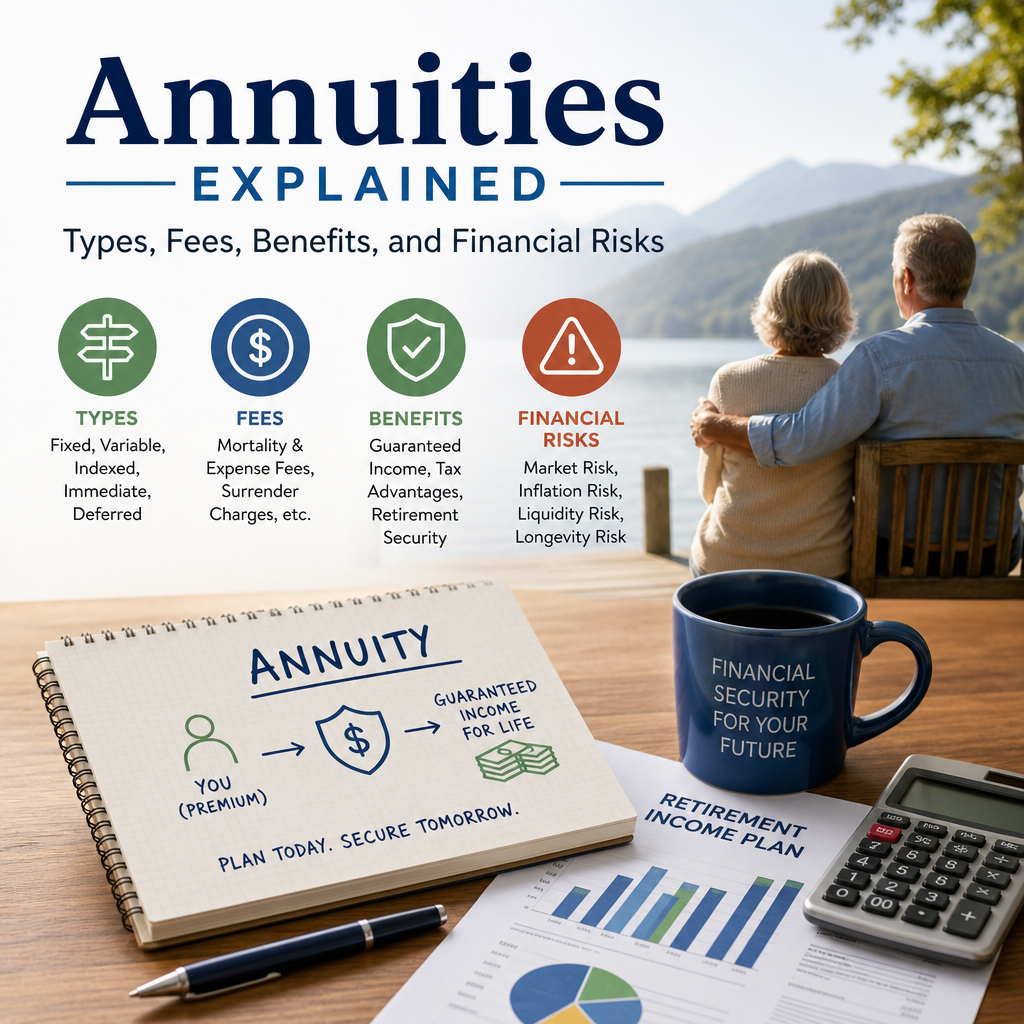
Annuities Explained: Types, Fees, Benefits, and Financial Risks
Annuities explained simply: they can turn savings into steady retirement income, but the right choice depends on the type, fees, and risks involved. Before you buy, it helps to understand how each annuity works and whether the tradeoffs fit your financial goals.
By: Mary Mitchell on July 28, 2026
Annuities often come up in retirement planning conversations, but many people still find them confusing. At a basic level, an annuity is a financial contract designed to provide income, usually later in life. For some retirees, that steady income can help reduce stress and create a more predictable budget. For others, the fees, restrictions, and tradeoffs make annuities less attractive than other options.
Understanding how annuities work is essential before putting money into one. The contract structure, payout method, insurance guarantees, and investment features can vary widely from product to product. That means two annuities may look similar at first glance but function very differently in practice.
This guide breaks down the main types of annuities, common fees, potential benefits, and important financial risks so you can evaluate whether an annuity fits your retirement goals.
What Is an Annuity?
An annuity is a contract, usually sold by an insurance company, that can turn a lump sum or a series of payments into income over time. People often use annuities to create a paycheck-like stream in retirement.
In general, annuities fall into two phases:
Accumulation phase: You contribute money and it grows according to the contract terms.
Distribution phase: You receive payments, either for a set period or for life.
Some annuities begin paying income right away. Others defer payments until a future date. The exact structure matters because it affects growth potential, tax treatment, income timing, and risk exposure.
Main Types of Annuities
There are several major annuity categories, and each serves a different purpose.
Immediate Annuities
An immediate annuity starts income payments soon after you make a lump-sum purchase, often within a year.
This type may appeal to someone who wants to convert savings into predictable income quickly. It is commonly used by retirees who are looking for simplicity and guaranteed cash flow.
Best for:
Retirees needing income now
People seeking stable payments
Those who do not want to manage investments themselves
Deferred Annuities
A deferred annuity delays payments until a later date. During the deferral period, the money may grow tax-deferred, depending on the contract type.
This option can work well for long-term planning, especially if you do not need the money immediately.
Best for:
People planning for future retirement income
Investors who want tax-deferred growth
Those comfortable locking money away for a while
Fixed Annuities
A fixed annuity offers a guaranteed rate of return for a set period. The insurance company takes on the investment risk, which gives the contract more predictability.
This can be attractive if you want stability rather than market exposure.
Potential advantages:
Predictable growth
Less market volatility
Easier to understand than more complex products
Variable Annuities
A variable annuity allows you to invest in subaccounts, which are similar to mutual funds. Your value and future payouts depend partly on market performance.
Because of that exposure, variable annuities can offer higher growth potential, but they also carry more risk.
Potential advantages:
Market-based growth potential
Tax-deferred accumulation
Optional riders for income or death benefits
Indexed Annuities
An indexed annuity links returns to a market index, such as the S&P 500, while usually providing some downside protection. These products often use formulas, caps, participation rates, or spreads to determine how much of the index gain you may receive.
Indexed annuities are often marketed as a middle ground between fixed and variable products, but their design can be complicated.
Key point: The growth potential may be limited, and the crediting method deserves careful review.
How Annuity Payments Work
Annuity payouts can be structured in different ways. Choosing the right payment option affects how long income lasts and what happens after you die.
Common Payout Options
Lifetime income
Payments continue for as long as you live.
Joint-and-survivor income
Payments continue for two lives, often a spouse and primary annuitant.
Period certain payouts
Payments last for a fixed number of years.
Lump-sum withdrawal
You may take some or all of the value out, depending on the contract terms and surrender rules.
Systematic withdrawals
You withdraw a set amount periodically rather than annuitizing the contract.
Some contracts include optional features called riders, such as guaranteed lifetime withdrawal benefits or death benefits. These features can add flexibility, but they usually increase costs.
Fees and Costs to Watch
One of the most important parts of understanding annuities is knowing the fees. Costs can reduce returns and make a product much more expensive than it first appears.
Common Annuity Fees
Mortality and expense risk charges
These help cover insurance company risks and administrative costs, especially in variable annuities.
Administrative fees
Charged for recordkeeping, contract management, and customer service.
Underlying fund expenses
In variable annuities, the investment subaccounts have their own expense ratios.
Surrender charges
Penalties for withdrawing money during the early years of the contract.
Rider fees
Extra charges for income guarantees, death benefits, or long-term care features.
Market value adjustments
Some fixed annuities include adjustments that can reduce or increase withdrawal value depending on interest rates.
Why Fees Matter
Fees do not just reduce returns in the short term. Over time, they can significantly affect how much income the contract produces. A product with appealing guarantees may still be a poor fit if the total cost is too high for your situation.
Before buying, ask for a full breakdown of:
Annual charges
Surrender schedule
Rider costs
Withdrawal limits
Bonus conditions
Income calculation rules
Benefits of Annuities
For the right person, annuities can be useful retirement tools. They are not ideal for everyone, but they do offer some important advantages.
1. Predictable Income
The biggest selling point of many annuities is the ability to create a reliable income stream. That can help cover essential expenses like housing, food, and medical costs.
2. Tax-Deferred Growth
Many deferred annuities grow tax-deferred, meaning you do not pay taxes on earnings until you withdraw money. That feature can help money compound over time.
3. Lifetime Income Options
Some annuities offer income that lasts for life, which can reduce the chance of outliving your savings. For people worried about longevity risk, that can be a major benefit.
4. Protection From Market Volatility
Fixed annuities and some indexed annuities may help reduce exposure to stock market swings. That can be comforting for conservative investors or retirees who want more stability.
5. Estate Planning Features
Certain contracts include death benefits or beneficiary options. These can help transfer remaining value to heirs, depending on contract terms.
Financial Risks and Tradeoffs
The benefits of annuities are real, but so are the risks. A smart buyer looks at both sides before making a commitment.
Liquidity Risk
Many annuities lock up money for years. If you need access to your funds during the surrender period, you may face penalties.
That can be a problem if:
Your emergency savings are low
You may need cash for healthcare or family needs
You expect large near-term expenses
Inflation Risk
Some annuity payments may lose purchasing power over time if they do not increase with inflation. A fixed payment that looks comfortable today may feel smaller in 10 or 20 years.
Complexity Risk
Annuity contracts can be difficult to compare. Indexing formulas, rider rules, caps, and exclusions can make the fine print hard to interpret.
This complexity can create confusion and increase the chance of buying the wrong product.
Opportunity Cost
Money placed into an annuity is money you cannot use for other investments. If the contract offers limited upside, you may miss out on higher returns elsewhere.
Insurance Company Risk
Annuities are backed by the issuing insurance company, so the company’s financial strength matters. State guaranty associations may offer limited protection, but they are not a substitute for evaluating the insurer carefully.
Who Might Benefit From an Annuity?
Annuities may make sense for people who want a predictable income floor in retirement. They can also help investors who are uncomfortable managing withdrawals from an investment portfolio.
An annuity may be worth considering if you:
Want to supplement Social Security or a pension
Need guaranteed income for essential expenses
Prefer a conservative approach to retirement planning
Are willing to give up liquidity for long-term stability
An annuity may be less suitable if you:
Need flexible access to your money
Want low-cost investing
Prefer full control over your portfolio
Are still in the early stages of retirement saving
Questions to Ask Before Buying an Annuity
Before signing any contract, take time to review the details carefully. A good annuity decision starts with clear answers.
Ask These Questions
What problem is this annuity solving?
What are the total fees, including riders and fund expenses?
How long is the surrender period?
Can I withdraw money without penalties, and if so, how much?
How are payouts calculated?
What happens if I die early?
What financial strength rating does the insurer have?
How does this compare with simply investing the money elsewhere?
If the answers are unclear, ask for the contract summary and prospectus or disclosure documents. If needed, consider speaking with a fiduciary financial professional.
Annuities vs. Other Retirement Income Options
Annuities are only one way to create retirement income. They often get compared with bonds, dividend-paying investments, CDs, and systematic portfolio withdrawals.
Annuities
Pros:
Guaranteed income options
Can provide lifetime payments
Helps reduce longevity risk
Cons:
Can be expensive
Often less liquid
Contract terms may be complex
Bonds and Bond Funds
Pros:
Can provide income
Typically more transparent
Easier to trade or sell
Cons:
No lifetime guarantee
Interest rate risk
Market value can fluctuate
Withdrawal Strategy From a Portfolio
Pros:
Flexible access to money
Full control over investments
Potential for growth
Cons:
No guaranteed lifetime income
Requires discipline and ongoing management
Market downturns can hurt withdrawals
A balanced retirement plan may use more than one approach. Some people combine a modest annuity with investments and cash reserves to create both stability and flexibility.
How to Evaluate Whether an Annuity Fits Your Plan
A useful annuity decision starts with your goals, not the product brochure.
A Practical Process
Define your income needs
List essential monthly expenses.
Identify gaps between guaranteed income and spending needs.
Review your time horizon
Determine when you need income.
Consider how long the contract locks up your money.
Check your liquidity needs
Keep emergency savings separate.
Avoid overcommitting funds you may need soon.
Compare costs and guarantees
Look at total fees, not just the advertised rate.
Understand what is actually guaranteed.
Evaluate the insurer
Review ratings and reputation.
Read contract disclosures carefully.
Consider tax implications
Tax-deferred growth can be helpful.
Withdrawals may be taxed as ordinary income.
Frequently Asked Questions
What is the main purpose of an annuity?
The main purpose of an annuity is to convert savings into a stream of income, often for retirement. Some annuities begin paying right away, while others grow tax-deferred and pay later. Many people use them to reduce the risk of running out of money in old age.
Are annuities a good investment?
Annuities are not really a one-size-fits-all investment. They can be useful for people who want guaranteed income and stability, but they may be less attractive if you want low fees, high liquidity, or full control over your money. The right choice depends on your financial goals and tolerance for restrictions.
What are the biggest risks of annuities?
The biggest risks include high fees, limited access to your money, inflation, and complicated contract terms. In some cases, market exposure or insurer strength also matters. A buyer should understand all terms before committing funds.
Can you lose money in an annuity?
Yes, depending on the type of annuity and the timing of withdrawals. Fixed annuities usually offer more stability, while variable annuities can lose value if the market declines. Early withdrawals may also trigger surrender charges, which can reduce what you receive.
How are annuities taxed?
Tax treatment depends on whether the annuity is qualified or nonqualified. In many cases, earnings grow tax-deferred, but withdrawals are generally taxed as ordinary income. Because tax rules can be complex, it helps to review the contract and speak with a tax professional if needed.
Annuities can be powerful retirement tools, but only when they match your goals, time horizon, and need for predictable income. They can help create stability, offer tax-deferred growth, and provide lifetime payment options that reduce the fear of outliving savings. At the same time, they often come with fees, surrender periods, and contract rules that can limit flexibility.
The best way to evaluate an annuity is to look beyond the sales pitch and focus on the details that affect your bottom line. Compare the total cost, understand the payout structure, ask about liquidity restrictions, and review the insurer’s financial strength. If you already have a solid emergency fund and a clear retirement income plan, an annuity may serve as one piece of a larger strategy. If you need flexibility or low-cost growth, other options may fit better.
In the end, the right annuity decision is a personal one. Take the time to understand how the product works, what it guarantees, and what it asks you to give up. That careful approach can help you protect your retirement income and make a more confident financial choice.
Mary S, CFP®, is a Certified Financial Planner with over 12 years of experience in personal finance, retirement planning, and wealth management. She writes educational content that helps readers understand financial concepts and make informed decisions based on reliable information.