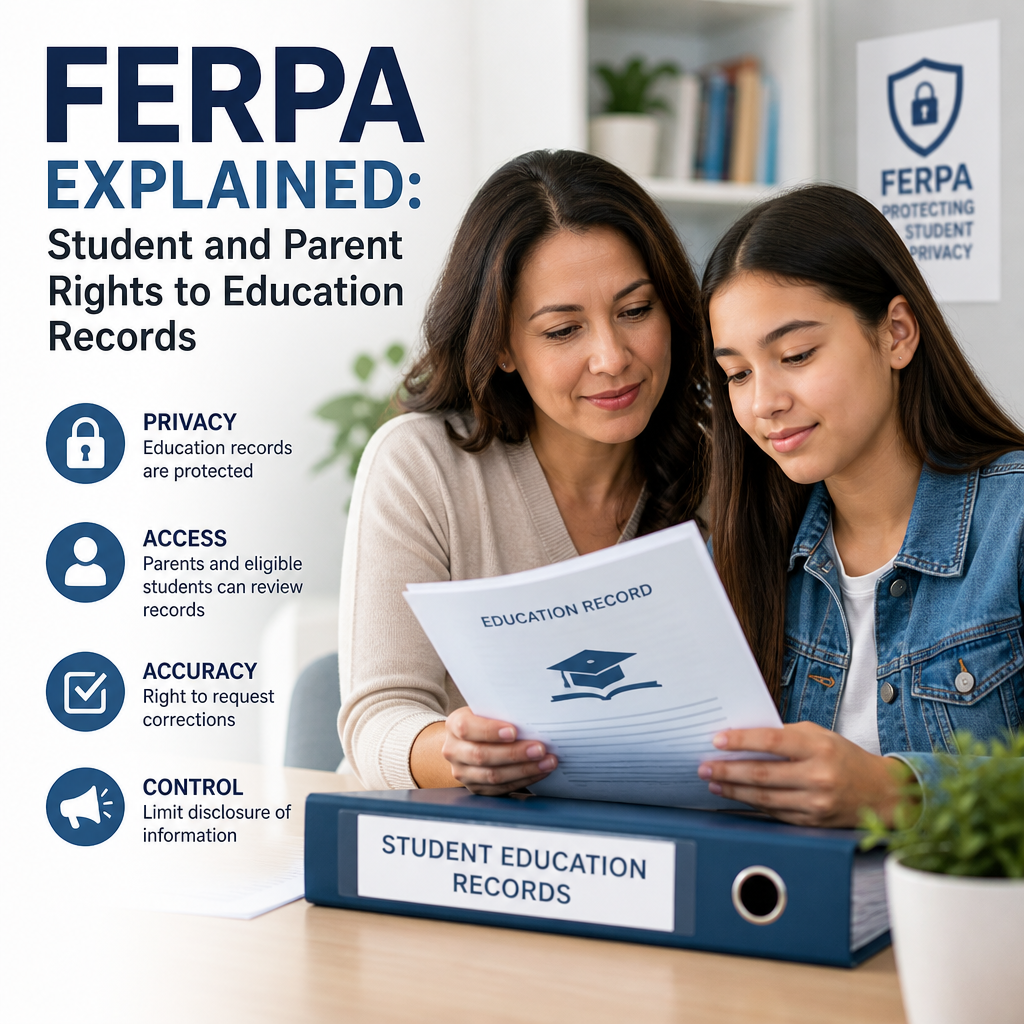
FERPA Explained: Student and Parent Rights to Education Records
FERPA rights help parents and students understand who can access education records, how to review them, and when schools must keep information private. In this guide, we break down the basics in plain English so you can better protect your child’s personal information.
By: Jennifer Collins - Education on July 28, 2026
When families talk about school privacy, FERPA is one of the most important laws to understand. Short for the Family Educational Rights and Privacy Act, FERPA gives parents—and later students themselves—important rights over education records. If your child is in school, applying to college, or transitioning into adulthood, knowing how FERPA works can help you protect personal information and make informed decisions.
This guide breaks down FERPA explained in plain English. You’ll learn what education records are, who has access to them, what rights parents and students have, and how schools are expected to protect privacy.
What Is FERPA?
FERPA is a federal law that applies to most schools, colleges, and universities that receive funds from the U.S. Department of Education. Its main purpose is to protect the privacy of student education records.
At a high level, FERPA gives eligible parents and students the right to:
Inspect and review education records
Request corrections to inaccurate or misleading information
Control the disclosure of certain personally identifiable information
File a complaint if they believe a school has violated their rights
FERPA does not make records completely secret. It creates a framework for when schools may share information and when they must keep it private.
What Counts as an Education Record?
Not every document connected to a student is an education record. FERPA generally covers records that are directly related to a student and maintained by a school or a person acting for the school.
Examples often include:
Report cards and transcripts
Attendance records
Class schedules
Disciplinary records
Special education records
Health records maintained by the school
Counseling records kept by the school
Admissions materials for enrolled students
What FERPA Does Not Usually Cover
Some information falls outside FERPA’s definition of education records. Common examples include:
Personal notes kept only by a teacher and not shared with others
Law enforcement unit records
Employment records when the job is not tied to student status
Alumni records after the person is no longer a student
Medical records kept by a doctor or clinic separate from school records
This distinction matters because FERPA only applies to records the school maintains as part of the student’s educational file.
FERPA Explained: Parent Rights Before the Student Turns 18
One of the most common misunderstandings about FERPA is that rights automatically shift at age 18. Age matters, but so does enrollment status. In general, parents have FERPA rights while their child is a dependent or a minor student in K–12 settings.
Rights Parents Typically Have
Parents of minor students usually can:
Review education records
They can request access to grades, attendance, discipline files, and other records maintained by the school.
Ask for corrections
If a record is inaccurate or misleading, parents can request an amendment.
Control certain disclosures
Schools generally need permission before sharing personally identifiable information, unless an exception applies.
Receive directory information notices
Schools must let parents know if they plan to release directory information and provide an opportunity to opt out in some cases.
Practical Example
Suppose a parent wants to see their child’s discipline record after a suspension. Under FERPA, the school generally must allow access, as long as the record qualifies as an education record and no specific exception applies.
What Changes When the Student Turns 18?
Once a student turns 18 or attends a postsecondary institution, FERPA rights usually transfer from the parent to the student. At that point, the student becomes the “eligible student.”
That means the student now has the right to:
Inspect and review their education records
Request corrections
Approve most disclosures of personally identifiable information
File FERPA complaints if needed
Important Exception: Tax Dependency
There is an important exception. If the student is claimed as a dependent for federal tax purposes, colleges and universities may, in some cases, disclose education records to the parent even without the student’s consent.
This does not mean parents automatically get full access to everything. Schools still follow their policies and may require proof of dependency before sharing records.
When Schools Can Share Information Without Consent
FERPA is not an absolute wall. It includes several exceptions that allow schools to disclose records without written consent in certain situations.
Common FERPA Exceptions
Schools may share information without consent in situations such as:
School officials with legitimate educational interests
Another school where the student plans to enroll
Health or safety emergencies
Compliance with a judicial order or lawfully issued subpoena
Directory information, unless the student or parent opts out
Financial aid purposes
Certain disciplinary proceedings involving violent crimes or sex offenses, under specific circumstances
What Is Directory Information?
Directory information is basic information that schools often consider less sensitive, such as:
Name
Address
Phone number
Email address
Date and place of birth
Honors and awards
Dates of attendance
Grade level
Participation in officially recognized activities
Schools must notify families or students about what they classify as directory information and give them a chance to restrict disclosure when required.
How to Review or Correct a Student Record
FERPA gives parents and eligible students a process for requesting access to records and asking for corrections.
Step 1: Submit a Written Request
Start by contacting the school in writing. Ask to review the specific records you want, and keep a copy of your request.
Step 2: Review the Records
Schools generally must provide access within a reasonable period. They may allow onsite review or provide copies, depending on the circumstances.
Step 3: Request an Amendment if Needed
If you believe a record is inaccurate, misleading, or violates privacy rules, ask the school to correct it. Be specific about what should change and why.
Step 4: Follow the School’s Process
If the school refuses to amend the record, it should allow you to request a hearing or formal review. If the dispute continues, you may be able to place a statement of disagreement in the file.
Practical Example
A transcript lists the wrong course grade because of a clerical error. Under FERPA, a parent or eligible student can ask the school to correct the mistake. If the school agrees, it should update the record.
FERPA and Special Education Records
Families of students with disabilities often rely on multiple education laws, including FERPA and the Individuals with Disabilities Education Act (IDEA). These laws work together but serve different purposes.
FERPA protects the privacy of educational records, while IDEA focuses on special education services and procedural safeguards.
Why This Matters
Special education records may include:
Individualized Education Programs (IEPs)
Evaluation reports
Progress monitoring documents
Meeting notes
Related service records
Parents usually have the right to inspect these records while the student is a minor. After rights transfer, the eligible student holds the FERPA rights, though parents may still have access in some situations depending on dependency, school policy, or other laws.
FERPA in K–12 Schools vs. Colleges
FERPA applies in both K–12 and higher education settings, but the experience looks different.
In K–12 Schools
Parents generally play the central role. Schools often communicate directly with parents about grades, attendance, discipline, and services. Even so, schools must still protect education records.
In Colleges and Universities
The student usually controls access to records. Parents may be surprised when a college refuses to release grades or billing-related academic information without consent. This is a normal part of FERPA’s transfer of rights.
Many colleges allow students to sign a release form so parents can view records or speak with the institution. Without that permission, the school may be limited in what it can share.
Common Misunderstandings About FERPA
FERPA is widely discussed, but it is also widely misunderstood. Here are a few myths worth clearing up.
Myth 1: FERPA Means Parents Can Never See School Records
Not true. Parents often can access records for minor students, and in some cases even after the student becomes an adult, depending on dependency or other circumstances.
Myth 2: FERPA Prevents Teachers from Communicating with Parents
Not exactly. Teachers can still communicate about a student’s progress, behavior, and needs as long as they follow school policy and privacy rules.
Myth 3: A School Can Share Nothing at All
Also false. FERPA allows several exceptions, including school officials with legitimate interests, directory information, and emergency situations.
Myth 4: FERPA Covers Social Media Posts About Students
Usually not in the way people assume. If a school’s social media post includes personally identifiable information from education records, privacy concerns may arise. But FERPA’s application depends on the specific facts and what information the school is disclosing.
Tips for Protecting Education Record Privacy
Whether you are a parent or a student, a few practical steps can help you stay in control of education records.
Helpful Best Practices
Read school privacy notices carefully
Ask what counts as directory information
Submit consent forms if you want parents or guardians to access college records
Keep copies of important school communications
Request record corrections promptly if you find an error
Use secure channels when sending sensitive information
Questions to Ask the School
If you are unsure about your rights, ask:
Who can access this record?
Is this considered an education record under FERPA?
What is your process for requesting a copy?
How do I correct inaccurate information?
Can I restrict directory information?
These questions can help you understand how your school handles privacy and record requests.
When to File a FERPA Complaint
If you believe a school has violated FERPA and you cannot resolve the issue directly, you may be able to file a complaint with the U.S. Department of Education.
A complaint may be appropriate if, for example:
The school refused lawful access to records
The school disclosed protected information without an applicable exception
The school did not follow required notice procedures
The school ignored a valid request to amend a record
Before filing, it often helps to keep written documentation of your communication with the school. That record can make it easier to explain what happened.
Frequently Asked Questions
1. Does FERPA apply to private schools?
FERPA generally applies to private schools only if they receive funding from the U.S. Department of Education. Many private K–12 schools do not fall under FERPA unless they participate in federal funding programs covered by the law.
2. Can parents see their college student’s grades?
Usually not without the student’s permission, unless the student is claimed as a dependent for tax purposes or another FERPA exception applies. In college, FERPA rights usually transfer to the student at age 18 or upon attendance at a postsecondary institution.
3. What is the difference between FERPA and HIPAA?
FERPA covers education records maintained by schools. HIPAA covers health information maintained by covered health care providers and insurers. School health records that are part of education records are often covered by FERPA, not HIPAA.
4. Can a school share directory information without consent?
Yes, if the school has designated the information as directory information and has given the required notice. Parents or eligible students may also have a right to opt out in many situations.
5. How do I know if a record is protected by FERPA?
If the record is directly related to a student and maintained by the school or someone acting for the school, it is often an education record under FERPA. If you are unsure, ask the school’s registrar, privacy office, or student services office for clarification.
Understanding FERPA explained in practical terms gives families and students real power. The law is designed to protect education records while still allowing schools to function and communicate in appropriate ways. For parents, FERPA can help you know when you can review records, request corrections, and protect sensitive information. For students, especially in college, FERPA marks an important step toward privacy and independence.
The key takeaway is simple: education records are protected, but the rules depend on the student’s age, enrollment level, and the type of information involved. Schools can share some information without consent, but they must also respect your rights and follow clear procedures. If something seems wrong, ask questions, request records in writing, and keep documentation.
Whether you are navigating elementary school, high school, or college, learning how FERPA works can prevent confusion and help you advocate effectively. Start by checking your school’s privacy notices and record request procedures so you know exactly where you stand.
Jennifer, M.Ed., holds a degree in Higher Education Administration, with
a focus on U.S. college financial aid, admissions policy, and student
support systems. She researches and writes about scholarships, federal
aid programs, and the college planning process to help students and
families make informed, well-supported decisions.