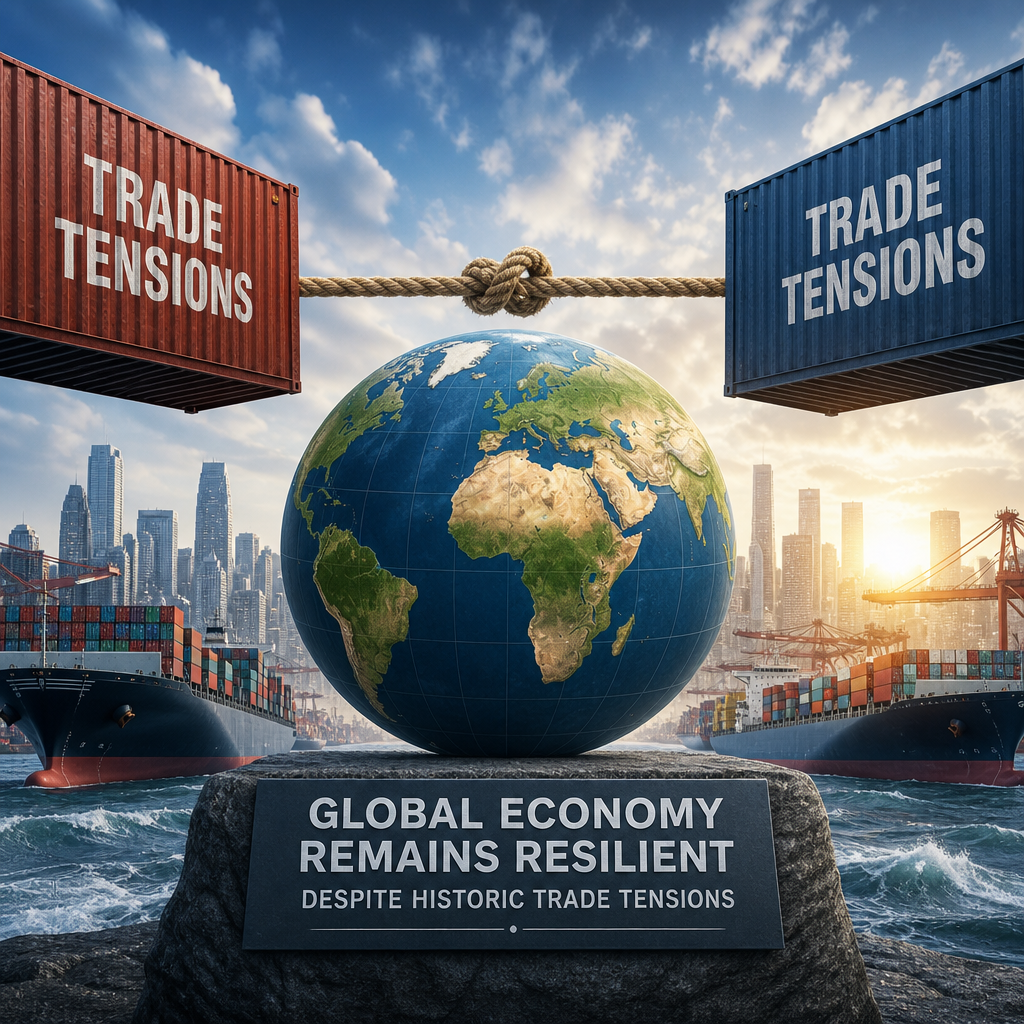
Global Economy Remains Resilient Despite Historic Trade Tensions
The global economy has shown surprising strength even as historic trade tensions reshape supply chains and raise costs for businesses. In this article, we explore what’s supporting that resilience, where the risks still lie, and why global trade continues to adapt.
By: pedropadm2025@gmail.com on July 28, 2026
The global economy remains resilient despite historic trade tensions, and that may surprise anyone who has followed years of tariffs, export controls, supply chain disruptions, and geopolitical uncertainty. While trade disputes have reshaped business strategies and raised costs in some sectors, the broader economy has shown a notable ability to adapt.
This resilience does not mean the world economy is free of pressure. It does mean that businesses, consumers, and governments have found ways to absorb shocks, redirect supply chains, and keep trade moving. From diversified sourcing to stronger domestic demand in key markets, the global system continues to function even under strain.
In this article, we’ll examine why the global economy remains resilient despite historic trade tensions, what forces are supporting growth, where the risks remain, and what businesses can do to prepare for a more fragmented trade environment.
Why the Global Economy Remains Resilient Despite Historic Trade Tensions
Trade conflicts often dominate headlines, but global economic performance depends on more than tariffs alone. A resilient economy can continue expanding even when parts of the system face pressure. That is what we have seen in recent years.
Several factors help explain this durability:
Diversified trade routes and suppliers reduce dependence on any one country or region.
Strong consumer demand in many economies keeps spending and production stable.
Services and digital trade have become more important, offsetting weakness in some goods sectors.
Businesses have become more agile, adjusting inventory, logistics, and sourcing faster than before.
Policy support from central banks and governments has helped cushion shocks.
The result is an economy that is more adaptable than many expected. Even as trade barriers rise in some areas, global commerce continues through new channels and relationships.
The role of globalization’s next phase
The old model of globalization focused heavily on low-cost manufacturing and long, highly efficient supply chains. Today’s version is more cautious. Companies are not abandoning international trade; they are reshaping it.
This shift includes:
Nearshoring and reshoring for critical goods
Dual sourcing to reduce supply risk
Greater emphasis on political and economic stability
Increased investment in digital infrastructure and data flows
Rather than a collapse in globalization, we are seeing a reconfiguration of it.
How Trade Tensions Are Changing Business Strategy
Trade tensions have not disappeared. They have changed how companies plan, invest, and compete. Many firms now treat trade risk as a core business issue, not just a policy concern.
Supply chain resilience over pure efficiency
For years, many businesses optimized for speed and low cost. Now, resilience matters just as much.
A manufacturer might choose to pay slightly more for multiple suppliers instead of relying on a single source overseas. A retailer may hold more inventory of critical products to avoid shortages. A technology company may map exposure to export restrictions before launching in a new market.
These decisions often raise short-term costs, but they can prevent larger disruptions later.
Pricing pressure and margin management
Trade barriers can affect input costs, shipping expenses, and delivery times. Companies often respond by:
Renegotiating supplier contracts
Passing some costs to consumers
Redesigning products to use alternative materials
Shifting production to regions with lower risk
Not every business can absorb these changes easily. Smaller firms, in particular, may have less room to adjust. Still, many companies have shown they can adapt without abandoning growth.
More attention to geopolitical risk
Executives now monitor not just exchange rates and inflation, but also sanctions, tariffs, and cross-border regulations. This has led to more scenario planning and more conservative expansion strategies.
In practice, that means businesses are asking questions like:
Which markets are most exposed to policy changes?
What happens if a key supplier faces restrictions?
How quickly can production be moved if needed?
Are we overly dependent on a single shipping corridor?
That level of planning is one reason the global economy remains resilient despite historic trade tensions.
Key Drivers Supporting Global Economic Resilience
Several broad trends are helping stabilize the world economy even during periods of trade conflict.
Domestic demand in major economies
Strong internal demand can offset weaker exports. In large economies, such as the United States, China, India, and parts of the European Union, household spending and investment remain powerful drivers of activity.
Even when trade slows, domestic services, housing, infrastructure, and consumer markets can keep growth moving.
Services and intangible trade
Not all trade involves physical goods. Services such as finance, software, education, healthcare, logistics, and professional consulting represent a growing share of cross-border economic activity.
These sectors are often less exposed to tariff-related disruptions than traditional manufacturing. As a result, they help support overall growth when goods trade faces pressure.
Technology and digital connectivity
Digital tools have made trade more flexible. Businesses can coordinate suppliers, manage inventories, and serve customers across borders with greater speed and visibility. Cloud computing, e-commerce platforms, and data analytics also help firms respond faster to sudden changes.
That improved responsiveness matters when policy shifts happen quickly.
Labor market adaptation
Workers and firms have adjusted to new patterns of demand. In many economies, employers have invested in training, automation, and process improvements to maintain productivity. This helps offset the drag from higher trade costs.
Where the Global Economy Still Faces Real Risks
Resilience should not be confused with immunity. The global economy remains vulnerable to several challenges.
Fragmentation of trade networks
As countries prioritize national security and industrial policy, trade networks may become more regional and less open. This can reduce efficiency and limit access to the lowest-cost suppliers.
A more fragmented world may also mean:
Higher production costs
Slower technology diffusion
More duplication of supply chains
Less predictable market access
Rising costs for consumers and businesses
When tariffs, quotas, or regulatory barriers increase, someone usually pays the cost. Sometimes it is the business; sometimes it is the consumer. Often, it is both.
Higher costs can reduce demand, squeeze margins, and make growth harder to sustain.
Uneven impact across sectors
Not every industry is affected equally. Sectors such as electronics, automotive, machinery, agriculture, and semiconductors often feel trade tensions more sharply than services or software. That unevenness can create local job losses and investment delays even while the broader economy remains stable.
Uncertainty itself is a drag
Markets dislike uncertainty. Companies may delay hiring, capital spending, or expansion plans if they cannot predict policy conditions. Even when trade restrictions are limited, the fear of future restrictions can slow decision-making.
What Policymakers Are Doing
Governments are trying to balance openness, security, and economic stability. That is not an easy task.
Industrial policy and supply chain security
Many countries are encouraging domestic production in strategic sectors, including energy, advanced manufacturing, pharmaceuticals, and technology. The goal is to reduce dependency on fragile or politically sensitive supply chains.
This can strengthen resilience, but it can also create inefficiencies if protectionism goes too far.
Coordinating monetary and fiscal responses
Central banks and fiscal authorities have worked to keep inflation, labor markets, and credit conditions under control. While policy tools cannot eliminate trade-related disruptions, they can help prevent temporary shocks from becoming broader recessions.
Trade diplomacy and selective agreements
Even amid historic tensions, countries continue to negotiate trade deals, investment pacts, and sector-specific agreements. These efforts help preserve market access and reduce friction where possible.
What Businesses Can Learn from This Environment
Companies that understand the current trade environment can make better strategic decisions. The most successful firms tend to combine flexibility with discipline.
Build scenario plans for tariffs, sanctions, and shipping delays.
Diversify sourcing where concentration risk is high.
Review contracts for price adjustment and force majeure clauses.
Invest in inventory visibility and logistics tracking.
Monitor policy developments in key markets regularly.
Example: A mid-sized appliance maker
Imagine a mid-sized appliance company that sources motors from one country and circuit boards from another. After trade tensions raise uncertainty, the company does not stop importing. Instead, it adds a secondary supplier, increases safety stock for essential parts, and redesigns one product line to use components that are easier to source.
The company spends more in the short term, but it avoids major production delays later. That is resilience in action.
Example: A global software firm
A software company may face fewer tariff issues, but it still deals with export controls, data regulations, and market access challenges. By localizing compliance processes and storing data regionally where required, the company continues expanding internationally without triggering avoidable risks.
Why Resilience Matters for the Long Term
Resilience is more than a buzzword. It is a competitive advantage.
A resilient global economy can:
Recover faster from shocks
Keep investment flowing
Support jobs across borders
Reduce the chance of severe shortages
Maintain confidence among consumers and businesses
That matters because trade tensions are unlikely to vanish overnight. Companies and countries that adapt well will be better positioned to thrive in a world where open markets and strategic competition exist side by side.
Frequently Asked Questions
1. What does it mean that the global economy remains resilient despite historic trade tensions?
It means the world economy continues to grow and function even while tariffs, trade disputes, and geopolitical concerns create pressure. Businesses and governments have adapted through diversification, policy support, and supply chain changes.
2. Are trade tensions still affecting prices?
Yes. Trade tensions can raise the cost of imported goods, components, shipping, and compliance. Some businesses absorb those costs, while others pass them on to consumers.
3. Which industries are most affected by trade tensions?
Industries that rely heavily on cross-border physical goods are often most exposed. These include manufacturing, semiconductors, automotive, agriculture, electronics, and industrial equipment. Services and digital sectors are generally less exposed, though not immune.
4. How are companies responding to global trade uncertainty?
Many companies are diversifying suppliers, nearshoring production, increasing inventory buffers, and investing in risk analysis. They are also paying closer attention to legal and regulatory changes in the markets where they operate.
5. Will trade tensions slow global growth in the future?
They can, especially if they lead to deeper fragmentation, higher costs, or prolonged uncertainty. However, the impact depends on how governments, businesses, and markets respond. Strong domestic demand, innovation, and policy coordination can help offset some of the downside.
The fact that the global economy remains resilient despite historic trade tensions is a reminder that modern economies are more adaptable than they may appear. Trade disputes, tariffs, and geopolitical friction still matter, and they continue to reshape supply chains, pricing, and investment decisions. But they have not brought global commerce to a halt.
Instead, businesses have diversified suppliers, governments have supported strategic sectors, and consumers have continued spending. Services, technology, and digital trade have also helped stabilize growth. The result is not a return to the old model of globalization, but the emergence of a more flexible, more cautious, and often more resilient one.
For business leaders and policymakers, the lesson is clear: resilience requires preparation. Companies that monitor risk, build optionality, and invest in supply chain visibility will be better equipped for whatever comes next. Readers who want to stay ahead should keep learning about trade policy, global markets, and the practical strategies that turn uncertainty into long-term strength.
Peter B holds a degree in Journalism and has 5 years of experience covering U.S. economic policy, labor markets, and financial news. He writes data-driven news content on topics like inflation, interest rates, and employment trends.