Nancy Grace Roman Space Telescope Prepares for Launch
The Nancy Grace Roman Space Telescope is nearing launch, bringing astronomers closer to a mission that could reshape our view of dark energy, exoplanets, and the distant universe. With its wide-field, high-speed surveys, Roman is ready to open a new chapter in space exploration.
By: pedropadm2025@gmail.com on July 28, 2026
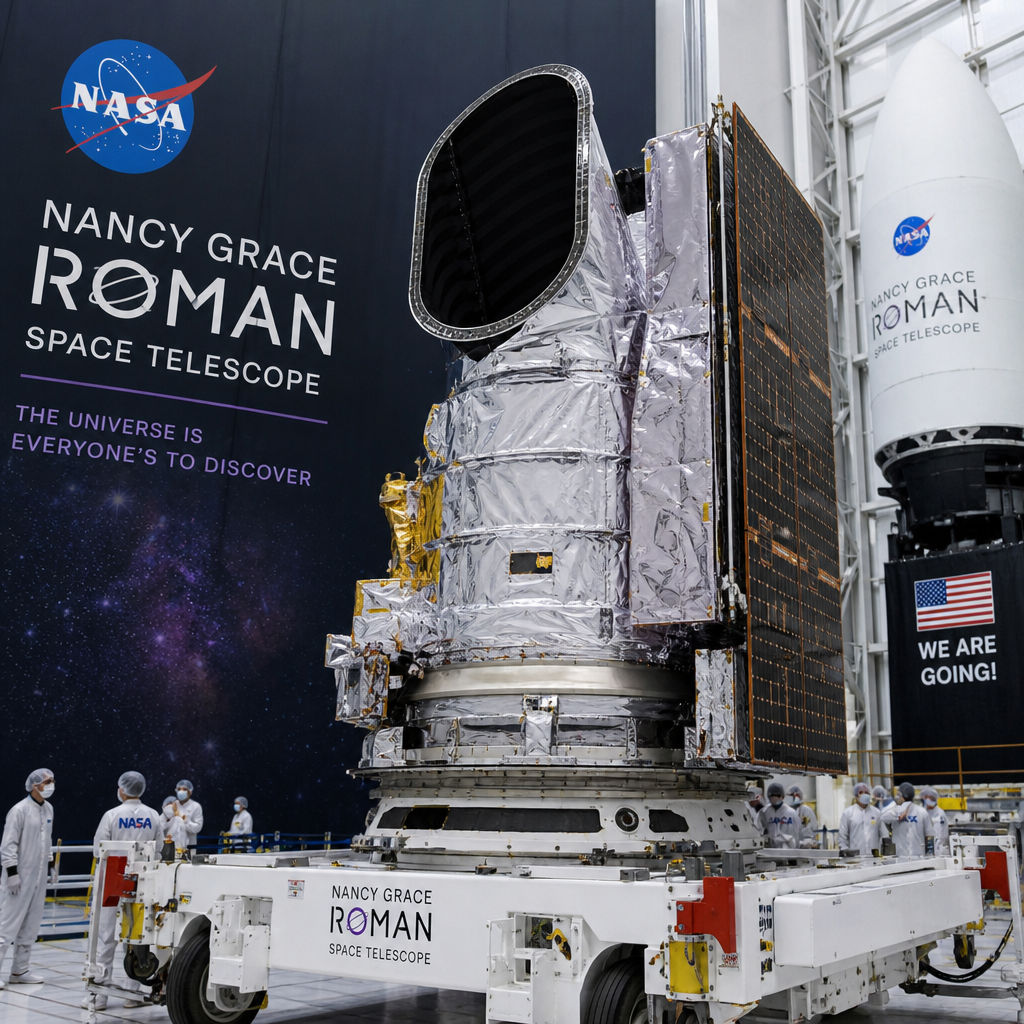
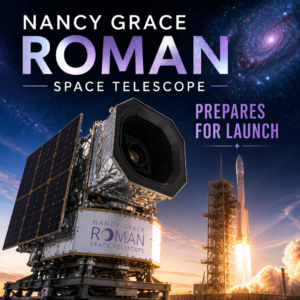
The Nancy Grace Roman Space Telescope is one of the most anticipated astronomy missions in decades, and its move toward launch has captured the attention of scientists, educators, and space enthusiasts alike. Designed to answer some of the biggest questions in astrophysics, Roman will build on the legacy of Hubble and Webb while taking a very different approach: wide-field, high-speed surveys of the universe. As the Nancy Grace Roman Space Telescope prepares for launch, it is entering the final stretch of testing, integration, and mission readiness that will determine how quickly it can begin opening new windows on the cosmos.
What makes Roman especially exciting is not just its advanced technology, but the range of scientific problems it can tackle. From dark energy to exoplanets, from galaxy evolution to cosmic structure, the telescope is designed to observe the sky on a scale and at a speed that previous observatories could not match. That combination of breadth and precision is why astronomers see the Nancy Grace Roman Space Telescope as a transformative mission rather than just another space observatory.
What Makes the Nancy Grace Roman Space Telescope Different?
The Nancy Grace Roman Space Telescope was built to study the universe with a wide field of view while maintaining sharp, detailed images. This makes it ideal for surveying large areas of the sky quickly and repeatedly. Instead of focusing on one object at a time, Roman can collect enormous amounts of data across broad regions of space.
A telescope built for surveys
Roman’s design centers on efficiency. It will observe large swaths of the sky far faster than many earlier telescopes, allowing astronomers to:
Search for distant galaxies and galaxy clusters
Track changes in celestial objects over time
Identify potential exoplanets through microlensing
Study dark energy and cosmic expansion
This survey capability gives Roman an important role in modern astronomy. It is not replacing other observatories; it is filling a crucial gap between deep, narrow observations and wide, systematic sky mapping.
Why the wide field matters
A wide field of view means Roman can gather context as well as detail. In astronomy, that matters because many phenomena are easier to understand when seen across a large sample. For example, rather than studying one galaxy in isolation, scientists can compare thousands of galaxies to look for patterns in their shapes, distances, and histories.
The Science Goals Behind the Mission
The Nancy Grace Roman Space Telescope is built around several major science objectives. Each one addresses a different mystery about how the universe works, and together they show why the mission is so valuable.
Understanding dark energy
One of Roman’s headline goals is studying dark energy, the mysterious force driving the accelerated expansion of the universe. Astronomers still do not know what dark energy is, but they do know it affects how the cosmos evolves on the largest scales.
Roman will help scientists investigate dark energy by:
Mapping the distribution of galaxies across cosmic time
Measuring subtle distortions in light caused by gravity, known as weak lensing
Observing large-scale structure to see how matter has clumped together over billions of years
These observations will give researchers more precise data to test competing theories about expansion and cosmic evolution.
Searching for exoplanets
Roman is also expected to be a major player in exoplanet research. Its microlensing survey can detect planets that are otherwise difficult to find, including smaller worlds and planets orbiting farther from their stars.
That matters because many current planet-hunting methods are better suited to close-in planets. Roman’s approach broadens the search and may reveal planets more similar to those in our own solar system. In particular, it can help astronomers better understand:
How common cold planets are
Whether free-floating planets exist in large numbers
How planetary systems form and evolve
Exploring galaxy formation and cosmic history
The telescope will also help scientists study how galaxies formed and changed over time. By surveying millions of galaxies, Roman can provide a more complete picture of how structures in the universe assembled after the Big Bang.
This includes:
The growth of galaxies through mergers and accretion
The role of dark matter in shaping cosmic structures
How star formation changed across billions of years
Because Roman can collect such large datasets, it is well suited to spotting rare objects and unusual cosmic events that smaller or narrower surveys might miss.
How the Telescope Is Preparing for Launch
The road to launch for the Nancy Grace Roman Space Telescope includes careful testing and engineering work. Space missions do not get one chance to succeed; they are built, tested, retested, and verified in extreme detail before they ever leave Earth.
Assembly and integration
Roman’s major components must work together as a single system. That includes its telescope optics, instruments, spacecraft bus, power systems, pointing controls, and communication hardware. Engineers integrate these parts and make sure each one performs correctly in combination with the others.
This process is essential because a space telescope cannot be repaired easily once it is in orbit. Every connection, sensor, and software system must perform reliably under launch and space conditions.
Environmental testing
Before launch, Roman must survive conditions far harsher than those on Earth. Testing typically includes:
Vibration testing to simulate launch forces
Thermal vacuum testing to mimic the cold, airless environment of space
Electromagnetic compatibility checks
End-to-end system validation
These tests help engineers confirm that the telescope will function as expected after launch. They also allow teams to identify and fix issues before the mission becomes irreversible.
Operational planning
Preparing for launch is not only about hardware. Mission teams also train for operations in space. They rehearse how Roman will deploy, calibrate its instruments, point at targets, and transmit data back to Earth.
That planning matters because the first months after launch are some of the most important in a space mission’s life. During that period, teams must carefully bring the observatory online and ensure its systems are stable and aligned.
Why Roman Is a Big Deal for Astronomy
The Nancy Grace Roman Space Telescope is more than a technical achievement. It represents a new way of doing astronomy at scale. For decades, observatories have pushed the frontiers of resolution, sensitivity, and depth. Roman adds something equally important: efficiency in wide-area space science.
A bridge between Hubble and Webb
Roman is often discussed alongside the Hubble Space Telescope and the James Webb Space Telescope, but it serves a different purpose. Hubble excels at sharp visible-light imaging, and Webb is unmatched in infrared deep-space exploration. Roman complements both by surveying broad regions of the sky quickly in near-infrared light.
That makes Roman a powerful discovery machine. It can identify promising targets that Hubble, Webb, and ground-based observatories can then study in greater detail.
A data-rich future for astronomy
Roman is expected to generate an enormous amount of data. That creates opportunities not only for professional astronomers, but also for the broader scientific community. Large datasets can support new analyses, comparison studies, and discoveries that were not part of the original mission plan.
This kind of mission often has long-term value because its archives can be revisited for years. As software improves and new theories emerge, scientists may uncover even more from Roman’s observations.
Practical Examples of What Roman Can Observe
To understand the mission’s value, it helps to imagine a few scenarios where the Nancy Grace Roman Space Telescope could make a difference.
Finding hidden exoplanets
Suppose astronomers want to know whether a small, distant planet exists in a system that is otherwise difficult to observe. Roman’s microlensing survey could detect the tiny brightening of background starlight that occurs when the planet’s gravity bends light in just the right way. That gives researchers a way to detect worlds that would otherwise remain invisible.
Mapping galaxy clusters
Roman can survey large numbers of galaxies and galaxy clusters. By comparing their shapes and distributions, scientists can better understand how dark matter influences structure formation and how the universe’s expansion has changed over time.
Spotting rare cosmic events
Because Roman can monitor large sky areas repeatedly, it may also capture rare or transient events, such as unusual stellar explosions or gravitational lensing effects. These discoveries can help astronomers test models of stellar evolution and gravity.
Challenges and Expectations Before Launch
Even when a mission is close to launch, it still faces challenges. For a complex observatory like Roman, success depends on precision, patience, and coordination among many teams.
Technical readiness
All systems must meet strict performance standards. If any subsystem falls short, engineers may need additional time to diagnose and correct the issue. That is normal in spaceflight, where reliability matters more than speed.
Budget and schedule discipline
Large missions often require careful management of timelines and resources. The goal is not simply to launch quickly, but to launch with confidence that the telescope will perform as expected over many years.
Public expectations
Because the Nancy Grace Roman Space Telescope has been discussed for so long, public anticipation is high. That excitement is a good sign, but it also means people should understand that space missions unfold in stages. Launch is only the beginning of a larger scientific journey.
What Happens After Launch?
Once Roman reaches space, the mission team will begin a sequence of carefully choreographed steps to bring the observatory into service.
Early orbit operations
After launch, Roman will need to deploy and stabilize its systems. Engineers will confirm that the spacecraft is healthy and that its main components are functioning properly.
Instrument commissioning
Next comes calibration. Scientists and engineers will test the instruments to make sure the telescope is aligned and producing accurate data. This phase is critical because even small calibration errors can affect observations later on.
Science operations begin
Once Roman is fully commissioned, it will begin its survey program. That is when the mission’s real science payoff begins. Researchers will use the data to explore cosmic expansion, exoplanets, galaxy evolution, and other key questions.
Why the Mission Matters Beyond Astronomy
The Nancy Grace Roman Space Telescope has value that extends beyond the research community. Missions like Roman inspire students, support engineering innovation, and help the public engage with science in meaningful ways.
Inspiring future scientists and engineers
Big missions often spark curiosity. A student who learns about Roman today may become the engineer who improves future spacecraft or the astronomer who uses Roman’s data to make a breakthrough discovery.
Advancing technology
Space telescopes require advanced optics, precision pointing systems, data handling tools, and thermal engineering. The expertise developed for missions like Roman often influences other fields, from aerospace engineering to scientific computing.
Expanding public understanding
Roman also gives the public a chance to better understand how science works. Discovery does not happen all at once. It comes from careful planning, testing, observation, and analysis over time. Watching a mission prepare for launch offers a real-world example of that process.
Frequently Asked Questions
What is the Nancy Grace Roman Space Telescope designed to study?
The Nancy Grace Roman Space Telescope is designed to study dark energy, exoplanets, galaxy formation, and large-scale cosmic structure. Its wide-field survey capability allows it to observe large portions of the sky efficiently.
How is Roman different from Hubble and Webb?
Roman differs from Hubble and Webb because it is optimized for wide-area surveys rather than narrow, ultra-deep observations. It complements those telescopes by finding targets and mapping large regions of the universe.
Why is Roman important for dark energy research?
Roman will help scientists measure how the universe expands and how matter is distributed across cosmic time. Those observations can provide stronger tests of theories about dark energy and cosmic acceleration.
Can Roman find Earth-like planets?
Roman is not primarily designed to find Earth-like planets in the same way some other missions do, but it can detect a wide range of exoplanets through microlensing, including planets that are farther from their stars and harder to detect with other methods.
What happens before a space telescope launches?
Before launch, a telescope goes through assembly, integration, environmental testing, calibration planning, and operational rehearsals. These steps help ensure the spacecraft can survive launch and function properly in space.
The Nancy Grace Roman Space Telescope is preparing to become one of the most important observatories in modern astronomy. With its wide-field design, advanced infrared imaging, and powerful survey capabilities, Roman is set to answer questions that have challenged scientists for decades. It will help reveal how dark energy shapes the universe, uncover hidden exoplanets, and trace the history of galaxies across cosmic time.
As the mission moves closer to launch, the careful testing and planning behind it remind us that major scientific achievements depend on patience, precision, and collaboration. Roman is not just a telescope; it is a discovery engine built to expand what humanity knows about the cosmos. For anyone interested in space science, this is an ideal time to follow the mission, learn from its progress, and watch for the discoveries that will follow once it reaches orbit. The next era of wide-field astronomy is almost here, and Roman is poised to lead it.
Peter B holds a degree in Journalism and has 5 years of experience covering U.S. economic policy, labor markets, and financial news. He writes data-driven news content on topics like inflation, interest rates, and employment trends.