College Accommodations for Students With Disabilities Explained
College accommodations can make the transition to higher education more manageable by helping students with disabilities access classes, campus life, and essential resources. This guide explains how college accommodations work, what supports may be available, and how students can request them with confidence.
By: Jennifer Collins - Education on July 28, 2026
Starting college is a major transition for any student, but for students with disabilities, it can also bring extra planning, paperwork, and questions. Understanding college accommodations for students with disabilities can make the process far less overwhelming and much more manageable. The right support can help students access classes, participate fully in campus life, and build confidence as they work toward their goals.
College is different from high school. Supports that were automatically provided in K–12 education may not carry over in the same way. Instead, students usually need to request accommodations themselves and share documentation with the college’s disability services office. That shift can feel intimidating at first, but it also gives students more control over the support they receive.
This guide explains what college accommodations are, how they work, and what students can expect when requesting them.
What Are College Accommodations for Students With Disabilities?
College accommodations are changes or adjustments that help students with disabilities access learning and campus life more equitably. These supports are designed to remove barriers without lowering academic standards.
Common examples include:
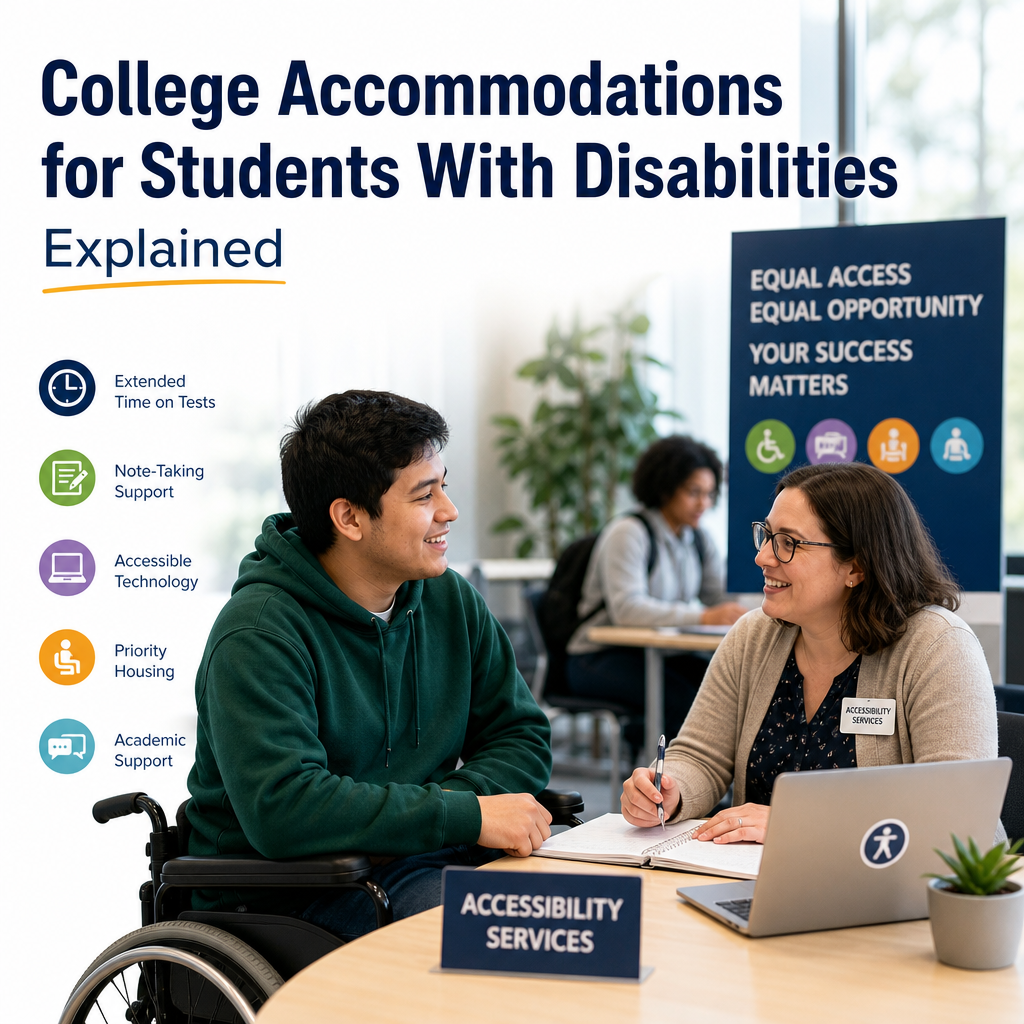
Extended time on exams
Note-taking support
Accessible classroom materials
Priority registration
Reduced-distraction testing environments
Assistive technology
Flexibility with attendance in some cases
Sign language interpreters or captioning
Accessible housing or transportation support
The goal is not to give students an unfair advantage. Instead, accommodations help provide equal access so students can demonstrate their knowledge and skills.
How College Accommodations Work
Unlike elementary and high school settings, colleges generally do not identify students automatically. The student must usually take the first step.
Step 1: Contact the disability services office
Most colleges have an office that handles disability-related support. Depending on the school, it may be called:
Disability Services
Accessibility Services
Student Access Services
Office of Accommodations
Students should contact the office as early as possible, ideally before classes begin. Early contact gives the school time to review paperwork, determine eligibility, and arrange support.
Step 2: Submit documentation
Colleges often require documentation showing the disability and how it affects learning or daily functioning. This may include:
Medical records
Psychological evaluations
Neuropsychological assessments
IEP or 504 plan records
Doctor or specialist letters
Requirements vary by school and by accommodation request. The documentation should generally be current and detailed enough to explain the functional impact of the disability.
Step 3: Meet with an accessibility coordinator
After reviewing the request, the college may schedule a meeting. This conversation helps determine what accommodations are reasonable and appropriate. Students should be prepared to describe:
Their diagnosis or condition
The barriers they face in class or on campus
What has helped in the past
Which accommodations they are requesting
Step 4: Receive an accommodation letter
If approved, the student usually receives an accommodation letter or similar notification. This document explains the approved support and how to use it. In many cases, the student must share the letter with professors or coordinate services through the disability office.
Step 5: Communicate with professors
Students often need to follow up with instructors to activate accommodations in specific classes. A professor may not know about a disability unless the student chooses to disclose it through the official process.
Common Types of College Accommodations
Accommodation needs vary from student to student. A support that works well for one person may not be necessary for another. Here are some of the most common types of college accommodations for students with disabilities.
Academic accommodations
These are the most familiar supports and are often tied directly to coursework.
Examples include:
Extra time on quizzes, exams, or in-class assignments
Breaks during long testing periods
Alternative exam formats
Permission to record lectures
Access to lecture notes or outlines
Peer note-taking support
Deadline extensions in specific situations
Reduced course load when appropriate
Testing accommodations
Testing can be especially challenging for students with ADHD, learning disabilities, chronic health conditions, anxiety, or mobility limitations. Common supports include:
Extended time
Separate testing rooms
Small-group testing environments
Use of a computer or approved software
Read-aloud or text-to-speech tools
Frequent breaks
Technology accommodations
Assistive technology can make a significant difference in academic success. Schools may provide or approve:
Screen readers
Speech-to-text software
Text-to-speech tools
Captioning services
Digital note-taking apps
Adaptive keyboards or input devices
Physical and environmental accommodations
Students with mobility or sensory needs may need changes to the learning environment, such as:
Accessible classrooms
Reserved seating
Elevator access
Adjustable desks
Housing modifications
Alternative classroom locations
Reduced sensory distractions when possible
Communication accommodations
For students who are deaf, hard of hearing, or have communication-related disabilities, colleges may provide:
ASL interpreters
Real-time captioning
Assistive listening devices
Written instructions or summaries
Communication access during meetings
Who Qualifies for Accommodations?
A wide range of disabilities may qualify for college accommodations. These can include:
Physical disabilities
Learning disabilities
ADHD
Autism spectrum disorder
Psychiatric disabilities
Chronic illnesses
Visual impairments
Hearing impairments
Temporary disabilities in some cases
Eligibility depends on how the disability affects access to education or campus participation. Colleges usually focus on the functional impact rather than the diagnosis alone.
It is also important to understand that a student does not need to be “struggling enough” to deserve support. If a disability creates a barrier, accommodations may help reduce that barrier.
College Is Different From High School
Many families are surprised by how different college accommodations are compared to special education in K–12 schools.
In high school
Schools are responsible for identifying and supporting the student
Parents often play a central role
Teachers may receive disability-related information automatically
Accommodations are typically part of an IEP or 504 plan
In college
The student must usually self-advocate
The student is responsible for requesting services
Documentation must often be submitted directly
Professors generally only receive what they need to know to implement accommodations
This shift can be empowering, but it also requires independence. Students should learn how to communicate their needs clearly and keep track of deadlines, forms, and meetings.
How to Request College Accommodations
Requesting accommodations can feel formal, but the process is usually straightforward.
1. Gather documentation early
Before applying or before classes begin, collect any records that may help support the request. If documentation is outdated or incomplete, ask a doctor, therapist, or evaluator what might be needed.
2. Review the college’s policy
Each college sets its own process. Check the website for:
Application forms
Documentation guidelines
Deadlines
Contact information
Appeal procedures
3. Be specific about barriers
When requesting support, explain what is difficult and why. For example:
“I need extra time on exams because my disability affects processing speed.”
“I need captioning because I cannot reliably access spoken lecture content.”
“I need flexible attendance because my condition causes unpredictable flare-ups.”
4. Ask about accommodations that fit your courses
A student’s needs may change by class. A lab course, online course, and lecture-based course may each require different support.
5. Follow up if needed
If a request is denied or incomplete, ask for clarification. Some schools have a review or appeal process. Students should keep copies of forms, emails, and letters.
Tips for Using Accommodations Effectively
Getting approved is only part of the process. Students also need to use accommodations well.
Plan ahead each semester
Accommodation letters may need to be renewed or updated each term. Don’t wait until a problem occurs. Reach out early and confirm what is needed for upcoming courses.
Talk to professors early
A brief conversation can prevent misunderstandings. Students do not need to share more personal information than they are comfortable with, but they should be ready to discuss how accommodations will work in practice.
Keep communication organized
Use a folder or digital system to store:
Emails
Approval letters
Medical documentation
Course syllabi
Deadlines
This helps students respond quickly if questions come up.
Know your responsibilities
Accommodations are designed to support access, but students still need to complete assignments, attend class when possible, and communicate when issues arise. Being proactive matters.
Speak up when something is not working
If an approved accommodation is not effective, students should tell the disability office. Needs can change, and colleges may be able to adjust support.
Practical Examples of College Accommodations
Here are a few realistic scenarios that show how accommodations work in everyday college life.
Example 1: A student with ADHD
A student with ADHD may struggle with sustained focus during long exams. The college approves:
50% extra time on exams
A distraction-reduced testing room
Permission to take short breaks
This setup helps the student show what they know without the added barrier of an overstimulating environment.
Example 2: A student with a chronic illness
A student with a condition that causes fatigue and flare-ups may request:
Flexible attendance when medically necessary
Deadline adjustments in limited circumstances
Priority registration to build a manageable schedule
These accommodations help the student balance health and academics.
Example 3: A student with a hearing disability
A student who is deaf or hard of hearing may need:
ASL interpreters in class
Captioning for lectures
Written summaries of audio content
With these supports, the student can fully participate in class discussions and access course material.
Common Misunderstandings About College Accommodations
Misconceptions can make students hesitate to seek help. Let’s clear up a few common ones.
“Accommodations are only for severe disabilities.”
Not true. If a condition substantially affects learning or access, accommodations may be appropriate.
“I have to wait until I fail a class.”
No. Students should request support as soon as they know they may need it.
“Accommodations guarantee success.”
Accommodations create access, but they do not replace study habits, planning, or engagement with coursework.
“My professors will know everything about my disability.”
Usually, they will only know what they need to implement approved accommodations.
“The process is the same at every school.”
Policies vary. Students should always check their college’s specific procedures.
What If Accommodations Are Denied?
A denial does not always mean the request is impossible. Sometimes the college needs more documentation, or the student may need to request a different support.
If a request is denied:
Ask for the reason in writing.
Review the documentation requirements.
Provide additional records if available.
Request an appeal or reconsideration.
Speak with an advocate, advisor, or trusted campus resource if needed.
Students should also understand the difference between a reasonable accommodation and a modification that would fundamentally alter a course or program. Colleges are required to provide appropriate access, but they are not required to change essential academic standards.
Building a Strong Support System
Success in college often depends on more than accommodations alone. Students may benefit from combining disability services with other campus resources, such as:
Academic advising
Tutoring centers
Counseling services
Writing centers
Career services
Student support programs
A strong support system can reduce stress and help students stay on track when coursework becomes demanding.
Frequently Asked Questions
What is the first step in getting college accommodations?
The first step is usually contacting the college’s disability or accessibility services office. Students should ask about the application process, documentation requirements, and deadlines. Reaching out early is important because some schools need time to review paperwork and set up support before classes start.
Do students have to tell every professor about their disability?
No. Students usually do not need to explain their diagnosis to every professor. In most cases, they only need to share the approved accommodation letter or follow the school’s process for activating support. Professors generally receive only the information necessary to provide the accommodation.
Can college accommodations include mental health conditions?
Yes. Mental health conditions such as anxiety, depression, PTSD, and other psychiatric disabilities may qualify for accommodations if they create barriers to learning or campus access. Support may include testing adjustments, flexibility in some situations, reduced-distraction environments, or other approved changes based on the student’s needs.
Are accommodations the same at every college?
No. Colleges have their own procedures, documentation rules, and timelines. While the general idea is similar across schools, the exact process can vary significantly. Students should always review their specific college’s disability services policies and speak with the office directly.
What if a student’s disability changes over time?
If a student’s needs change, they should contact the disability services office again. Accommodations may need to be updated, expanded, or revised. A change in symptoms, diagnosis, or course demands can all affect what support is most helpful.
Understanding college accommodations for students with disabilities can make the transition to higher education much smoother. The process may seem complicated at first, but it becomes easier when students know what to expect: contact the disability services office, provide documentation, discuss functional barriers, and request supports that fit their courses and campus life.
The most important thing to remember is that accommodations are about access. They help level the playing field so students can focus on learning, participating, and moving toward graduation with greater confidence. Whether a student needs extended test time, captioning, assistive technology, or another type of support, the right accommodations can make a meaningful difference.
If you are preparing for college, start early, ask questions, and keep records organized. Self-advocacy takes practice, but it is one of the most valuable skills a student can develop. With the right information and support, college can be a place where students with disabilities thrive academically and personally.
Jennifer, M.Ed., holds a degree in Higher Education Administration, with
a focus on U.S. college financial aid, admissions policy, and student
support systems. She researches and writes about scholarships, federal
aid programs, and the college planning process to help students and
families make informed, well-supported decisions.