Family and Medical Leave Act Eligibility and Employee Protections Explained
The Family and Medical Leave Act can give eligible workers the time they need to handle serious health or family matters without risking their job. Understanding who qualifies and what protections apply can make it easier to plan your leave with confidence.
By: Emily Adams on July 29, 2026
The Family and Medical Leave Act is one of the most important workplace laws in the United States for employees who need time away from work for serious health or family reasons. If you’ve ever wondered whether you qualify for leave, how much time you can take, or what protections you have while away, understanding the Family and Medical Leave Act can help you make informed decisions and avoid costly mistakes.
This law does not apply to every worker in every situation, but when it does, it can provide job-protected leave and critical peace of mind. In this article, we’ll break down Family and Medical Leave Act eligibility, employee protections, common leave reasons, and practical steps to take if you think you may need FMLA leave.
What the Family and Medical Leave Act Does
The Family and Medical Leave Act (FMLA) is a federal law that allows eligible employees of covered employers to take unpaid, job-protected leave for specific family and medical reasons. It was designed to help workers balance job responsibilities with serious personal or family needs.
FMLA leave may be used for reasons such as:
The birth or adoption of a child
Caring for a spouse, child, or parent with a serious health condition
The employee’s own serious health condition
Certain military family situations
In many cases, FMLA leave can run intermittently or on a reduced schedule if medically necessary. That flexibility can be especially helpful for ongoing treatments, recovery periods, or caregiving responsibilities.
Family and Medical Leave Act Eligibility Requirements
Not every employee is eligible for FMLA leave. To qualify, both the employer and the employee must meet certain criteria.
Covered Employers
The FMLA generally applies to:
Private-sector employers with 50 or more employees within a 75-mile radius
Public agencies, including local, state, and federal employers
Public and private elementary and secondary schools
If your employer is smaller than the federal threshold, you may not be covered under FMLA. However, some states have their own family and medical leave laws that offer broader protections.
Employee Eligibility
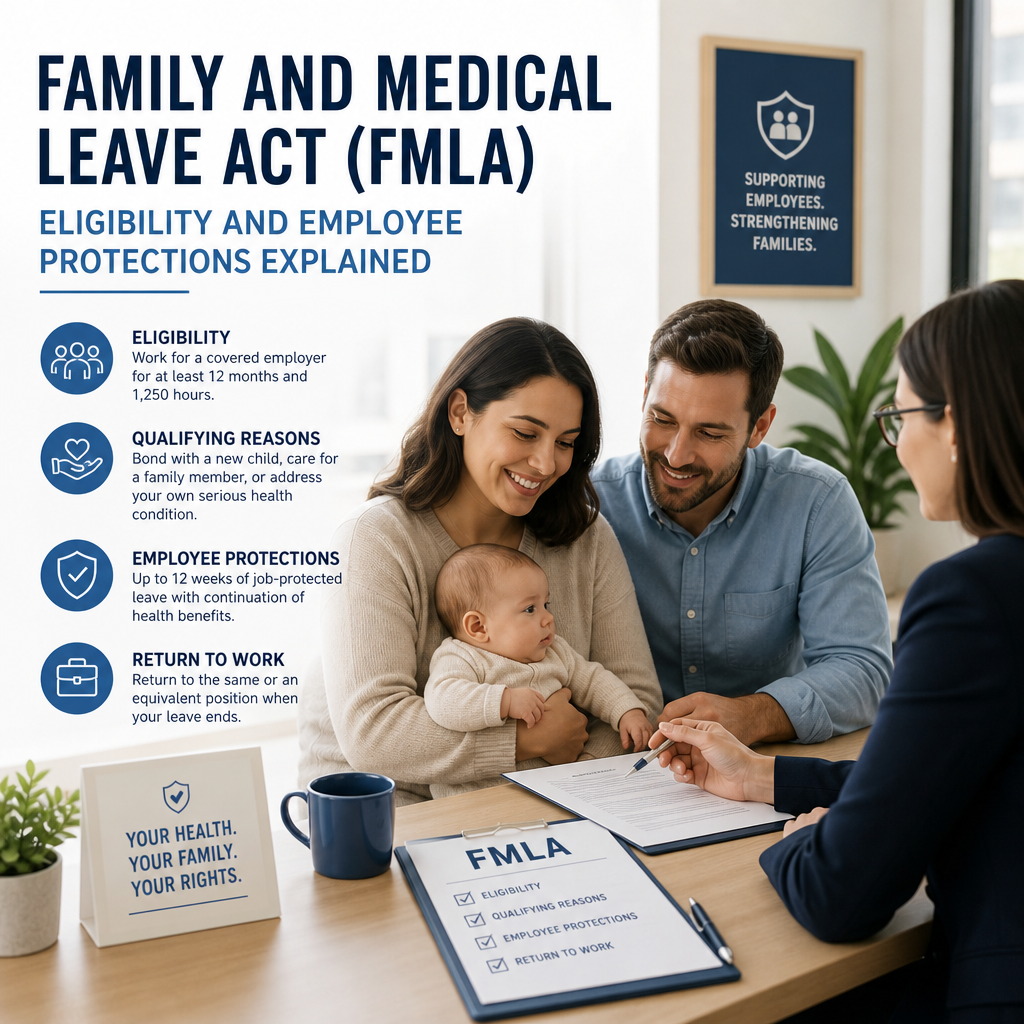
To be eligible for FMLA leave, an employee must generally:
Work for a covered employer
Have worked for the employer for at least 12 months
Have completed at least 1,250 hours of service during the 12 months before the leave begins
Work at a location where the employer has at least 50 employees within 75 miles
These requirements can feel technical, but they matter. For example, an employee who has worked for a company for two years but only averaged part-time hours may not meet the 1,250-hour requirement.
Why Eligibility Matters
Eligibility determines whether you have a legal right to take FMLA leave and return to your job afterward. If you are unsure about your status, ask your employer’s HR department to confirm your eligibility in writing.
Qualifying Reasons for FMLA Leave
The Family and Medical Leave Act covers only certain situations. Understanding the qualifying reasons can help you determine whether your situation likely falls under the law.
Serious Health Condition
A serious health condition generally involves an illness, injury, impairment, or physical or mental condition that requires:
Inpatient care, or
Continuing treatment by a health care provider
Examples may include surgery recovery, chemotherapy, severe asthma, complications from pregnancy, or a condition requiring ongoing treatment and follow-up appointments.
Caring for a Family Member
FMLA may be available when you need to care for:
A spouse
A child under 18, or an adult child who is unable to care for themselves due to a disability
A parent
“Caring for” can include both physical and emotional support, as well as assistance with medical decisions, transportation, or daily needs.
Birth, Adoption, or Foster Placement
Eligible employees may take leave for:
The birth of a child and bonding time
Placement of a child for adoption or foster care
Bonding with a newly placed child
This leave is often taken in one block, but in some cases, employers may allow intermittent use depending on the circumstances and company policy.
Military Family Leave
The FMLA also includes leave for certain military-related situations, such as:
Qualifying exigencies related to a family member’s covered active-duty deployment
Caring for a covered servicemember with a serious injury or illness
These provisions can be especially important for military families balancing service-related demands and caregiving obligations.
How Much Leave Can You Take?
Under FMLA, eligible employees can generally take up to 12 workweeks of leave in a 12-month period for qualifying reasons. For military caregiver leave, the amount can be up to 26 workweeks in a single 12-month period.
Intermittent Leave and Reduced Schedules
Not all leave must be taken all at once. In some situations, employees may use FMLA leave intermittently or on a reduced schedule.
Examples include:
Attending ongoing medical treatments
Managing recurring symptoms
Taking a parent to regular specialist appointments
Caring for a child after surgery
Intermittent leave can be useful, but it often requires careful tracking and communication with your employer.
Employer Leave Calculation Methods
Employers may use different methods for measuring the 12-month leave period, such as:
Calendar year
Fixed 12-month period
12-month period measured forward from the first FMLA leave date
Rolling 12-month period measured backward from the date leave is used
This calculation affects how much leave remains available, so it’s important to understand your employer’s specific method.
Employee Protections Under the Family and Medical Leave Act
One of the most valuable parts of the Family and Medical Leave Act is the protection it offers while an employee is away from work.
Job Protection
If you take approved FMLA leave, your employer generally must restore you to:
The same job you had before leave, or
An equivalent position with the same pay, benefits, and working conditions
An “equivalent” position should be substantially similar in duties, responsibilities, shift, location, and status.
Health Benefits Continuation
During FMLA leave, your employer must generally maintain your group health insurance under the same conditions as if you were still actively working. That means:
Your coverage should continue
You may still need to pay your normal share of premiums
Your employer cannot drop your health insurance simply because you are on leave
If you do not return to work after leave, different rules may apply regarding benefit repayment in some situations.
Protection from Retaliation
Employers cannot punish employees for requesting or using FMLA leave. Retaliation can include:
Termination
Demotion
Reduced hours
Discipline tied to protected leave
Negative treatment for asking questions about leave rights
If you believe your employer retaliated against you, document what happened and save related emails, schedules, and performance records.
Protection from Interference
Employers also cannot interfere with your FMLA rights. That means they cannot:
Discourage you from taking leave
Refuse to process a valid leave request
Mislead you about your eligibility
Demand more information than the law allows
Interference can be subtle, such as repeated pressure to delay treatment or threats about job security.
What Employees Should Do Before Taking Leave
If you think you may need FMLA leave, taking a few practical steps early can reduce stress and prevent delays.
1. Notify Your Employer as Soon as Possible
When leave is foreseeable, you should generally give advance notice. For planned medical treatment or expected childbirth, try to notify your employer at least 30 days in advance when possible.
If an emergency happens, provide notice as soon as you reasonably can.
2. Request the Right Forms
Your employer may ask for certification from a health care provider or other documentation supporting the leave request. Respond promptly and keep copies of everything you submit.
3. Understand Deadlines
FMLA paperwork often comes with deadlines. Missing a deadline can delay leave approval or create confusion about your rights.
4. Keep Good Records
Save the following:
Leave request emails
Medical certifications
HR responses
Pay stubs or benefit notices
Notes about conversations with supervisors or HR
Written records can be valuable if questions arise later.
5. Ask About Paid Leave Options
FMLA leave is unpaid, but you may be able to use:
Vacation time
Sick leave
Paid time off
Short-term disability benefits
Some employers require or allow paid time off to run concurrently with FMLA leave.
Common Misunderstandings About FMLA
Many employees have the same questions about the Family and Medical Leave Act, and misinformation can lead to missed opportunities.
“FMLA Means Paid Leave”
Not necessarily. FMLA itself does not require paid leave. It provides job protection and benefits continuation, but payment usually depends on employer policy, accrued leave, disability benefits, or state law.
“My Employer Can Fire Me While I’m on FMLA”
An employer generally cannot fire you because you took protected leave. However, FMLA does not protect employees from termination for unrelated, legitimate reasons such as documented misconduct or layoffs that would have happened anyway.
“Part-Time Employees Never Qualify”
Part-time employees can qualify if they meet the eligibility requirements, including the 1,250-hour rule and coverage rules for the employer.
“I Have to Be Completely Bedridden to Qualify”
Not true. Many serious health conditions do not require total incapacity. Ongoing treatment, surgery recovery, chronic conditions, and certain mental health conditions may qualify if the legal criteria are met.
Practical Examples of FMLA Leave in Real Life
Here are a few examples that show how FMLA leave may work in everyday situations.
Example 1: Surgery Recovery
An employee needs several weeks off after back surgery. The employee gives notice, submits medical certification, and takes FMLA leave for recovery. During leave, health insurance continues, and the employee returns to an equivalent job afterward.
Example 2: Caring for a Parent
A worker’s mother develops a serious health condition and needs help with treatment and daily care. The employee uses intermittent FMLA leave to attend medical appointments and assist on treatment days.
Example 3: Childbirth and Bonding
An employee uses FMLA leave after the birth of a child. The leave is taken in one continuous block to allow time for recovery and bonding.
These examples are simple, but they show how the law supports both medical needs and family responsibilities.
When to Seek Help
Sometimes FMLA issues become complicated. Consider seeking help if:
Your employer says you are not eligible, but you think you may be
Your leave request was denied without a clear reason
You were disciplined after requesting leave
You were not reinstated to a comparable position
Your employer interfered with your medical certification process
You can also review guidance from the U.S. Department of Labor or speak with an employment attorney if your situation is serious or disputed.
Frequently Asked Questions
1. Is the Family and Medical Leave Act only for full-time employees?
No. Part-time employees can qualify if they meet the law’s eligibility requirements, including working for a covered employer, having at least 12 months of employment, and completing 1,250 hours of service in the previous 12 months. Part-time status alone does not disqualify someone.
2. Can my employer deny FMLA leave if I am eligible?
If you are eligible and your reason qualifies under the law, your employer generally should not deny FMLA leave. However, your employer may ask for proper notice and supporting certification. If required documentation is missing or incomplete, approval may be delayed until you provide it.
3. Does FMLA leave have to be taken all at once?
No. FMLA leave can sometimes be taken intermittently or on a reduced schedule when medically necessary or when the qualifying reason allows it. This is common for ongoing treatment, chronic conditions, and caregiving needs that require repeated absences.
4. Will I still have health insurance while on FMLA leave?
In most cases, yes. Employers must generally maintain group health coverage under the same conditions as if you were still working. You may still be responsible for your usual share of premiums, so make sure you understand payment instructions before leave begins.
5. What should I do if I think my employer violated my FMLA rights?
Start by documenting everything, including dates, emails, and conversations. Then review your employer’s leave policies and consult official guidance from the U.S. Department of Labor. If the issue is serious, you may want to speak with an employment lawyer or file a complaint with the appropriate agency.
The Family and Medical Leave Act gives eligible employees a crucial safety net when serious health or family needs arise. It can provide up to 12 weeks of job-protected leave in many cases, continuation of health benefits, and protection from retaliation or interference. But those rights depend on meeting eligibility requirements, understanding qualifying reasons, and following the proper notice and documentation steps.
If you are facing surgery, a serious illness, caregiving duties, or a major life event like the birth or adoption of a child, it is worth checking whether FMLA applies to your situation. A little preparation can make the process smoother and help you avoid unnecessary stress during an already difficult time.
Take time to review your employer’s leave policy, gather documentation early, and confirm your rights through trusted official sources. Knowing how the Family and Medical Leave Act works can help you protect both your job and your peace of mind when life demands time away from work.
Emily A, holds a Master's degree in Public Administration (MPA) and has over 7 years of experience researching federal and state assistance programs. She writes educational content focused on government benefits, public policy, and community resources, using information from official agencies to help readers understand available programs and eligibility requirements.