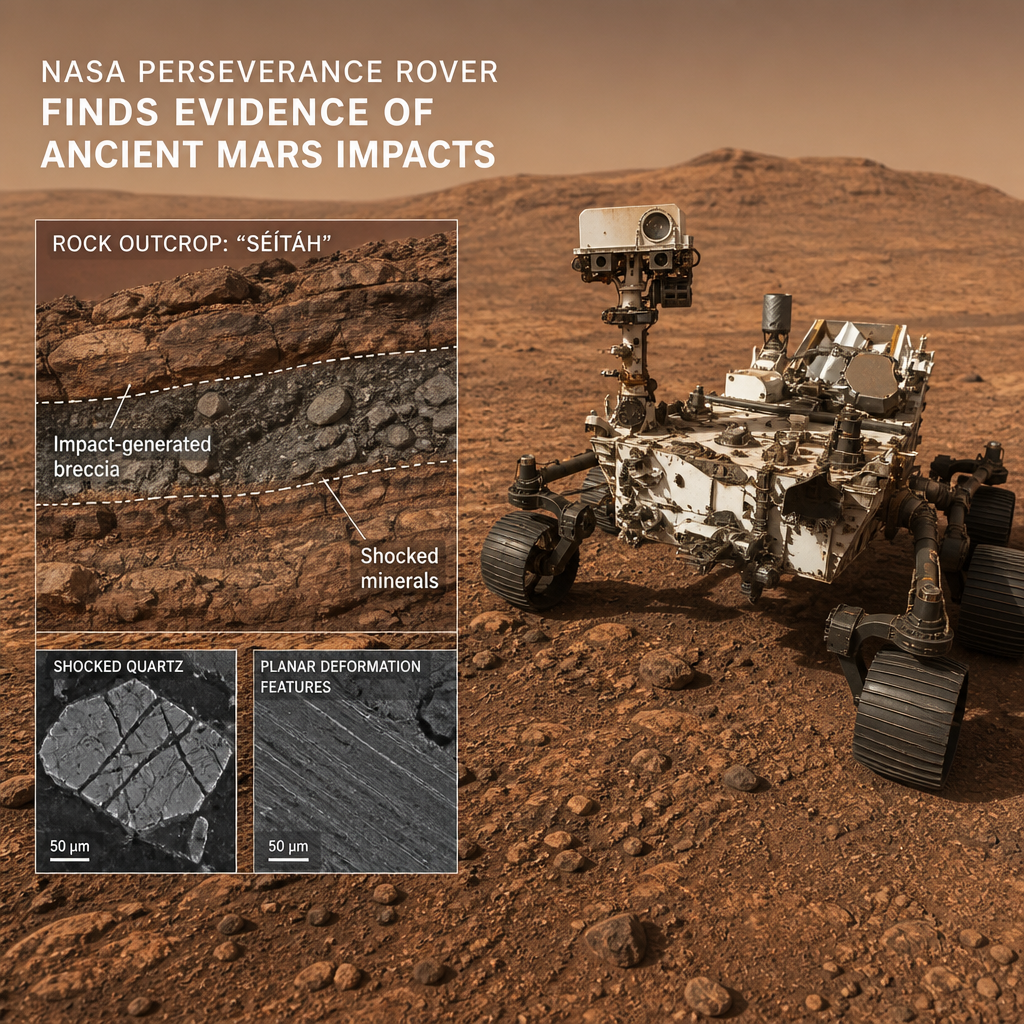
NASA Perseverance Rover Finds Evidence of Ancient Mars Impacts
NASA’s Perseverance rover is uncovering fresh clues about ancient impacts on Mars, revealing how powerful collisions helped shape the planet’s surface and preserve its earliest history. These discoveries could also offer new insight into how water moved through Mars long ago and whether the planet was ever habitable.
By: pedropadm2025@gmail.com on July 28, 2026
NASA’s Perseverance rover has turned Mars into a much more detailed scientific puzzle, and one of the most intriguing pieces is evidence of ancient impacts on Mars. These impact clues help scientists understand how the planet’s surface formed, how water may have moved through it, and whether Mars once had conditions that could support life.
Perseverance is exploring Jezero Crater, a location chosen because it likely held a lake long ago. As the rover studies rocks, soils, and layered terrain, it is revealing a history shaped not only by water and wind, but also by powerful asteroid and meteor impacts. Those collisions left behind fractured rocks, shock-altered minerals, and geologic structures that preserve Mars’ early story.
In this article, we’ll look at what ancient impacts on Mars mean, why they matter, and how Perseverance is helping scientists read the planet’s deepest history.
What Are Ancient Impacts on Mars?
Ancient impacts on Mars refer to collisions with asteroids, comets, or other rocky bodies that struck the planet billions of years ago. These events were common in the early solar system, when planets were still collecting material and the inner solar system was a much more chaotic place.
Unlike modern meteorites, which usually create small craters, early impacts could reshape huge regions. They may have:
Blasted out large craters
Melted rock
Created fractured bedrock
Altered minerals with intense pressure and heat
Exposed deeper layers of Martian crust
Because Mars lacks active plate tectonics like Earth, many ancient impact features remain preserved for long periods. That makes the planet a geological time capsule.
Why impact evidence matters
Impact structures tell scientists more than just where a rock hit the surface. They can help answer questions such as:
How old is a region on Mars?
What kind of environment existed there?
Did water move through fractured rocks after the impact?
Could the resulting habitats have supported microbial life?
In other words, ancient impacts on Mars are not just scars. They are clues.
How Perseverance Detects Signs of Ancient Impacts on Mars
Perseverance does not directly “see” ancient impacts in the way a human would spot a fresh crater from orbit. Instead, it uses a combination of cameras, spectrometers, and sampling tools to study rocks up close and identify impact-related features.
Tools the rover uses
Perseverance carries instruments that help scientists examine Mars in detail:
Mastcam-Z for high-resolution imaging and stereo views
SuperCam for analyzing rock composition from a distance
PIXL for fine-scale chemical mapping
SHERLOC for detecting organic-related chemistry and mineral changes
WATSON for close-up texture imaging
RIMFAX for radar views beneath the surface
These tools let scientists look for evidence of heating, fracturing, melting, and mineral alteration—all possible signs of ancient impacts.
What scientists look for
Researchers search for features that often form during or after an impact, including:
Broken or brecciated rocks
Melted rock textures
Veins filled by later minerals
Shocked minerals
Unusual layering or disrupted bedding
Fractures that suggest strong mechanical disturbance
When several of these signs appear together, scientists can make a stronger case that an ancient impact influenced the region.
What Perseverance Has Found So Far
Perseverance has been studying the floor of Jezero Crater and surrounding geologic units that may preserve a record of multiple events. While the rover’s findings are still being analyzed, scientists have identified rocks and textures that suggest a long and complicated history.
A landscape shaped by more than water
Jezero Crater was once a lake basin, but it was not formed in a simple, calm environment. The region likely experienced:
Impact excavation that formed the crater itself
Volcanic activity or lava flows in nearby areas
Erosion by wind and possibly water
Sediment deposition in ancient lake settings
Later alteration by fluids moving through cracks
That combination means Perseverance is investigating terrain that may contain both lake sediments and impact-related materials.
Fractured and altered rocks
Some rover observations point to rocks that were broken and later changed by mineral-rich fluids. These kinds of samples are important because impact events can open pathways for water to circulate underground. When that happens, fluids can deposit new minerals in cracks and pores.
This matters because mineral-filled fractures can preserve a history of:
Heat
Pressure
Fluid flow
Chemical reactions over time
Those are exactly the kinds of conditions scientists want to study when considering whether Mars once supported life.
Why Ancient Impacts on Mars Matter for Habitability
One of the biggest reasons scientists care about ancient impacts on Mars is that impacts may have helped create habitable environments.
Impacts can create temporary heat sources
A large collision can generate significant heat, which may:
Melt nearby rock
Create hydrothermal systems
Warm subsurface water
Alter minerals in ways that are detectable today
Hydrothermal systems are especially interesting because they can last long enough for water-rock interactions to occur. On Earth, environments like these can support microbial ecosystems.
Impacts can expose fresh material
When an asteroid hits Mars, it can excavate deeper layers of crust that were previously buried. That gives scientists access to ancient material that may have been shielded from surface radiation and erosion.
Freshly exposed material can reveal:
Older crustal compositions
Hidden minerals
Signs of ancient environments
Potential biosignature preservation zones
Fractures may help water move
Impact-related fractures can act like plumbing systems for subsurface fluids. If water once moved through those fractures, it could have transported dissolved minerals and possibly created protected niches for life.
That does not prove life existed, of course. But it strengthens the case for studying impact zones as prime locations in the search for past habitability.
How Ancient Impacts on Mars Fit Into Jezero Crater’s History
Jezero Crater is a scientifically rich site because it appears to have recorded multiple stages of Martian history. It likely began as an impact crater, then later hosted a lake and river delta system.
An impact crater turned lake basin
The crater itself is evidence of a major ancient impact. Over time, water likely entered the basin and formed a lake. River channels may have carried sediments into the crater, building delta-like deposits that Perseverance is now investigating.
That sequence matters because it means the crater may preserve layered evidence of:
Impact formation
Surface reshaping
Water-driven sedimentation
Chemical alteration over time
A layered scientific record
Each layer in Jezero tells part of the story. Some layers may reflect quiet lake deposition, while others may have been disturbed by later geologic events. If Perseverance finds impact-altered rocks within or beneath the lake sediments, that could help scientists connect crater formation to later environmental changes.
This layered record is one reason Perseverance was sent to Jezero in the first place. It’s not just looking for one event—it’s looking for the full sequence of events that shaped the region.
What Makes Impact Evidence Hard to Study on Mars?
Even with advanced instruments, identifying ancient impacts on Mars is challenging. Time, erosion, and later geologic activity can blur the evidence.
Erosion changes the surface
Mars experiences constant wind erosion. Over billions of years, that can wear down craters, remove finer details, and shift sediments around. What once looked like a clean impact signature may now appear fragmented or buried.
Multiple processes can look similar
Not every broken rock came from an impact. Fractures can also form through:
Tectonic stress
Thermal expansion and contraction
Drying and shrinkage
Volcanic activity
Sediment compaction
Scientists must compare many observations before deciding whether a feature truly reflects ancient impacts on Mars.
Context is everything
A single rock is rarely enough to tell the full story. Perseverance’s strength lies in combining chemistry, texture, location, and subsurface radar data. The rover’s team can then place each sample within the broader geologic context.
What These Discoveries Could Mean for Sample Return
Perseverance is caching samples for a future Mars sample return mission. That makes evidence of ancient impacts on Mars especially valuable, because laboratory analysis on Earth could reveal details that rover instruments cannot fully measure.
What scientists may learn from returned samples
If samples include impact-altered material, researchers could study:
Mineral structures at extremely fine scales
Isotopic signatures
Evidence of shock pressure
History of fluid alteration
Potential organic preservation pathways
These analyses would help scientists reconstruct the chronology of Martian geology with much higher precision.
Why impact-related samples are valuable
Impact processes can lock in information about early planetary conditions. For example, shock pressure and heating can transform minerals in ways that reveal the intensity of the event. If water later moved through the rock, it may have left behind mineral veins that record a second phase of alteration.
Together, those clues can show how Mars evolved from a hotter, more dynamic planet into the colder desert we see today.
What This Means for the Search for Life
The search for ancient life on Mars depends heavily on understanding the planet’s environment. Impact structures are important because they may have created places where life could have emerged or survived.
Potentially favorable conditions
Ancient impacts on Mars may have created:
Warm subsurface zones
Hydrothermal circulation systems
Chemically active rocks
Protected underground environments
These are not proof of life, but they are the kinds of settings astrobiologists want to study closely.
Preserving possible biosignatures
Some impact settings can both damage and preserve evidence. High heat may destroy delicate molecules near the impact center, but fractures, buried sediments, and mineral-filled pores can protect materials elsewhere in the crater system.
That balance makes impact sites complicated but promising. They may hold the very records scientists need to understand whether Mars ever hosted microbial life.
Practical Takeaways From Perseverance’s Research
Perseverance’s discoveries are still unfolding, but they already offer a few useful takeaways for anyone following Mars exploration:
Mars has a more complex geologic past than a dry, dusty surface suggests.
Ancient impacts on Mars likely helped shape the terrain Perseverance is studying.
Impact events may have created or modified environments where water once flowed.
The rover’s instruments can detect clues in rock texture, chemistry, and structure.
Returned samples could answer major questions that remain unresolved today.
For readers new to planetary science, the big idea is simple: impact craters are not just holes in the ground. On Mars, they are archives.
Frequently Asked Questions
1. What did Perseverance find about ancient impacts on Mars?
Perseverance has found rocks and terrain features in Jezero Crater that suggest the region experienced a complex history involving impact, fracturing, and later alteration by fluids. Scientists are analyzing textures, mineral changes, and subsurface structures to better understand how ancient impacts shaped the area.
2. Why are ancient impacts on Mars important to scientists?
Ancient impacts on Mars help scientists understand the planet’s early geology, the role of water, and the possibility of past habitability. Impact events can expose deep rock layers, create fractures for fluids to move through, and produce heat that may have supported hydrothermal systems.
3. How does Perseverance know if a rock was affected by an impact?
The rover looks for signs such as broken rock textures, melt features, unusual mineral patterns, fractures, and evidence of shock or alteration. It uses multiple instruments to combine images, chemistry, and subsurface data before making a scientific interpretation.
4. Could ancient impacts on Mars have supported life?
Possibly. Large impacts can create warm, chemically active environments and underground fracture networks that may have been favorable for microbial life. However, finding conditions that could support life is not the same as finding evidence that life actually existed.
5. Will returned Mars samples help confirm impact evidence?
Yes. If Perseverance’s samples contain impact-altered material, laboratory testing on Earth can reveal much more detail than rover instruments alone. Scientists can examine mineral structures, chemistry, and isotopes to better reconstruct the history of ancient impacts on Mars.
NASA’s Perseverance rover is doing more than exploring a crater—it is helping scientists read one of the oldest chapters in Mars’ history. Evidence of ancient impacts on Mars gives researchers a window into the planet’s violent beginnings, its changing surface, and the role that water may have played after those collisions. In Jezero Crater, impact features, altered rocks, and layered deposits may together reveal how Mars evolved from a dynamic world into the cold, dry planet we study today.
The importance of these findings goes beyond geology. Ancient impacts could have created heat, fractures, and hydrothermal systems that made Mars more habitable in the past. They may also help identify rocks most likely to preserve signs of ancient chemistry or even biosignatures. As Perseverance continues its mission and prepares samples for future return to Earth, each discovery brings scientists closer to understanding whether Mars was ever a world capable of supporting life.
For anyone interested in planetary science, this is a reminder that the red planet still has many stories left to tell. The evidence is there; Perseverance is just learning how to read it.
Peter B holds a degree in Journalism and has 5 years of experience covering U.S. economic policy, labor markets, and financial news. He writes data-driven news content on topics like inflation, interest rates, and employment trends.