Open Health Stack Could Connect Fragmented Digital Health Systems
An open health stack offers a practical path to connect fragmented digital health systems, helping data move more smoothly between portals, apps, and clinical tools. By building on shared standards and reusable infrastructure, it can make care more coordinated without locking organizations into one vendor.
By: pedropadm2025@gmail.com on July 28, 2026
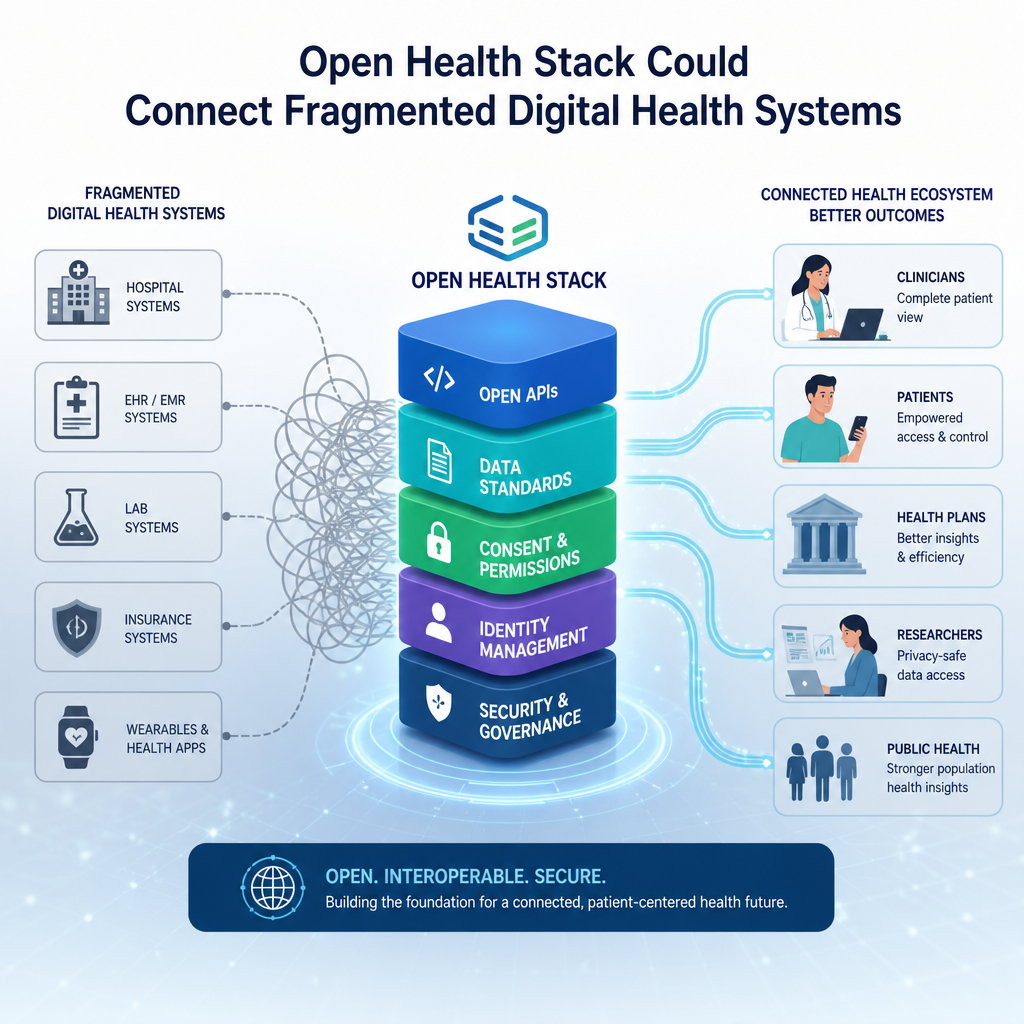
Healthcare runs on information, but too often that information is trapped in silos. A patient’s lab results live in one portal, their medication list in another, and their specialist notes in a third system that does not speak the same digital language. That fragmentation frustrates patients, slows clinicians, and makes it harder for health organizations to deliver coordinated care. An open health stack offers a practical way to reduce that friction by connecting fragmented digital health systems through shared standards, interoperable services, and reusable infrastructure.
Instead of building every digital health tool from scratch, an open health stack creates a foundation that different systems can plug into. It can help hospitals, clinics, public health agencies, startups, and payers exchange data more reliably while preserving choice and flexibility. In a healthcare environment where interoperability is no longer optional, this approach is gaining attention for good reason.
What Is an Open Health Stack?
An open health stack is a modular set of technologies, standards, and services that makes it easier for digital health systems to work together. Think of it as a common framework for building and connecting healthcare applications.
At a practical level, it may include:
Shared data standards such as HL7 FHIR
APIs that allow systems to exchange information
Identity and consent tools
Security and access controls
Clinical, administrative, or public health services built on top of common infrastructure
The term “open” matters. It suggests that the architecture is based on transparent standards, reusable components, and broad participation rather than a closed proprietary system. That openness can lower barriers for innovation while improving interoperability across the healthcare ecosystem.
Why fragmentation happens in digital health
Healthcare organizations often adopt technology in layers over many years. A hospital may use one EHR, a lab vendor, a telehealth platform, a population health tool, and several specialty apps. Each system may solve a specific problem, but integration is not always seamless.
Common causes of fragmentation include:
Legacy systems that were never designed to share data
Vendor-specific data formats
Duplicate patient records
Inconsistent implementation of standards
Limited governance around identity, consent, and access
The result is a digital environment where data exists, but it is difficult to use at the point of care.
Why an Open Health Stack Matters for Healthcare Interoperability
An open health stack could connect fragmented digital health systems by creating a shared layer for exchange and reuse. That does not mean every system becomes identical. It means they can communicate more effectively.
Better continuity of care
When providers can access a more complete patient record, they can make better-informed decisions. A shared stack can support:
Medication reconciliation
Referral coordination
Lab and imaging result sharing
Care transitions between settings
Chronic disease management across multiple clinicians
For patients, this means fewer repeated questions, fewer duplicate tests, and less confusion about where their information lives.
Faster innovation
Digital health startups often spend significant time solving the same integration problems over and over. An open health stack can reduce that burden by offering common infrastructure for identity, authorization, and data exchange.
That creates room for innovation in areas such as:
Remote patient monitoring
Digital therapeutics
Care navigation
Public health reporting
AI-assisted clinical workflows
When innovators can build on shared services, they can focus more on solving clinical and operational problems.
Lower implementation complexity
Healthcare IT teams know that integration projects can be expensive and time-consuming. An open stack can simplify deployment by reducing the number of custom interfaces and point-to-point connections.
This can help organizations:
Reduce maintenance overhead
Standardize workflows
Improve security oversight
Support scalable system growth
Make future upgrades less disruptive
In short, the architecture can make digital health systems easier to manage over time.
Core Components of an Open Health Stack
To understand how an open health stack works, it helps to break it into core building blocks. Not every implementation will look the same, but the principles are consistent.
1. Data standards
Standards define how health data is structured and interpreted. HL7 FHIR is one of the most widely discussed standards because it supports modern API-based exchange.
Data standards help systems communicate about:
Patient demographics
Diagnoses
Medications
Allergies
Procedures
Immunizations
Clinical observations
Without common standards, each integration becomes a custom translation project.
2. APIs and interoperability layers
APIs are the pathways that allow software systems to request and share information. In an open health stack, APIs serve as the connective tissue between applications.
An effective interoperability layer can support:
Read and write access to data
Secure authentication
Consent-aware information exchange
Event notifications
Data normalization
This layer is essential for connecting fragmented digital health systems without forcing every tool to use the same internal architecture.
3. Identity and patient matching
A major challenge in healthcare data exchange is knowing whether two records belong to the same person. Identity management and patient matching are critical parts of any open health stack.
Useful capabilities include:
Unique patient identifiers where appropriate
Master patient index support
Probabilistic matching
Identity verification workflows
Provider and organization authentication
Reliable identity services reduce errors and improve trust in exchanged data.
4. Security and consent management
Healthcare data is sensitive, so any open architecture must prioritize privacy and compliance. A strong stack includes security controls such as:
Role-based access
Strong authentication
Audit logging
Encryption in transit and at rest
Consent tracking
Data segmentation for sensitive information
Good security design does not slow interoperability; it makes interoperability sustainable.
5. Modular applications and services
The value of an open health stack becomes clearer when organizations can swap or add applications without rebuilding the entire environment. That modularity helps support:
Scheduling platforms
Patient engagement tools
Claims and billing services
Care management dashboards
Population health analytics
A flexible stack lets each organization choose the tools that fit its needs while still participating in a broader connected ecosystem.
Real-World Use Cases for an Open Health Stack
The promise of an open health stack is not abstract. It can solve practical problems across healthcare settings.
Hospital and clinic integration
A health system may want to connect emergency department records, outpatient visits, and specialty care notes. Using an open health stack, it can improve continuity between departments and reduce duplicate documentation.
For example, if a primary care physician orders labs and a specialist needs the results, an interoperable stack can make those results available without manual faxing or portal hopping.
Public health reporting
During outbreaks or routine surveillance, public health agencies need timely access to data from many sources. A connected digital health infrastructure can support better reporting of:
Notifiable diseases
Immunization records
Syndromic surveillance data
Lab results
Vital statistics
This does not eliminate policy or governance challenges, but it can improve the technical ability to share information when needed.
Consumer health applications
Patients increasingly use apps to track fitness, medications, appointments, and personal health records. An open health stack can help these apps connect with clinical systems so that patients have a more complete picture of their health.
That may include:
Viewing records from multiple providers
Managing medications in one place
Sharing data with care teams
Receiving reminders and educational content
When patients can access and understand their own information, engagement often improves.
Health equity and access initiatives
Fragmentation can be especially harmful in underserved communities where patients move between providers, safety-net clinics, and public programs. An open health stack can support more consistent data sharing across organizations that serve vulnerable populations.
This can help reduce gaps in:
Care coordination
Referral follow-up
Eligibility verification
Language-access workflows
Community resource connections
A connected infrastructure can support more equitable care delivery when implemented thoughtfully.
Challenges That Must Be Solved
An open health stack is promising, but it is not a magic fix. Several practical challenges remain.
Governance and trust
Who controls the standards? Who decides what data can move, and under what conditions? Governance matters because a technical stack alone cannot solve policy disagreements.
Organizations need clear rules around:
Data ownership
Consent requirements
Access permissions
Compliance responsibilities
Vendor accountability
Without governance, even a well-designed stack can stall.
Legacy system integration
Many healthcare organizations still depend on older systems that were never built for modern interoperability. Connecting them may require middleware, adapters, or phased migration strategies.
This is often where projects get difficult. Success usually depends on:
Prioritizing high-value use cases
Mapping existing data carefully
Testing workflows with real users
Planning for incremental rollout
Data quality
Connected systems are only useful if the data itself is accurate and consistent. A shared stack can move bad data faster, which is not helpful.
Organizations should invest in:
Data normalization
Validation rules
Duplicate record reduction
Clinical terminology mapping
Regular data quality audits
Cost and implementation readiness
Although an open health stack can reduce long-term complexity, initial adoption still requires resources, training, and change management. Teams need to understand both the technical and operational impact.
Success depends on aligning technology with workflow, staffing, and patient needs.
What Health Leaders Should Consider
If you are evaluating whether an open health stack makes sense for your organization, start with a practical lens.
Ask these questions first
Which interoperability problems are hurting care delivery today?
What systems need to connect first?
Which standards are already in use?
What security and consent requirements apply?
Who will own governance and support?
How will success be measured?
Start with high-value workflows
It is usually smarter to begin with one or two concrete use cases rather than trying to connect everything at once. Good starting points often include:
Medication history exchange
Discharge summary sharing
Referral management
Lab result delivery
Patient identity matching
These use cases show clear value and create momentum for broader adoption.
Build for flexibility
A well-designed open health stack should avoid locking the organization into a single vendor or narrow workflow. That flexibility can help health systems adapt as standards evolve and patient expectations change.
Look for architecture that supports:
API-first design
Standards-based integration
Modular service replacement
Transparent governance
Scalable security controls
The Bigger Picture: From Siloed Systems to Connected Care
The healthcare industry has spent years talking about interoperability, but the real challenge is operationalizing it at scale. An open health stack could connect fragmented digital health systems by providing a reusable backbone for data sharing, application development, and coordinated workflows.
That kind of infrastructure does not solve every problem. It does, however, create a stronger foundation for better care coordination, more responsive public health, and more useful digital tools for clinicians and patients. In a world where healthcare data is growing faster than many organizations can manage it, openness and standardization are not just technical preferences. They are strategic necessities.
Frequently Asked Questions
What is the main purpose of an open health stack?
The main purpose of an open health stack is to provide a shared, standards-based infrastructure that helps different digital health systems communicate and exchange data more easily. It reduces the need for custom integrations and supports interoperability across healthcare organizations.
How does an open health stack improve patient care?
It improves patient care by making relevant information more accessible across settings. Clinicians can see more complete records, avoid duplicate work, coordinate follow-up more effectively, and make better-informed decisions. Patients may also have easier access to their own health information.
Is an open health stack the same as an electronic health record?
No. An electronic health record is one application that stores and manages clinical data. An open health stack is broader. It is the underlying framework of standards, APIs, identity services, and security components that can connect EHRs and other health applications.
What standards are commonly used in open health stack designs?
HL7 FHIR is one of the most common standards discussed in modern interoperability efforts. Other standards and supporting frameworks may also be used depending on the use case, such as terminology standards, identity protocols, and secure messaging approaches.
What are the biggest barriers to adoption?
The biggest barriers usually include legacy system complexity, governance concerns, data quality issues, security and privacy requirements, and the cost of implementation. Success often depends on starting with a clear use case and building incrementally.
Healthcare no longer has the luxury of isolated systems that cannot easily share information. An open health stack offers a practical path toward a more connected digital health environment by bringing together standards, APIs, identity services, and security controls in one coherent framework. That matters for clinicians who need timely information, for patients who want simpler access to their records, and for organizations trying to improve efficiency without sacrificing flexibility.
The real value of this approach is not just technical elegance. It is operational impact. When systems connect more cleanly, care teams can work more efficiently, patients can move through the health system with less friction, and innovation becomes easier to scale. The path forward will require governance, investment, and careful implementation, but the payoff can be significant.
For health leaders, the next step is to identify the most pressing interoperability gaps and evaluate where an open health stack can deliver immediate value. Starting small, building on trusted standards, and keeping the patient experience at the center can help turn fragmented digital health systems into a more connected and usable whole.
Peter B holds a degree in Journalism and has 5 years of experience covering U.S. economic policy, labor markets, and financial news. He writes data-driven news content on topics like inflation, interest rates, and employment trends.