TEACH Grants Explained: Service Obligations and Conversion Rules
The TEACH Grant can be a valuable way to help pay for teacher training, especially if you plan to work in a high-need subject area at a low-income school. But because it comes with a service obligation, it’s important to understand the rules upfront so you don’t accidentally turn grant money into a loan.
By: Jennifer Collins - Education on July 28, 2026
If you’re studying to become a teacher and looking for help paying for school, the TEACH Grant can sound like a great deal—and in many cases, it is. The award can provide funding for students who plan to teach in high-need subject areas at schools that serve low-income families. But the program comes with an important catch: if you don’t meet the service requirements, the grant can convert into a federal Direct Unsubsidized Loan.
That’s why understanding TEACH Grants explained in plain language matters. Before you accept the money, you need to know what you’re agreeing to, how the service obligation works, and what happens if your teaching plans change. In this guide, we’ll break down the essentials so you can make a confident, informed decision.
What Is a TEACH Grant?
The Teacher Education Assistance for College and Higher Education (TEACH) Grant is a federal student aid program designed to encourage students to enter the teaching profession in high-need fields.
Unlike a traditional scholarship, a TEACH Grant comes with a service obligation. If you fulfill the terms, the money stays a grant. If you don’t, it becomes a loan that must be repaid with interest.
Who TEACH Grants are designed for
TEACH Grants typically support students who plan to teach:
In a high-need subject area
At a low-income school
For a required period of time after graduation
These grants are often available to students in eligible undergraduate, postbaccalaureate, and graduate programs.
High-need fields commonly include
The specific list can change, but it often includes areas such as:
Mathematics
Science
Special education
Foreign languages
Reading specialist roles
English language acquisition
Other subjects identified as high need by the federal government
Always confirm your program’s current eligibility before relying on a TEACH Grant.
How the TEACH Grant Works
A TEACH Grant gives eligible students financial aid while they are enrolled in school. In exchange, the student agrees to complete a teaching commitment after finishing the program.
If you complete the service requirement correctly, the grant remains a grant. If not, the grant converts into a Direct Unsubsidized Loan, and you must repay it with interest from the date each grant disbursement was made.
Basic process
You apply for the grant through your school.
Your school verifies that you meet the eligibility requirements.
If awarded, the funds are applied to your education costs.
You sign a TEACH Grant Agreement to Serve or Repay.
After graduation, you complete the required teaching service—or the grant converts to a loan.
TEACH Grant Service Obligations Explained
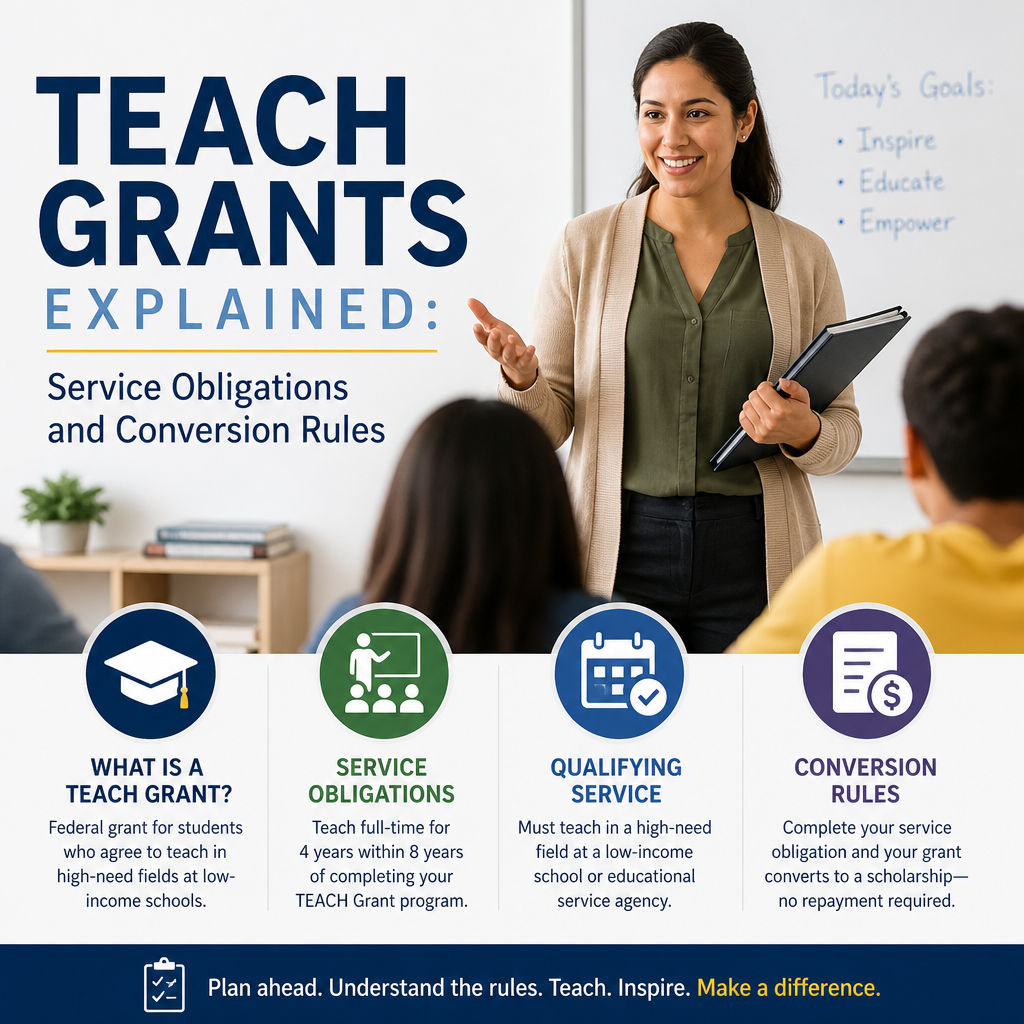
The service obligation is the heart of the program. To keep the grant, you must meet all federal requirements after you finish your program.
What the teaching requirement includes
To satisfy the TEACH Grant service obligation, you generally must:
Teach in a high-need subject area
Teach at an elementary school, secondary school, or educational service agency
Work at a school that serves low-income students
Complete the service for at least four academic years within eight years after finishing the program for which the grant was received
What counts as qualifying employment
A qualifying school is usually one that appears in the Department of Education’s Teacher Cancellation Low Income Directory or another approved source. The school must meet the low-income criteria for the year you teach there.
Your position must also be full-time teaching in the approved subject area. In many cases, partially related work or administrative duties won’t count toward the obligation.
The four-year rule
The TEACH Grant requires you to complete four full academic years of qualifying teaching. These years do not have to be consecutive, but they must be finished within the allowed time frame.
That flexibility can help if you:
Need a break between years of teaching
Relocate to another qualifying school
Take time off for family or career reasons
Still, you must stay within the eight-year window unless an approved exception applies.
TEACH Grant Agreement to Serve or Repay
Before you receive TEACH Grant funds, you must sign the Agreement to Serve or Repay. This document is more than a formality. It is a legally binding promise that explains your responsibilities.
Why this agreement matters
By signing, you agree that you will either:
Complete the required teaching service, or
Repay the grant as a loan if you do not meet the terms
You also agree to keep in touch with the federal government and provide updated information as needed.
Important things to remember
Read the agreement carefully and keep a copy for your records. If your school asks you to sign again for another year of funding, review the terms each time. Small administrative details can matter later if there is a question about your service record or loan conversion.
TEACH Grant Conversion Rules
One of the most important parts of TEACH Grants explained is understanding conversion rules. A grant can become a loan for several reasons, and that shift can happen even if you intended to teach.
When a TEACH Grant converts to a loan
A TEACH Grant can convert to a Direct Unsubsidized Loan if you:
Fail to complete the required teaching service
Do not teach in a qualifying high-need field
Work at a school that does not meet the low-income requirement
Do not finish the service within the required time frame
Fail to respond to required certification requests from the loan servicer or Department of Education
What happens after conversion
Once the grant converts, you owe the amount of each grant disbursement as a federal loan. Interest is charged from the date each payment was originally made, not from the conversion date.
That means conversion can become expensive if you wait too long to resolve the issue.
Can conversion be reversed?
In some cases, yes. If your grant converts because of a paperwork or certification issue and you later provide documentation showing you actually met the service obligation, you may be able to have the loan status corrected. However, this depends on the facts of the case and the timing of your documentation.
If you believe a conversion happened incorrectly, contact your loan servicer and the Department of Education right away.
How to Stay Eligible for Grant Forgiveness
The best way to protect your TEACH Grant is to plan ahead and keep good records.
Practical steps to follow
Confirm that your degree program is TEACH Grant eligible
Make sure your intended teaching field qualifies as high need
Verify that your future school qualifies as a low-income school
Save copies of your signed agreements and correspondence
Track your teaching years carefully
Submit any required certifications on time
Keep your records organized
A simple folder—digital or physical—can save you serious trouble later. Save:
Offer letters
Employment verification
School identification details
Teaching certificates
Annual service documentation
Copies of all TEACH Grant forms
This paperwork may be essential if you ever need to prove that you met the service requirement.
Common Mistakes That Lead to Conversion
Many TEACH Grant recipients run into problems because they misunderstand the requirements or miss a deadline.
Mistake 1: Assuming any teaching job qualifies
Not every teaching position counts. The job must be in a qualifying subject area and at a qualifying low-income school.
Mistake 2: Missing certification deadlines
The government may ask you to certify your teaching service periodically. Ignoring these requests can trigger conversion even if you are teaching in an eligible setting.
Mistake 3: Not checking school eligibility each year
A school may qualify one year and not the next. Always verify the current status before assuming your work counts.
Mistake 4: Failing to finish the full service requirement
You need four academic years. Partial completion usually won’t protect the grant from conversion.
Mistake 5: Not planning for career changes
If you think you may switch careers, move out of teaching, or take time away from the classroom, build that possibility into your decision-making before accepting the grant.
TEACH Grants vs. Other Federal Aid Options
The TEACH Grant can be valuable, but it is not the best fit for everyone. It helps to compare it with other aid options.
TEACH Grant vs. Pell Grant
A Pell Grant is need-based federal aid that does not require a teaching service obligation. It is generally less complicated than a TEACH Grant.
TEACH Grant vs. student loans
A student loan must always be repaid, with interest. A TEACH Grant gives you a chance to avoid repayment if you complete the required service. But if you don’t, it becomes a loan anyway.
TEACH Grant vs. scholarships
Some private or school-based scholarships have no service obligation at all. Others may require work, teaching, or GPA maintenance. Always compare the fine print before choosing.
Is a TEACH Grant Right for You?
A TEACH Grant can be a strong option if you are committed to teaching in a high-need area and you understand the rules from the start.
It may be a good fit if you:
Know you want to teach long term
Plan to work in a qualifying school
Are pursuing an eligible subject area
Want grant aid that may not need to be repaid if you meet the terms
It may not be the best choice if you:
Are unsure about a teaching career
May switch to a different profession
Are unlikely to teach in a qualifying school
Prefer aid with no future service obligation
The key is honesty about your career plans. A TEACH Grant can help reduce college costs, but it is only worth it if you can realistically meet the requirements.
Frequently Asked Questions
1. What is the main downside of a TEACH Grant?
The biggest downside is the service obligation. If you do not complete the required teaching service, the grant converts into a loan with interest. That can create a significant financial obligation if you were not expecting it.
2. How many years do I need to teach to keep a TEACH Grant?
You generally need to teach full time for four academic years within eight years of finishing the program for which you received the grant. The teaching must be in a high-need subject area at a qualifying low-income school.
3. What happens if I teach, but not in a high-need field?
Teaching in the wrong subject area usually does not satisfy the TEACH Grant requirement. Even if you are working as a teacher, the grant can still convert to a loan if the subject area is not approved.
4. Can a TEACH Grant convert to a loan if I miss paperwork deadlines?
Yes. Failing to complete required certification or documentation can trigger conversion, even if you are otherwise doing the right kind of teaching. That’s why recordkeeping and timely responses are so important.
5. Can I repay the grant early if it converts to a loan?
Yes, once converted, it becomes a federal Direct Unsubsidized Loan, and you can repay it under the federal loan rules. Paying early may reduce interest costs, but the loan is still based on the original grant amounts and interest accrues from the disbursement date.
The TEACH Grant can be a valuable source of federal aid for future teachers, but it works very differently from a traditional grant. The most important thing to remember is that the money comes with a binding service obligation. If you complete four academic years of qualifying teaching in a high-need subject area at a low-income school, the grant can remain a grant. If you do not, it can convert into a Direct Unsubsidized Loan with interest.
That is why careful planning matters. Before accepting the award, confirm that your program, subject area, and future school all meet the requirements. Keep detailed records, respond to certification requests, and stay aware of deadlines. Small mistakes can turn an affordable funding option into a costly repayment issue.
For students who are fully committed to teaching where they are needed most, the TEACH Grant can be a smart investment in both education and career goals. Understanding the rules now can help you protect that opportunity later.
Jennifer, M.Ed., holds a degree in Higher Education Administration, with
a focus on U.S. college financial aid, admissions policy, and student
support systems. She researches and writes about scholarships, federal
aid programs, and the college planning process to help students and
families make informed, well-supported decisions.