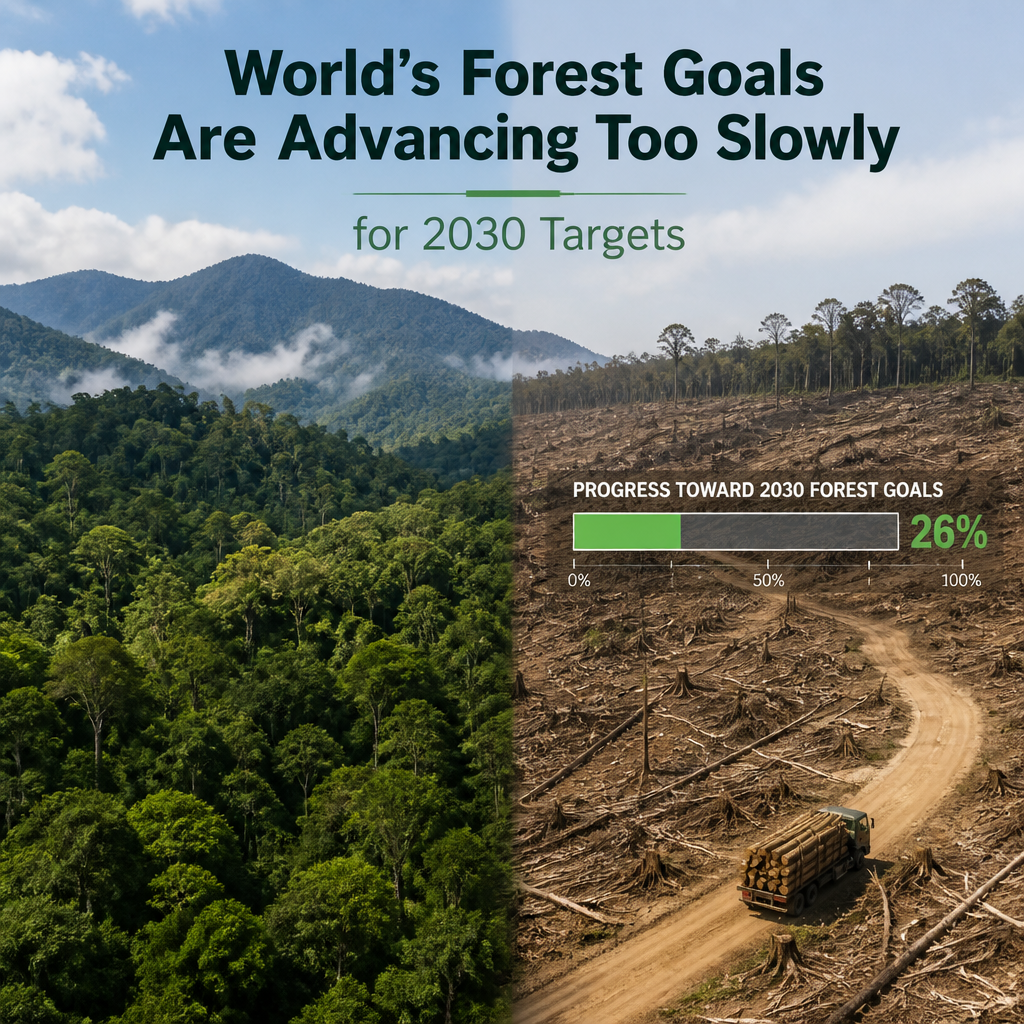
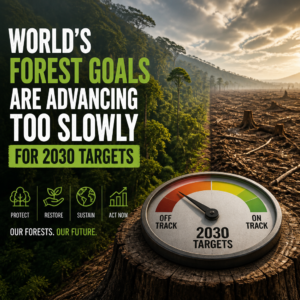
World’s Forest Goals Are Advancing Too Slowly for 2030 Targets
World’s forest goals are advancing too slowly to meet 2030 targets, putting climate, biodiversity, and livelihoods at risk. Protecting and restoring forests now means moving faster on action, funding, and coordination before the window closes.
By: pedropadm2025@gmail.com on July 28, 2026
Forests are one of the planet’s most important natural systems, but world’s forest goals are advancing too slowly to meet 2030 targets. That reality matters far beyond conservation circles. Forests store carbon, protect biodiversity, support rainfall patterns, and provide livelihoods for millions of people. When forest recovery, protection, and sustainable management fall behind, the consequences reach climate policy, food security, and local economies.
The world has set ambitious forest goals for 2030, including halting deforestation, restoring degraded landscapes, and strengthening sustainable forest management. Yet the pace of progress remains uneven. In some places, forest protection is improving. In others, logging, agricultural expansion, wildfires, and weak governance continue to erase gains faster than they can be restored.
This slowdown is not just a policy problem. It is a timing problem. Forests take decades to recover, but climate and biodiversity deadlines are much closer. If countries want to meet 2030 commitments, they need to move faster, fund smarter, and coordinate better.
Why the 2030 Forest Targets Matter
The global forest agenda is tied to several major international commitments, including climate action, biodiversity protection, and land restoration. These goals are connected because forests influence nearly every environmental system on Earth.
Forests support climate stability
Forests absorb and store large amounts of carbon. Protecting them helps avoid additional emissions, while restoring degraded forests can remove carbon from the atmosphere over time. That makes forest conservation a critical part of climate strategy.
Forests protect ecosystems and species
Many plants and animals depend on forests for food, shelter, and breeding grounds. When forests are fragmented or cleared, species lose habitat and ecosystems become less resilient.
Forests support people and economies
Communities depend on forests for:
Timber and non-timber products
Fuelwood and building materials
Clean water and soil protection
Medicinal plants and food resources
Cultural and spiritual value
For Indigenous peoples and forest-dependent communities, healthy forests are not abstract environmental assets. They are part of daily life.
Why World’s Forest Goals Are Advancing Too Slowly to Meet 2030 Targets
The phrase world’s forest goals are advancing too slowly to meet 2030 targets captures a frustrating reality: there is no single reason for the delay. Instead, a mix of economic pressure, weak enforcement, and underfunding is slowing progress.
1. Deforestation still outpaces restoration
One of the biggest barriers is that forests are being cleared or degraded faster than they are being restored. Even where reforestation or restoration programs exist, newly planted trees cannot immediately replace mature forest ecosystems. Recovery takes time, and many restoration projects are too small to offset ongoing losses.
2. Agricultural expansion remains a major driver
In many regions, land is converted for cattle ranching, soy, palm oil, cocoa, rubber, or other commodities. Food production is essential, but the way land is expanded often creates pressure on forests. Without stronger land-use planning and supply chain accountability, deforestation continues.
3. Governance and enforcement are uneven
Forest laws are only effective if they are enforced. In some countries, illegal logging, land grabbing, and unregulated mining continue because agencies lack resources, political support, or transparency tools.
Common enforcement problems include:
Weak monitoring systems
Limited budgets for forest agencies
Corruption or unclear land tenure
Slow prosecution of environmental crimes
Overlapping legal jurisdictions
4. Restoration is underfunded
Forest restoration sounds straightforward, but it requires years of planning, planting, maintenance, and community engagement. Many projects begin with enthusiasm and then stall because of weak funding or poor long-term management.
5. Climate change is making forests more vulnerable
Longer droughts, stronger storms, heat stress, and wildfires are making it harder for forests to recover. In some regions, a forest that once regenerated naturally now needs active intervention to survive.
What Slowing Progress Means for Climate and Biodiversity
When forest goals lag, the impacts spread quickly.
Climate targets become harder to reach
If forests are lost, stored carbon is released. That increases the burden on other climate solutions, such as clean energy, efficiency, and industrial decarbonization. In other words, delayed forest action makes the overall climate challenge more expensive and more difficult.
Biodiversity declines accelerate
Forests contain some of the world’s highest concentrations of species. When habitat disappears, extinction risks rise. Even selective logging or fragmentation can reduce habitat quality and disrupt migration, pollination, and seed dispersal.
Water systems become less stable
Forests help regulate watersheds by slowing runoff, filtering water, and maintaining soil structure. When tree cover is removed, communities can face more erosion, flooding, and seasonal water stress.
Local communities face greater risk
Forest loss can affect food availability, income, and cultural continuity. It can also increase conflict over land use, especially when communities are excluded from decisions about the forests they rely on.
What Is Working in Forest Protection and Restoration
Even though overall progress is too slow, there are signs of progress worth learning from. Effective forest action usually combines policy, local participation, and long-term investment.
Community-led forest management
Many of the most successful forest conservation efforts involve local and Indigenous leadership. These communities often have deep ecological knowledge and a direct stake in long-term stewardship.
What works well:
Secure land rights
Shared decision-making
Local monitoring and enforcement
Benefit-sharing from sustainable forest products
Stronger supply chain accountability
Companies are increasingly expected to trace products back to their source and reduce deforestation in supply chains. When buyers demand sustainability, producers have more incentive to protect forests.
Examples include:
Zero-deforestation sourcing commitments
Certification systems
Traceability technologies
Due diligence on land-use risks
Landscape-scale restoration
Restoration works best when it is planned at the landscape level rather than as isolated tree-planting projects. That means matching species to local conditions, protecting natural regeneration, and ensuring restored areas connect to existing forests.
Better forest monitoring
Satellite imagery, remote sensing, and digital reporting tools now make it easier to detect forest loss and measure progress. Transparent monitoring can help governments, businesses, and civil society identify where action is working and where it is failing.
Practical Ways Countries Can Speed Up Progress
To close the gap before 2030, countries need a more realistic and coordinated strategy. Good intentions alone will not be enough.
Strengthen land tenure and Indigenous rights
Secure land rights are one of the strongest foundations for forest protection. When communities have legal authority over land, they are more likely to manage forests sustainably and resist outside pressure.
Reduce pressure from commodity production
Governments and businesses can reduce forest loss by:
Improving agricultural productivity on existing farmland
Preventing expansion into high-value forest areas
Requiring deforestation-free sourcing
Supporting smallholders in adopting sustainable practices
Invest in natural regeneration
Not every degraded area needs intensive tree planting. In some places, forests can recover naturally if grazing, fires, and logging pressure are reduced. Natural regeneration can be more cost-effective and ecologically sound than large-scale planting campaigns.
Fund long-term restoration, not one-time projects
A common mistake is treating restoration like a short campaign. Forest recovery needs maintenance, monitoring, and local participation over many years. Funding models should reflect that reality.
Use policy across sectors
Forest goals will fail if they are treated as an isolated environmental issue. Forestry, agriculture, finance, infrastructure, and trade policies all influence land use. Governments should align these sectors so they work toward the same outcome.
How Businesses and Consumers Can Help
Forest protection is not only a government responsibility. Private companies and consumers also shape demand for forest-risk commodities and products.
What businesses can do
Companies can reduce their impact by:
Mapping supply chains
Setting measurable deforestation targets
Supporting regenerative sourcing
Investing in restoration and community partnerships
Reporting progress transparently
Businesses that rely on forests or forest-linked commodities should treat sustainability as a risk-management issue, not just a branding choice.
What consumers can do
Consumers may not control global forest policy, but purchasing decisions still matter. People can support better outcomes by choosing products with credible sustainability standards, reducing waste, and backing organizations that protect forest ecosystems.
Measuring Progress the Right Way
One reason forest progress can look better than it really is is that counting trees is not the same as restoring forests. A healthy forest includes more than tree cover.
Important indicators include
Net forest loss or gain
Forest quality and fragmentation
Biodiversity indicators
Community land rights
Fire risk and resilience
Survival rates in restoration projects
Relying only on tree-planting numbers can create a false sense of progress. Real success means protecting functioning ecosystems, not just adding seedlings.
The Path to 2030 Requires Urgency and Accountability
The 2030 forest targets are still achievable in parts, but only if action accelerates quickly. That means moving from broad promises to measurable implementation.
Priorities for the next few years
Stop conversion of intact forests
Restore degraded areas with ecological care
Support community and Indigenous stewardship
Improve monitoring and enforcement
Align climate, biodiversity, and land-use policies
Fund long-term forest resilience
The challenge is not a lack of knowledge. The world already knows what tends to work. The missing ingredient is consistent execution at scale.
Frequently Asked Questions
1. What does it mean that world’s forest goals are advancing too slowly to meet 2030 targets?
It means global efforts to reduce deforestation, restore degraded land, and improve sustainable forest management are not moving fast enough to meet international deadlines. Progress exists, but the pace is too uneven to match the scale of forest loss and environmental pressure.
2. Why are forests so important for climate action?
Forests absorb and store carbon, helping reduce the amount of greenhouse gases in the atmosphere. They also support rainfall patterns, protect soils, and reduce the risk of climate-related ecosystem collapse. Losing forests makes climate goals harder and more expensive to achieve.
3. Is planting more trees enough to meet forest restoration goals?
No. Tree planting is only one part of restoration. Healthy forest recovery also depends on species choice, soil conditions, water availability, protection from fire and grazing, and long-term care. In some areas, natural regeneration can work better than planting.
4. What are the biggest causes of deforestation?
Major drivers include agricultural expansion, logging, mining, infrastructure development, and land grabbing. In many regions, weak enforcement and unclear land tenure also allow deforestation to continue unchecked.
5. How can communities help protect forests?
Communities can help through local stewardship, monitoring, sustainable harvesting, advocacy for land rights, and participation in restoration efforts. When communities have secure rights and real decision-making power, forest outcomes are often stronger and more durable.
The fact that world’s forest goals are advancing too slowly to meet 2030 targets should be a wake-up call, not a reason for resignation. Forests remain one of the most powerful natural tools for climate stability, biodiversity protection, and community resilience. But they cannot recover on hope alone. They need stronger laws, better enforcement, secure land rights, smarter land-use planning, and long-term funding that matches the scale of the challenge.
The good news is that solutions already exist. Countries can protect intact forests, restore degraded landscapes, and empower communities to manage land sustainably. Businesses can clean up supply chains and reduce deforestation risk. Consumers and civil society can push for accountability and better standards. None of these actions is enough by itself, but together they can change the trajectory.
The next few years will matter enormously. If governments and institutions act with urgency now, 2030 can still be a turning point instead of a missed deadline. The choice is clear: continue losing forest cover at a dangerous pace, or commit to the practical work needed to protect and restore the world’s forests before it is too late.
Peter B holds a degree in Journalism and has 5 years of experience covering U.S. economic policy, labor markets, and financial news. He writes data-driven news content on topics like inflation, interest rates, and employment trends.