Global Energy Investment in 2026 Shifts Toward Clean Technologies
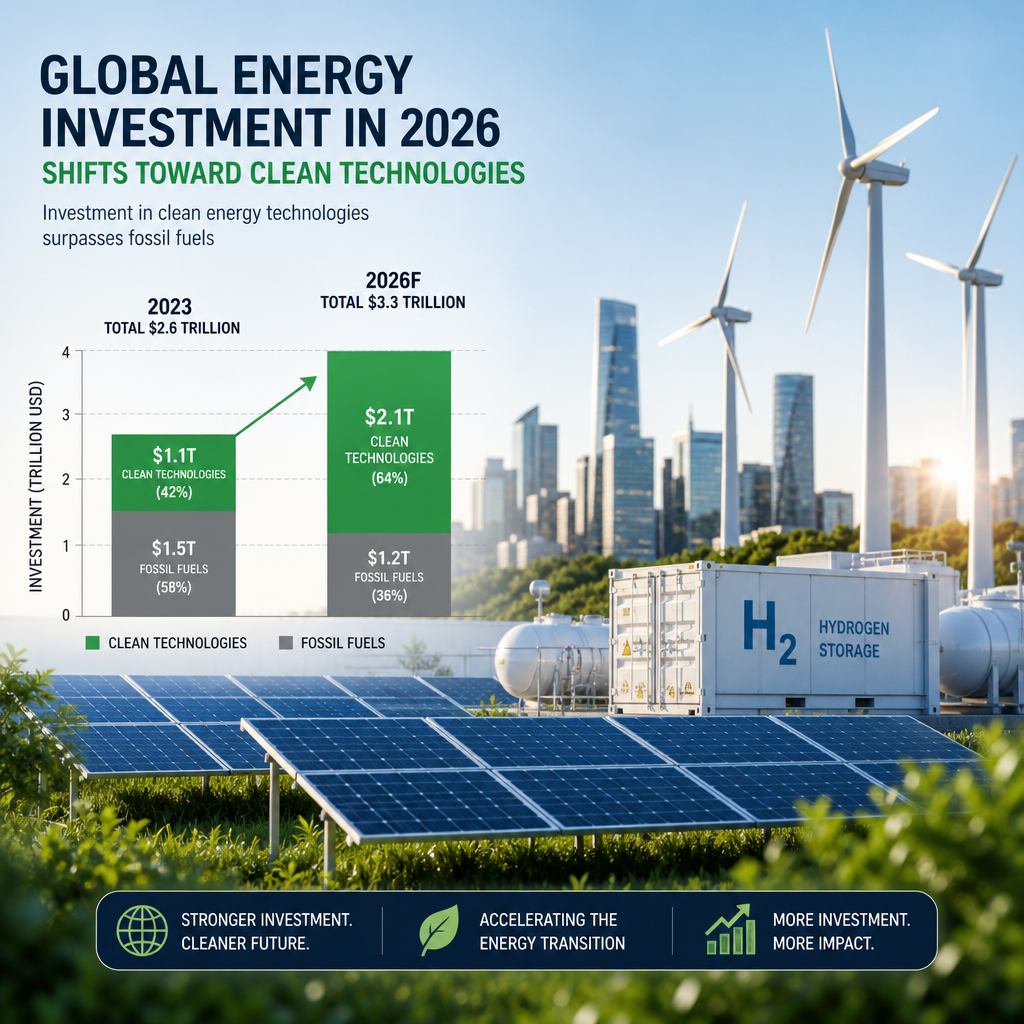
Global energy investment in 2026 is leaning more heavily toward clean technologies as solar, wind, storage, and electrification become safer, smarter bets for governments and investors. Driven by energy security, policy support, and rising power demand, this shift is reshaping how the world plans its next generation of infrastructure.
By: pedropadm2025@gmail.com on July 28, 2026
Global energy investment in 2026 is expected to move even more decisively toward clean technologies as governments, utilities, investors, and large corporations continue to prioritize lower-carbon infrastructure. This shift is not happening in a vacuum. It reflects a mix of energy security concerns, maturing technology, policy incentives, and rising demand for electricity from data centers, electrified transport, and industrial decarbonization.
For businesses, policymakers, and consumers, understanding how global energy investment in 2026 shifts further toward clean technologies can help clarify where capital is flowing and why. Solar, wind, battery storage, transmission upgrades, electric vehicles, heat pumps, and green hydrogen are no longer niche bets. They are increasingly central to long-term energy planning.
At the same time, the transition remains uneven. Fossil fuels still play a major role in the global energy system, and regional differences remain significant. But the direction of travel is clear: the next wave of energy investment is being shaped by clean power, flexible grids, and electrification.
Why Global Energy Investment in 2026 Is Moving Toward Clean Technologies
Several forces are pushing capital toward cleaner energy systems. Some are economic. Others are political or operational. Together, they are reshaping project pipelines across the energy sector.
1. Clean technologies are becoming more bankable
One of the biggest reasons global energy investment in 2026 shifts further toward clean technologies is that many options now offer more predictable economics than in the past.
Solar and onshore wind, for example, can often be built at scale with relatively low operating costs. Battery storage has also matured quickly, helping developers manage intermittency and support grid reliability. Investors like technologies that can be modeled, financed, and deployed with confidence.
2. Energy security remains a top priority
Recent geopolitical disruptions have reminded countries how vulnerable they can be to fuel price shocks and supply concentration. Clean energy can reduce exposure to imported fuels by relying more on domestic resources such as sunlight, wind, and local grid infrastructure.
That does not mean every country can replace fossil fuels overnight. It does mean energy independence and resilience now factor heavily into investment decisions.
3. Policy incentives continue to shape capital flows
Governments around the world are using tax credits, clean energy standards, permitting reform, and public financing tools to accelerate deployment. These policies reduce risk and make private capital more willing to fund large-scale projects.
In many markets, the combination of policy support and falling technology costs has made clean energy infrastructure highly attractive compared with older thermal generation.
4. Electricity demand is rising
The clean energy transition is happening alongside a broader increase in electricity demand. Growth in artificial intelligence, cloud computing, electric vehicles, industrial electrification, and climate-driven cooling needs is pushing utilities and regulators to expand generation and grid capacity.
This creates new opportunities for investment in:
Renewable generation
Battery storage systems
Transmission and distribution upgrades
Demand response technologies
Energy efficiency and load management tools
Key Sectors Benefiting From the Clean Energy Shift
The phrase global energy investment in 2026 shifts further toward clean technologies includes more than just solar panels and wind turbines. It covers an ecosystem of technologies that help power systems become cleaner, more flexible, and more resilient.
Solar power remains a core investment area
Solar continues to attract substantial investment because it can be deployed quickly and scaled across different market sizes. Utility-scale solar projects remain especially attractive where land, grid access, and permitting support are available.
Distributed solar, including rooftop installations for homes and businesses, also plays an important role. These systems can lower bills, improve resilience, and reduce demand on centralized infrastructure.
Wind energy keeps evolving
Onshore wind remains important in many regions, while offshore wind continues to attract long-term strategic interest despite higher development complexity. Offshore projects require major upfront investment, but they can deliver large amounts of power close to coastal population centers.
Investors are also watching turbine technology, supply chain localization, and grid interconnection issues more closely than before.
Battery storage is becoming essential
If renewable power is the backbone of the transition, battery storage is becoming the connective tissue. Storage helps smooth fluctuations in supply and demand, supports grid stability, and enables more renewable electricity to be used when it is needed most.
In 2026, battery storage investment is likely to remain strong because utilities and independent power producers increasingly view it as a practical complement to solar and wind.
Transmission and grid modernization are gaining attention
A clean energy future depends on more than generation. It also requires strong transmission networks, digital grid controls, and faster interconnection.
Without these upgrades, even well-financed clean energy projects can stall. That is why grid modernization has become a major theme in energy infrastructure planning. Investors are paying more attention to:
High-voltage transmission lines
Substation upgrades
Smart meters and grid software
Interconnection queues and permitting timelines
Cybersecurity for digital energy systems
Electrification technologies are expanding
Electrification is another major beneficiary of the investment shift. As more end uses move from direct fossil fuel combustion to electricity, the demand for clean power grows.
Important segments include:
Electric vehicles and charging networks
Heat pumps for residential and commercial buildings
Industrial electric boilers and process heat
Efficient appliances and building systems
These technologies help cut emissions while often improving efficiency and long-term operating costs.
What This Means for Investors and Energy Companies
As global energy investment in 2026 shifts further toward clean technologies, market participants are adjusting their strategies in meaningful ways.
Investors are rethinking risk and return
Capital allocators are looking beyond simple megawatt counts. They are evaluating projects based on:
Policy stability
Grid connection access
Supply chain reliability
Offtake agreements
Technology readiness
Construction timelines
Long-term maintenance costs
This more nuanced approach helps investors identify projects with stronger execution prospects, not just attractive headlines.
Energy companies are diversifying portfolios
Large utilities, oil and gas companies, and independent power producers are all adapting. Some are expanding into renewables, storage, and grid services. Others are focusing on lower-carbon fuels, carbon capture, or hybrid business models.
Companies that can combine traditional energy expertise with clean technology deployment may have an advantage. They often understand large-scale project management, infrastructure development, and regulatory compliance.
Corporate buyers are influencing demand
Corporate power purchase agreements and sustainability commitments continue to drive demand for clean electricity. Large companies want to reduce emissions, stabilize energy costs, and meet investor expectations.
This has a practical effect on the market. Developers can often secure financing more easily when they have strong long-term buyers for their output.
Regional Differences Still Matter
While the global trend is clear, regional energy investment patterns differ widely.
North America
North America is seeing strong interest in solar, storage, grid modernization, and EV infrastructure. Policy incentives and corporate clean energy demand are major drivers, though permitting and transmission constraints remain real challenges.
Europe
Europe continues to emphasize energy security, decarbonization, and electrification. Offshore wind, interconnection upgrades, heat pumps, and industrial efficiency are especially important in many markets.
Asia-Pacific
Asia-Pacific remains central to global energy investment, with both high clean energy deployment and ongoing fossil fuel consumption. China, India, Japan, South Korea, and Southeast Asian markets each have distinct energy needs, policy frameworks, and financing conditions.
Emerging markets
In many emerging economies, access to affordable capital is still a major barrier. Yet distributed solar, mini-grids, and efficient cooling solutions can provide meaningful benefits where centralized infrastructure is limited.
Blended finance, development banks, and public-private partnerships are especially important in these regions.
Challenges That Could Slow the Transition
The clean energy investment story is strong, but it is not frictionless. Several constraints could slow deployment or raise project costs.
Permitting and interconnection delays
Many projects face bottlenecks long before they break ground. Permitting timelines, local opposition, environmental reviews, and utility interconnection queues can delay deployment and raise uncertainty.
Supply chain pressure
Although supply chains have improved, they remain vulnerable to pricing swings, trade disputes, and concentration in key materials and components. Project developers need more resilient sourcing strategies.
Financing conditions
Interest rates, credit conditions, and inflation still matter. Even promising clean energy projects can become harder to finance if borrowing costs rise or revenue assumptions weaken.
Workforce and skills gaps
The clean energy buildout requires engineers, electricians, lineworkers, technicians, and project managers. Workforce shortages can slow installation and maintenance if training pipelines do not keep pace.
Practical Examples of the Shift
To better understand how this transition works in practice, consider a few common investment patterns.
Example 1: A utility adds solar and storage instead of new gas peakers
Rather than building a new fossil fuel peaking plant, a utility may choose solar paired with batteries. This can offer capacity, flexibility, and lower emissions while meeting rising demand during high-cost hours.
Example 2: A manufacturer signs a long-term renewable power contract
A factory with high electricity use may enter into a power purchase agreement to lock in cleaner electricity for years ahead. This helps with cost planning and supports corporate climate targets.
Example 3: A city upgrades building systems and EV charging
A municipal government may invest in heat pumps, efficient street lighting, and charging infrastructure. These projects reduce emissions and often improve long-term operating efficiency.
How Businesses Can Prepare for 2026 and Beyond
Companies do not need to be energy developers to benefit from the changing landscape. They can respond in practical ways.
Review energy procurement strategy
Businesses should examine how much of their electricity exposure is fixed, variable, or hedged. They may find opportunities to add renewable contracts, efficiency upgrades, or onsite generation.
Evaluate electrification opportunities
Facilities that rely on older fossil fuel systems may benefit from switching to electric alternatives, especially where grid power is increasingly clean and cost-competitive.
Strengthen resilience planning
As climate risks and grid stress increase, resilience matters more. Backup systems, storage, demand management, and diversified energy sourcing can reduce downtime.
Track policy and market developments
Energy policy can change quickly. Companies should monitor tax incentives, local regulations, and utility rules that may affect project timing and return on investment.
Frequently Asked Questions
What does “global energy investment in 2026 shifts further toward clean technologies” mean?
It means that more money is expected to flow into solar, wind, storage, grid upgrades, electrification, and related low-carbon infrastructure than into many traditional fossil fuel projects. The shift reflects both market forces and policy support.
Which clean technologies are likely to attract the most investment in 2026?
Solar power, battery storage, transmission and distribution upgrades, electric vehicle charging, and grid software are likely to remain major investment areas. Wind energy, especially in strong resource regions, will also continue to attract capital.
Why are investors interested in clean energy now?
Investors are drawn to improving technology, lower operating costs, policy incentives, and rising electricity demand. Many clean energy assets are now more mature and easier to finance than they were a decade ago.
Does the clean energy shift mean fossil fuels are disappearing soon?
No. Fossil fuels will still play an important role in the global energy system for years. The shift means clean technologies are gaining a larger share of new investment and capacity additions, not that the transition is complete.
How can businesses benefit from this investment trend?
Businesses can benefit by locking in cleaner electricity contracts, improving efficiency, electrifying equipment, and modernizing energy systems. These steps can reduce risk, support sustainability goals, and improve long-term cost control.
The direction of energy capital in 2026 is increasingly clear: the world is investing more heavily in clean technologies that can deliver reliable power, lower emissions, and greater long-term resilience. Solar, wind, storage, electrification, and grid modernization are no longer side bets. They are becoming core pillars of energy strategy for utilities, governments, and corporations alike.
Still, the transition will not be automatic. Permitting delays, grid constraints, financing conditions, and supply chain issues can slow progress. That is why the most successful investors and organizations will be the ones that look beyond headlines and focus on execution, infrastructure readiness, and long-term value.
For businesses and decision-makers, this is a pivotal moment. The clean energy shift is not only about climate goals. It is also about competitiveness, resilience, and smarter capital allocation. Those who understand where the market is heading can position themselves early, reduce risk, and take advantage of a rapidly changing energy landscape.
Peter B holds a degree in Journalism and has 5 years of experience covering U.S. economic policy, labor markets, and financial news. He writes data-driven news content on topics like inflation, interest rates, and employment trends.